
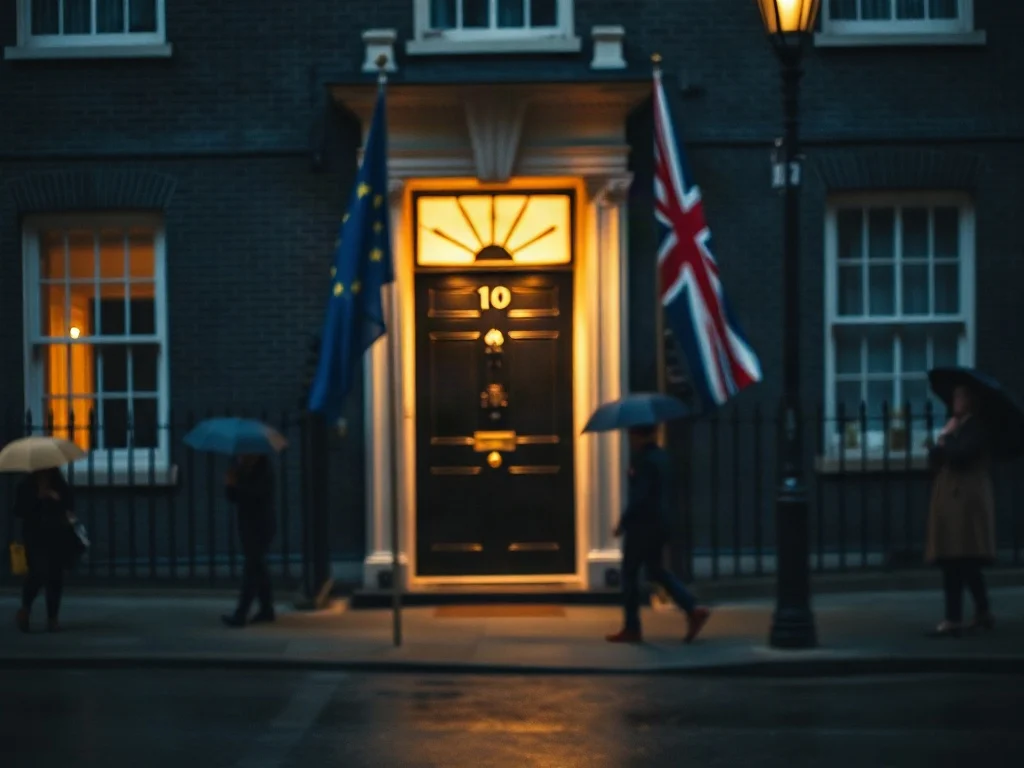
The prospect of UK rejoining the EU has moved from the margins of British politics toward the centre of government conversation. The BBC’s Laura Kuenssberg reports that the prime minister, Andy Burnham, wants to get closer to the European Union, and her headline adds a warning: he should not expect a smooth ride. Opening a conversation is easy. Converting it into a sequence of negotiable, legally sound and electorally survivable steps is much harder. This analysis separates the signal from the substance and sets out the legal, economic and political obstacles that any attempt to reverse Brexit would face.
Andy Burnham wants to get closer to the EU – but he shouldn’t expect a smooth ride.
A caveat first. The published summary of the BBC report says only that government insiders discussed the prime minister opening the conversation. It does not set out a detailed policy. What follows is therefore analysis of the constraints, not a claim about what Downing Street has decided. Where I describe the position of the EU or of British parties, I rely on established treaty mechanics and publicly documented events.
What Burnham’s signal actually changes
Andy Burnham built his public profile as Mayor of Greater Manchester, a role that rewards pragmatism and deal-making with Whitehall. That background suggests a transactional approach to Europe: incremental, sector by sector and framed around economic benefit, not constitutional identity.
Yet Andy Burnham’s EU policy faces a problem his predecessor Keir Starmer also met. Any rhetorical shift toward Brussels is read in two ways. Supporters hear a correction of an expensive mistake. Opponents hear a betrayal of the 2016 result. A government that wants closer ties has to decide whether to describe them as a reset, a realignment or a route back to membership. Each word carries different political costs, and the choice is itself a strategic decision.
Background: how the UK left and what already exists
The UK voted to leave in the 2016 EU membership referendum, with 51.9 percent for Leave and 48.1 percent for Remain on a turnout of 72.2 percent. Brexit took effect legally on 31 January 2020 under the withdrawal agreement. The UK left the single market and the customs union at the end of 2020.
The current relationship rests on the EU-UK Trade and Cooperation Agreement. It delivers tariff-free goods trade if rules of origin are met, but it does not remove regulatory checks. The Windsor Framework separately governs trade arrangements for Northern Ireland.
The Office for Budget Responsibility has long assumed that Brexit reduces the UK’s long-run productivity by about 4 percent compared with remaining in the EU. That is an official forecast, not an observed fact, and economists dispute its precision. It nonetheless anchors the case for closer ties.
The 2025 reset as a template
In May 2025, the UK and the EU held a summit that produced commitments on a security and defence partnership, extended fishing access, and plans to negotiate an agreement on food and agricultural standards. Some of these items were agreements in principle, with detailed negotiation to follow. The summit matters here because it shows the model the EU is most willing to use: bounded, sector-specific deals with clear reciprocal obligations.
Can the UK rejoin the EU after Brexit? The legal route
Formally, yes. Article 49 of the Treaty on European Union allows any European state that respects the Union’s values to apply. In practice, three features of the process make it demanding.
- Unanimity. Every member state must approve accession, and each must ratify the final treaty under its own constitutional rules. Any single capital can slow or block the process.
- Conditions. Applicants are assessed against the Copenhagen criteria. The UK would easily meet the political and economic tests, but it would still need to negotiate chapter by chapter, including on the body of EU law it has diverged from since 2020.
- Time. Recent enlargement negotiations have run for years, and in some cases for over a decade.
It is also unclear whether the EU would negotiate full membership with a government that has not first secured a clear democratic mandate. Most analysts assume that a new referendum would be politically necessary in the UK, though that is a political expectation and not a settled legal requirement.
What would rejoining the EU require on terms?
The harder question is not whether the UK may apply but on what terms it would be readmitted. The pre-Brexit settlement included bespoke exceptions that the EU has little incentive to restore.
The rebate and budget contributions
The UK rebate, secured in 1984, reduced British net contributions for decades. The EU has signalled no appetite for restoring special budget treatment, so a returning UK would probably pay more than it did before 2016. That makes a difficult selling point for a government already managing tight public finances.
The euro and Schengen
Before Brexit, the UK held opt-outs from the euro and the Schengen Area. New members are normally expected to commit to joining the euro in principle, although the timing is in practice controlled by the member state, as Sweden’s long delay shows. Whether the UK could negotiate comparable exemptions is uncertain. Treat any confident claim on either side as speculation.
Freedom of movement and fisheries
Membership would restore freedom of movement for workers, and the UK would again fall under the Common Fisheries Policy. Both are politically sensitive. Immigration in particular is the issue on which opponents would concentrate their campaign.
The domestic politics: sequencing is everything
Burnham leads the Labour Party, which relies on both pro-European urban voters and former Leave-voting seats in the Midlands and the North. Moving too fast alienates the second group. Moving too slowly disappoints the first. Meanwhile, Reform UK can use any approach to Brussels as a mobilising argument, and it has every incentive to do so.
Public opinion has softened on Brexit since 2016, and polls have generally shown that more people think leaving was a mistake than think it was right. But that does not translate automatically into support for rejoining on specific terms, such as paying more or accepting free movement. Support for an abstract idea is a different thing from support for its costs.
Why a gradual path is both safer and riskier
A gradual approach (a veterinary agreement, then mobility schemes, then possibly closer customs alignment) limits exposure to a single decisive vote. But it also means a government accepts EU rules without having a seat at the table where they are written. Critics on the left and the right can both attack that as a poor trade: obligations without influence.
Economic trade-offs: where the gains are largest
Not all forms of closeness are equal. The potential gains are concentrated in a few areas.
- Sanitary and phytosanitary alignment would reduce border checks on food and agricultural goods, a significant pain point for exporters.
- Customs arrangements could cut paperwork for goods manufacturers, though a full customs union would limit the UK’s ability to sign independent trade deals.
- Mobility schemes, including a return to the Erasmus Programme or an equivalent youth scheme, carry modest costs but high symbolic value.
- Services and professional recognition offer large potential gains but are the hardest to negotiate, because the single market‘s service rules depend on regulatory alignment and shared institutions.
The trade-off is simple. Each step that delivers more economic benefit also gives up more sovereignty, in the sense of independent rule-making. Whether that is acceptable depends on a political judgement that economic analysis cannot settle.
Practical guidance: what to monitor
For businesses, investors and analysts trying to read the direction of travel, the following indicators matter more than headlines.
- Formal mandates. Watch for a published negotiating mandate, not statements to the press. Briefings from insiders are an early signal, not a commitment.
- EU capitals’ responses. Reaction from EU member states, especially France, will indicate how much flexibility exists on fishing, youth mobility and budget questions.
- Legislation. Look for dynamic alignment clauses in UK law, which show how far Parliament is prepared to accept automatic adoption of EU rules.
- Official forecasts. Updates from the OBR will show how the fiscal arithmetic changes with each step.
- Common mistakes to avoid: treating a reset as the first step to membership, or assuming that rejoining would restore the pre-2016 terms.
FAQ: UK rejoining the EU
Is the UK allowed to rejoin the EU?
Yes. Article 49 of the Treaty on European Union permits any European country that respects EU values to apply, but all member states must agree to its accession.
How long would rejoining take?
There is no fixed timetable. Accession talks have often taken many years. A UK application could in theory move faster because the country already has well-developed institutions, but that is a reasonable expectation, not a certainty.
Would the UK get its rebate back?
There is no evidence that the EU would restore it. Most analysts expect new members to join on standard budget terms, though the outcome would be a matter for negotiation.
Would the UK have to join the euro?
New members are normally required to commit to adopting the euro in principle, but timing is determined largely by the member state’s own decisions. Whether the UK could secure a formal opt-out is unresolved.
The real test is sequencing, not sentiment
The most important insight is that closeness to the EU is not one decision but a ladder of them, and each rung has a different price. Burnham’s conversation may be easy to start because the first steps (veterinary rules, mobility, security cooperation) deliver visible benefits at modest political cost. The difficulty arrives at the higher rungs, where the UK would be asked to accept rules, budget contributions and freedoms that were central to the 2016 argument.
Watch three things. First, whether Downing Street names an endpoint or deliberately leaves it ambiguous. Second, whether Brussels treats the UK as a privileged partner or as a future applicant, since the EU’s answer will shape the available options. Third, whether Reform UK or the Conservatives can turn each concession into a referendum on trust. The unanswered question is whether a government can build durable consent for closer ties without first asking voters directly. If it cannot, the smooth ride the BBC says Burnham should not expect may turn out to be only the beginning of a very rough one.
Frequently Asked Questions
Can the UK legally rejoin the EU, and what would the process involve?
Yes. Article 49 of the Treaty on European Union lets any European state that respects EU values apply. The process requires unanimous approval from all member states, negotiation of each chapter of EU law, and ratification by every country under its own constitutional rules, so any single capital could delay it.
Would the UK get the same terms it had before Brexit if it rejoined?
Not necessarily. The article notes the UK would negotiate chapter by chapter, including on EU law it has diverged from since 2020. Previous special arrangements were negotiated as a member, so there is no guarantee the EU would restore them, and new conditions could apply.
What did the 2025 UK-EU reset actually deliver, and why does it matter now?
The May 2025 summit produced commitments on security and defence, extended fishing access, and plans to negotiate food and agricultural standards. Some were only agreements in principle. It matters because it shows the EU prefers bounded, sector-specific deals with clear reciprocal obligations, rather than a wholesale return.
Is the claim that Brexit cuts productivity by about 4 percent a proven fact?
No. It is an Office for Budget Responsibility forecast, not an observed outcome, and economists dispute its precision. It still matters politically because it anchors the economic case for closer ties, but critics can challenge the assumptions behind it, which weakens its use as definitive evidence.
Has the government actually announced a plan to rejoin the EU?
No. The published summary of the BBC report says only that insiders discussed the prime minister opening a conversation about closer ties. It sets out no detailed policy, so the article's analysis concerns likely legal, economic and political constraints rather than a confirmed Downing Street decision.
Why does the wording of Burnham's approach, such as reset or rejoin, matter?
Each term carries different political costs. Supporters read closer ties as correcting a costly mistake, while opponents see a betrayal of the 2016 result. Calling it a reset, a realignment or a route back to membership shapes public tolerance and negotiating room, so the choice of language is itself a strategic decision.