
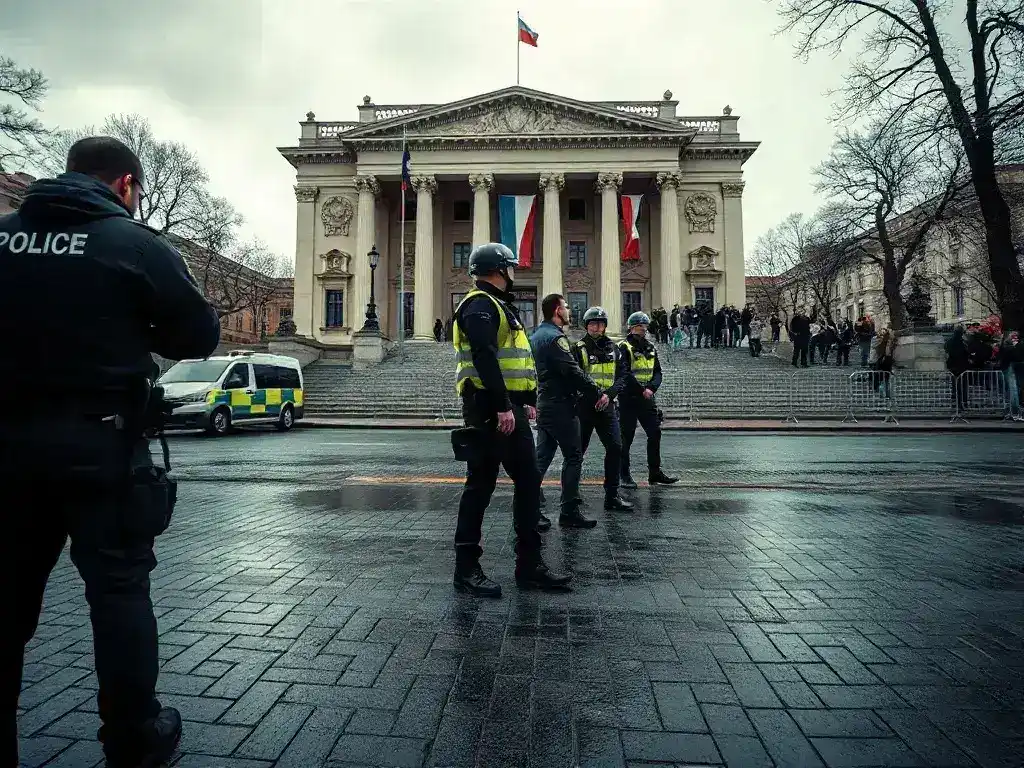
The Poland judicial crisis has moved from legal briefs to the pavement outside a courthouse. Police have been deployed during a stand-off over control of the country’s top court, after the government suspended two senior justices and moved to bring criminal charges against them. A dispute that for years played out in rulings, resolutions and Brussels reports is now a physical contest over who may enter a building and who may sit on the bench. This analysis separates what is known from what is contested, explains why executive action against sitting judges is so legally fraught, and sets out what to watch next.
What is known, and what is not
The reported facts are narrow. Two senior justices have been suspended by the government. The government has said it will pursue criminal charges against them. Police have been deployed amid a stand-off over who controls the court. Anything beyond that, including the exact legal basis cited, the identity of the officials giving orders and the precise status of the justices, should be checked against the latest primary reporting and official statements.
That caution matters because the legal question is not whether the government is angry with these judges. It is whether any branch of government has the power to remove or suspend them in this way. In a system built on separation of powers, the answer is normally no. Judges are removed through procedures run by the judiciary or by parliament under tightly defined rules, not by ministerial decision.
How Poland’s courts became contested ground
The Constitutional Tribunal dispute
The roots lie in 2015, when the outgoing and incoming parliamentary majorities fought over the appointment of judges to the Constitutional Tribunal. The Law and Justice government that took power that year installed its own appointees and changed the Tribunal’s operating rules. In 2021 the European Court of Human Rights, in Xero Flor v Poland, found that the Tribunal panel in that case was not a tribunal established by law because of irregularities in one judge’s appointment. Successive opponents of the former government have since argued that the Tribunal is not a legitimate court.
The Supreme Court and the disciplinary system
The Supreme Court of Poland was reshaped through new chambers, a new National Council of the Judiciary selection method and a Disciplinary Chamber empowered to punish judges. The Court of Justice of the European Union repeatedly found that the arrangements raised problems under EU law, including on the independence of the Disciplinary Chamber. Poland replaced that chamber in 2022, but critics argue the underlying issue of how judges were appointed was never resolved.
The change of government
When Donald Tusk returned as prime minister in December 2023, his coalition promised to restore the rule of law. It faced a structural obstacle. The coalition controls the government and the Sejm, but the President of Poland holds a veto and the power to appoint judges. First Andrzej Duda and then Karol Nawrocki, who took office in 2025, have been politically aligned with the previous governing camp. That gridlock explains why reform by statute has stalled and why the government has been tempted by other routes.
The legal problem with suspending justices by executive action
The Polish Constitution guarantees the independence of courts and judges and provides that judges may be held criminally liable or detained only with the consent of the competent court. In principle, then, a justice’s immunity can only be lifted through a judicial procedure. A government that bypasses it is claiming that the procedure itself is illegitimate because of how the relevant bodies were composed.
That argument is not frivolous. If a body was assembled in breach of the law, its decisions are open to challenge. But it has a dangerous implication. If executives may decide which courts count as lawful, then any government can nullify any ruling it dislikes by calling the bench illegitimate. The test of a rule-of-law remedy is whether it could safely be used by an opponent in the opposite situation.
Two readings of the same event
- The restoration reading: the previous government captured the courts unlawfully, European courts confirmed defects, and normal remedies are blocked by a presidential veto. Extraordinary steps, on this view, repair a prior violation.
- The overreach reading: even if the earlier reforms were unlawful, the cure cannot be unilateral executive action. Suspending justices and threatening prosecution entrenches the principle that judges serve at the government’s pleasure.
Both readings contain truth. The first correctly identifies the origin of the problem, and the second correctly identifies the risk of the solution. Scholars who work on judicial independence have long warned about this trap. Defending legality by illegal means tends to damage the thing being defended.
Why the police deployment is the real signal
Legal arguments can be sustained for years without consequence. A police cordon cannot. Once officers are posted at a court, the question changes from who is right to who can enforce their position. Three things follow.
- Authority becomes visible. Whichever orders the police follow reveals which institution they treat as the legitimate source of command.
- Rulings lose their value. If a court cannot sit, or if its judgments are not published or obeyed, litigants and businesses lose a working forum for disputes.
- Escalation risk rises. Criminal charges against judges invite counter-moves, such as rulings that declare government acts invalid, which the government may refuse to recognise.
This is what a constitutional crisis looks like in practice: two institutions each claiming final authority, with no neutral arbiter left to decide between them. Poland has been close to this condition for years. The deployment suggests it has become more acute.
The European Union dimension
The dispute is not purely domestic. The European Union treats judicial independence as a condition of the legal order that underpins the single market and the mutual recognition of court decisions. The Commission launched Article 7 proceedings against Poland in 2017 and closed them in 2024 after concluding that the clear risk of a serious breach was no longer present, a judgment that followed the change of government. Billions of euros in frozen EU funds were tied to judicial reforms.
This creates an awkward position for Brussels. It encouraged the new government to repair the judiciary, yet a unilateral suspension of justices cuts against the EU’s own insistence on process. The Venice Commission, the Council of Europe’s advisory body on constitutional law, has previously criticised Polish judicial changes and stressed that legitimate repair must itself follow legal procedure. Its published opinions at venice.coe.int are the best benchmark for judging whether current steps meet European standards. Judgments of the EU’s top court are available through Curia.
What practitioners and analysts should monitor
For lawyers and compliance teams
Track which court’s rulings are published and enforced, and whether lower courts follow them. For cross-border contracts and investment disputes, uncertainty about the final appellate authority is a risk to price in. Consider arbitration clauses and EU-law claims that can be pursued outside Polish courts.
For investors and businesses
Watch the link between judicial disputes and EU funds, since frozen or conditioned transfers have a direct fiscal effect. Political risk premiums tend to follow perceived enforcement uncertainty more than any single ruling.
For journalists and researchers
Verify who issued each order and under which statutory provision. Many reports will describe a ‘suspension’ without clarifying whether it came from the government, a prosecutor, a disciplinary body or a court. Those are legally very different acts.
Common analytical mistakes
- Treating the dispute as simple government versus opposition rather than a contest between two theories of legality.
- Assuming that a prior wrong justifies any remedy.
- Ignoring the presidential veto, which explains much of the government’s behaviour.
- Mistaking a police presence for a final settlement.
Frequently asked questions
Why did Poland’s government suspend two senior justices?
Based on the reporting, the government is acting against two senior justices as part of a dispute over control of the top court. Its position rests on the argument that the court’s composition stems from unlawful appointments made under the previous government. Opponents say the government lacks authority to suspend judges at all.
Can a government legally suspend Supreme Court justices in Poland?
Under the constitutional guarantees of judicial independence and immunity, removal or prosecution of judges normally requires judicial procedures. Executive suspension is therefore highly contested, and the legality will likely be argued before domestic and European courts.
Why is Poland’s rule of law under threat?
Since 2015, disputes over judicial appointments, disciplinary powers and the Constitutional Tribunal have left parts of the court system with contested legitimacy. Deadlock between the government and the president has prevented a negotiated fix.
How could the EU respond?
Options include infringement procedures, rulings from the Court of Justice, conditions on funding and political pressure. Brussels is likely to demand that any repair follow lawful procedure.
The question that will outlast the stand-off
The most important insight is that the crisis is no longer about whether Poland’s judiciary was damaged. European courts have said that parts of it were. The issue now is whether the repair can be carried out without adopting the methods that caused the damage. A restored judiciary built on executive suspensions would be a government-controlled judiciary of a different political colour, and the next majority would inherit the precedent.
Watch four things. First, whether the police follow orders from the government or from court officials. Second, whether the suspended justices challenge the measures before European courts, and how quickly those courts respond. Third, whether prosecutors actually file charges, which would test whether judicial immunity is respected. Fourth, whether the presidential veto is overcome through negotiation, a constitutional change or a new political settlement.
A reasoned prediction, which is interpretation rather than fact: the most probable outcome is not a clean victory for either side but a prolonged dual-authority situation, with some courts recognised and others ignored, until an election or a negotiated package forces a settlement. The unresolved question is whether Poland’s institutions can reach that settlement before the habit of resolving legal disputes with force becomes permanent.