
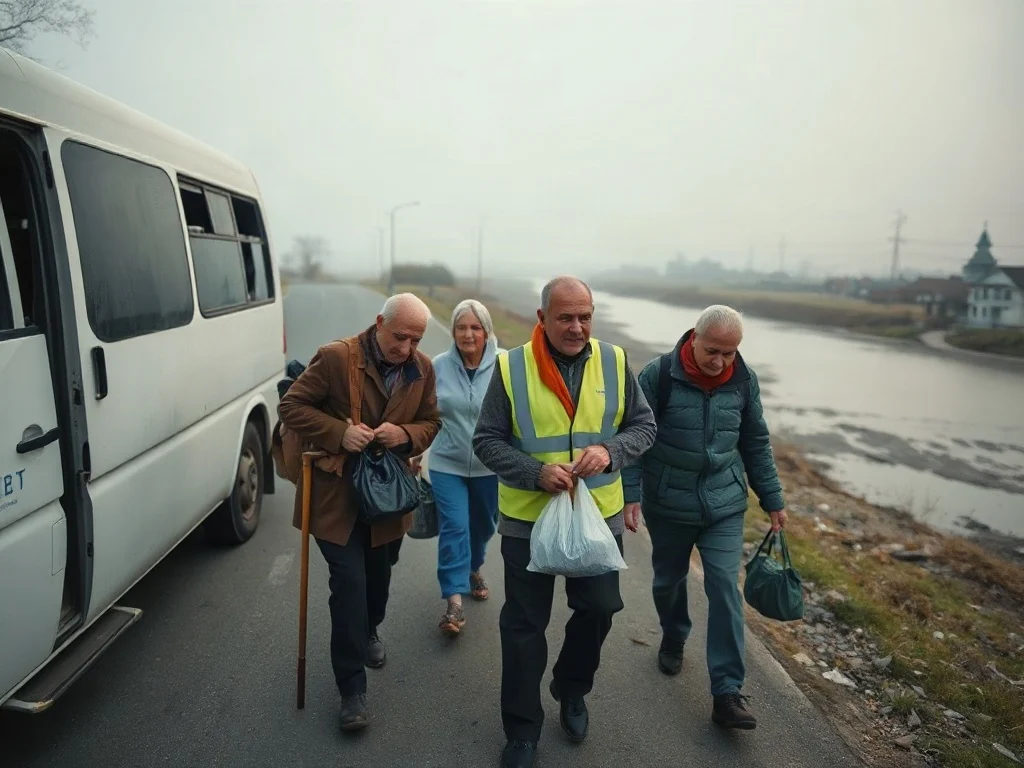
The Oleshky evacuation carried out during a rare ceasefire is notable less for its scale than for its rarity. Hundreds of civilians were reported to have left the Russian-occupied town, while hundreds more are understood to have stayed despite the danger. The available reporting is brief, so this analysis separates what is established from what is not, and uses that gap to examine why evacuations from front-line occupied settlements are so hard to organize and so hard to read.
Oleshky sits in Kherson Oblast on the left bank of the Dnieper, directly across the river from the regional capital. Each element of that position shapes the story: occupation, proximity to the front, and a river that makes movement in either direction difficult.
What We Know About the Oleshky Evacuation
The core facts in the report are narrow. Hundreds of people were evacuated from Oleshky. The departures took place during a ceasefire described as rare. Hundreds of other residents are understood to have remained.
The report leaves several important questions open:
- Who negotiated and monitored the pause in fighting.
- How long the ceasefire lasted and what area it covered.
- Which route the evacuees used and where they were taken.
- Whether departure was fully voluntary and whether anyone was screened or restricted.
Until those details are confirmed by independent organizations, any firm conclusion about the operation’s success would be speculation. The phrase “understood to have stayed” also signals uncertainty. Nobody appears to have a verified count of those remaining.
Why Oleshky Matters in the Wider War
Geography and occupation
Russian forces took Oleshky in the early phase of the Russian invasion of Ukraine in 2022. When Ukrainian forces later liberated the right bank, including the city of Kherson, the river became a de facto front line. Towns on the Russian-held side, Oleshky among them, ended up exposed to artillery and drone fire while cut off from Ukrainian-controlled territory.
The dam’s aftermath
The destruction of the Kakhovka Dam in June 2023 flooded low-lying areas along the lower Dnieper, and Oleshky was among the affected communities. Responsibility for the dam’s destruction remains contested between Moscow and Kyiv. The flooding is widely documented, though, and it damaged housing and infrastructure that were already under strain. A population already isolated by occupation became more dependent on whatever supplies and services reached it.
The Difficulty of Evacuating from Occupied Territory
Why ceasefires are the exception
Most evacuations in this war happen from territory a government controls, with that government setting the routes and logistics. Evacuating from an occupied town is structurally different. Two warring parties must agree on timing, routes and guarantees, and each has reasons to distrust the other. Each side has at times accused the other of obstructing or endangering civilian movement, so a localized pause that actually holds is an unusual outcome.
That is why a ceasefire narrow enough to allow a civilian departure should not be mistaken for a broader de-escalation. Local pauses can work precisely because they ask little of either side, and they say little about the prospects for wider negotiation.
The role of neutral intermediaries
Humanitarian evacuations usually depend on a trusted third party. The International Committee of the Red Cross has historically served this function in conflicts, although its access in this war has been limited and criticized at times. The United Nations and its humanitarian coordination arm, OCHA, track access and civilian needs, but neither can compel a party to open a route. Whether any of these actors was involved in Oleshky is not stated in the report, and it matters a great deal for how the operation should be judged.
Why Hundreds Chose to Stay
The detail that many residents remained, despite the danger, is the most analytically interesting part of the story. Observers asking why people stay in a front-line town tend to offer several explanations. The report does not confirm which apply to Oleshky, so these should be read as general patterns in conflict settings, not findings about this town.
- Age and mobility. Older and disabled residents often cannot travel, or fear that they cannot withstand relocation.
- Property and livelihood. Leaving a home can mean losing it, especially where ownership is disputed or the area is occupied.
- Distrust of the evacuation itself. People may doubt that the route is safe, or may not want to be taken into territory controlled by the other side.
- Family ties. Relatives who cannot or will not leave keep others in place.
- Lack of information. In places with limited communications, residents may not learn of an evacuation window until it has closed.
Treating those who stayed as simply reckless is a mistake. For many people the decision is a calculation under severe constraint, and the risk of leaving can look as real as the risk of remaining.
The Legal Framework Around Civilian Evacuation
Under international humanitarian law, an occupying power carries specific duties toward the civilian population. The Fourth Geneva Convention regulates the protection of civilians in occupied territory. It permits evacuation where imperative military reasons or the security of the population demand it, but it prohibits forcible transfers and deportations of protected persons.
This is where the Oleshky case demands careful scrutiny. A genuine humanitarian corridor lets civilians leave voluntarily toward a destination of their choosing. An evacuation that steers people only toward one side’s territory, or that is conducted without free consent, raises different legal and ethical questions. The report does not say which description fits, and readers should be wary of any account, from either side, that presents the operation in purely triumphant or purely sinister terms before independent verification.
Practical Lessons for Humanitarian Planning
Even with limited information about Oleshky, the case illustrates points that humanitarian professionals, local authorities and analysts can apply to similar situations.
- Plan for partial uptake. Evacuation windows rarely empty a settlement. Planners should expect many residents to remain and should keep aid delivery, medical access and communication channels open for them.
- Communicate early and credibly. Trust deficits are the main barrier. Information needs to reach residents through channels they believe, well before the window opens.
- Prepare for the next window. A successful pause creates a precedent. The most useful follow-up is a documented process that can be repeated quickly if another ceasefire occurs.
- Document conditions of departure. Independent monitoring of who left, how and to where protects evacuees and reduces later disputes.
- Support receiving communities. Evacuees become internally displaced persons or refugees, and need housing, registration, psychological support and legal documentation.
Common analytical mistakes
Observers frequently over-read a single event. A rare ceasefire does not demonstrate a changed strategic posture. A headline number of evacuees does not measure the need that remains. And a reported figure for those who stayed is, in the absence of a census, an estimate.
The Technology Problem: Drones and Isolation
One factor shaping life in towns like Oleshky is the pervasive use of uncrewed aerial vehicles near the front. Short-range drones make movement along roads hazardous even when heavy artillery is quiet, and they complicate supply and evacuation. The more a settlement depends on a single exposed road or river crossing, the narrower the safe window for any evacuation becomes. This is one reason a formal pause in fighting is so valuable: it temporarily neutralizes the threat that normally makes departure so dangerous.
What to Watch Next
Several developments will determine whether the Oleshky evacuation was a one-off or the start of a pattern.
- Confirmation of details. Statements from the parties, humanitarian bodies and independent reporters on who organized the pause and how the evacuees were treated.
- The fate of those who stayed. Access to food, water, medicine and electricity for remaining residents is the real measure of the town’s humanitarian situation.
- Repeat windows. Whether another ceasefire is agreed, and whether it is announced with enough notice for residents to act on it.
- Reconstruction and return. The dam’s aftermath and ongoing shelling mean that even if the fighting eased, rebuilding Oleshky would take years.
Frequently Asked Questions
Where is Oleshky?
Oleshky is a town in Kherson Oblast, southern Ukraine, on the left bank of the Dnieper opposite the city of Kherson. It has been under Russian occupation since 2022.
Why was the ceasefire considered rare?
Local pauses in fighting that allow civilians to leave occupied front-line areas require cooperation between two adversaries who distrust each other. The report describes the ceasefire as rare, and the analysis above explains why such arrangements seldom materialize.
Why did hundreds of residents stay in Oleshky?
The report does not give reasons. In comparable conflict settings, common factors include age, disability, property concerns, distrust of the evacuation process and family obligations.
Is evacuating civilians from occupied territory legal?
International humanitarian law allows evacuation for the security of the population or for imperative military reasons, but prohibits forcible transfer and deportation of protected persons. The legality of any specific operation depends on its conditions, especially consent and destination.
The Real Test Comes After the Ceasefire Ends
The most important insight is that the Oleshky evacuation measures access, not safety. A pause in fighting briefly proved that civilians could leave, but the people who remained are the clearer test of whether humanitarian principles hold in occupied territory. The unanswered question is whether this window was an isolated exception or a template. If independent organizations can confirm the terms and the treatment of evacuees, the episode could become a practical model for future local pauses. If the details remain murky, it will stand as a reminder that in this war, even a rescue can be too opaque to evaluate. Watch for verification from neutral bodies, for conditions facing the residents who stayed, and for any sign that the parties will agree to another window before the next season of fighting closes this one.
Frequently Asked Questions
Does the Oleshky ceasefire signal a broader de-escalation in southern Ukraine?
No. Local pauses work precisely because they ask little of either side, such as a narrow window for civilians to leave. They say very little about the prospects for wider negotiations, and the report does not suggest the fighting elsewhere changed.
Why is it so hard to evacuate civilians from an occupied town like Oleshky?
Both warring parties must agree on timing, routes and guarantees, and each distrusts the other. Each side has accused the other of obstructing or endangering civilian movement. Unlike evacuations from government-held areas, no single authority controls the logistics.
Which organizations could have mediated the Oleshky evacuation?
The International Committee of the Red Cross is the usual neutral intermediary, though its access in this war has been limited and criticized. The UN and OCHA monitor access and needs but cannot compel a route to open. The report does not say whether any of them took part.
Can we judge whether the Oleshky evacuation was a success?
Not yet. The report does not say who monitored the pause, how long it lasted, which route was used, where evacuees went, or whether departure was fully voluntary. Until independent organizations confirm these details, any firm verdict on success would be speculation.
How many people remain in Oleshky after the evacuation?
There is no verified figure. The report says hundreds are understood to have stayed, and that wording signals uncertainty. Occupation, isolation and the lack of independent access make it difficult for anyone to produce a reliable count of remaining residents.
How did the Kakhovka Dam's destruction affect Oleshky?
The June 2023 destruction of the dam flooded low-lying areas along the lower Dnieper, including Oleshky, damaging housing and infrastructure already under strain. This left an isolated population more dependent on limited supplies. Responsibility for the destruction is still contested between Moscow and Kyiv.