
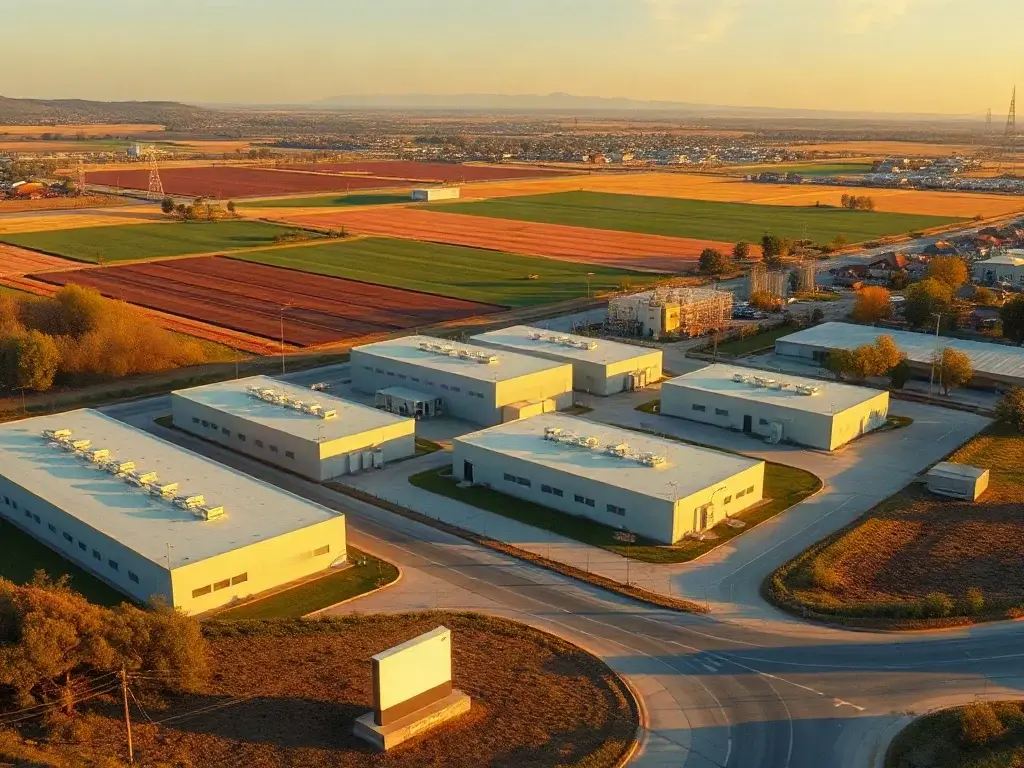
OpenAI wants the public to stop saying ‘data center’ and start saying ‘compute campus.’ The company confirmed to Business Insider that it plans to promote the term, and the shift matters because OpenAI compute campuses are not only a naming experiment. They are a bid to reframe the most contested physical footprint of the AI boom. This analysis looks at what the company said, why the old label became a political liability, and whether a new phrase can change how communities judge the facilities behind ChatGPT.
What OpenAI Actually Said
According to the report, an OpenAI spokesperson said the phrase ‘better describes the scale and role of the infrastructure we’re building for AI.’ The spokesperson added: ‘These are long-term investments in computing, energy infrastructure and skilled work.’ The company also said it wants ‘the communities hosting that infrastructure to help shape it and share in the opportunities it creates.’
Three claims are packed into those statements. The first is about scale: these sites are larger than the traditional data center. The second is about role: they are presented as economic and energy assets rather than server warehouses. The third is about governance: host communities are promised a voice. The name is the most visible part of a broader message.
Why the Term ‘Data Center’ Became a Liability
The Public Opinion Problem
The report cites a Pew Research poll finding that 54% of Americans say AI data centers are bad for the environment. That figure comes from the Pew Research Center, and it shows that negative sentiment is now the majority position, not a fringe view. The reasons people give vary. Common concerns in the wider debate include electricity demand, water use, noise and land use, though the article itself does not break down respondents’ reasons.
Efforts to improve this image have, in the article’s words, ‘mostly failed.’ Meta, Amazon and Microsoft have pledged millions of dollars to communities and schools near their facilities. Money alone has not reversed the perception, which suggests the objection is not purely financial.
A Voting Issue
The report also notes that data centers have become a major issue for voters in the midterm elections. That moves the debate from zoning boards to ballots. When local siting fights become national campaign material, the companies’ vocabulary becomes part of the political contest, and a term like ‘data center’ can carry baggage that executives want to shed.
Does a Rebrand Change the Substance?
The Case for the New Term
There is a legitimate descriptive argument. The word ‘campus’ implies multiple buildings, shared utilities and long-term site planning. Modern AI facilities built around graphics processing units often involve dedicated power supply, cooling systems and substantial grid connections. A small server room and a multi-building AI site are very different things, and a single word for both is imprecise. Industry vocabulary does evolve: ‘server farm’ gave way to ‘data center,’ and parts of the industry moved toward cloud computing language to describe distributed services.
The Case Against It
The critical reading is just as plausible. The phrase borrows the warm associations of a university or corporate park and pairs them with the abstract word ‘compute.’ It removes any reference to data, to servers, and to the physical industrial reality. That is the classic function of a euphemism. Linguists describe a related pattern as the euphemism treadmill: when a new word is attached to an unpopular thing, the negative associations tend to migrate to the new word over time. If residents dislike the noise, power demand or tax arrangements, calling the site a campus will not stop them from disliking it.
This is an interpretation, not a proven outcome. No data in the report shows how the public will respond to the phrase, and the article itself says only that ‘time will tell’ whether it catches on.
Framing, Greenwashing and the Credibility Gap
The move is a textbook example of framing. Research on framing generally holds that word choice can shift how people interpret an issue, but only when the frame is consistent with what people observe. A rebrand works best when it accompanies visible changes, such as lower local impacts or concrete benefits. Without that, critics may label it greenwashing by vocabulary, even if the company’s intent is sincere.
The credibility gap is where OpenAI’s approach will be tested. The spokesperson’s wording, ‘long-term investments in computing, energy infrastructure and skilled work,’ makes promises that can be checked. Communities can ask how many permanent jobs exist, who pays for grid upgrades, and whether energy infrastructure is additive or competes with residential supply. The label raises expectations that the facts must then meet.
The Regulatory Backdrop
Timing is not incidental. The article says Axios reported that OpenAI was preparing for a blue wave in the midterm elections, which could produce a more regulation-minded government. If so, the rebrand can be read as part of a defensive posture. Language that emphasizes community partnership and infrastructure investment is easier to defend in a regulatory hearing than language associated with resource-hungry server halls.
It is worth separating what is reported from what is inferred. The reported facts are that OpenAI confirmed the term and that Axios reported election preparations. The link between the two is an analytical inference, and OpenAI has not said the rebrand is a regulatory strategy.
What This Means for Communities and Companies
For Local Officials and Residents
Terminology should not determine the review process. Whatever a project is called, the questions remain the same:
- What are the projected power and water requirements at full build-out?
- Who funds new transmission and generation capacity?
- How many permanent, skilled jobs are contractually committed, as opposed to temporary construction roles?
- Is there an enforceable community benefits agreement, or only voluntary pledges?
For Other AI Developers
Rivals face a choice. If ‘compute campus’ gains traction, competitors may adopt it to avoid being left with the older, more negative label. If it is mocked, they will avoid it. The more durable lesson from the pledges by Meta, Amazon and Microsoft is that spending without participation has not persuaded skeptics. OpenAI’s stated emphasis on letting communities ‘help shape’ the infrastructure is the more consequential part of its message, provided it is backed by binding commitments.
Common Mistakes to Avoid
- Treating a name as a strategy. Rebranding without operational change invites ridicule.
- Overpromising jobs. Automated facilities typically employ far fewer people than their size suggests, so vague claims about ‘skilled work’ need numbers.
- Ignoring local opposition early. Siting fights are cheaper to resolve before land is purchased.
Frequently Asked Questions
What is a compute campus?
It is OpenAI’s proposed term for large AI infrastructure sites that the industry usually calls data centers. The company says it better reflects their scale and their role, combining computing, energy infrastructure and skilled employment.
Why is OpenAI renaming data centers?
OpenAI says the new name better describes what it is building. The context suggests a reputational motive as well: a Pew poll found 54% of Americans consider AI data centers bad for the environment, and the facilities are an issue in the midterm elections.
Is a compute campus different from a data center?
OpenAI argues that it is, citing scale and purpose. Based on the reporting, no technical standard separates the two terms. It is a branding distinction, not a new engineering category.
Will the new term improve public opinion?
Nobody knows yet. Past community pledges by large tech firms have mostly failed to shift attitudes, which suggests a name alone is unlikely to do so without tangible local benefits.
The Question a New Name Cannot Answer
The most important insight is that the rebrand concedes something: the industry now believes ‘data center’ is a worse word than the thing it describes. But public skepticism of AI infrastructure rests on observable costs, not on vocabulary. Electricity bills, water draws and the distribution of benefits will shape opinion far more than a phrase.
Watch three things. First, whether other major builders adopt ‘compute campus’ or quietly ignore it. Second, whether the midterm results produce regulation that treats these sites as energy-intensive industrial users regardless of what they are called. Third, whether OpenAI’s promise to let communities ‘help shape’ its infrastructure becomes written, enforceable agreements. A reasonable prediction is that the term will survive only if the commitments behind it are verifiable. If they are not, ‘compute campus’ risks becoming the next label critics use with irony, and the euphemism treadmill will have claimed another word.
Frequently Asked Questions
¿Qué diferencia técnica hay entre un 'campus de cómputo' y un centro de datos tradicional?
Según el artículo, 'campus' sugiere varios edificios, servicios compartidos y planificación a largo plazo. Las instalaciones de IA basadas en GPU suelen requerir suministro eléctrico dedicado, sistemas de refrigeración y grandes conexiones a la red, por lo que son muy distintas de una pequeña sala de servidores.
¿Por qué no bastan las donaciones de Meta, Amazon o Microsoft para mejorar la imagen de estas instalaciones?
El artículo indica que esos esfuerzos han fracasado en su mayoría. Aunque estas empresas han prometido millones a comunidades y escuelas, la percepción negativa persiste, lo que sugiere que la objeción no es solo económica y que influyen también factores como el ruido, la energía o el uso del terreno.
¿Qué es la 'rueda de eufemismos' y cómo puede afectar al término 'campus de cómputo'?
Es un patrón descrito por lingüistas: cuando se asigna una palabra nueva a algo impopular, las connotaciones negativas migran con el tiempo al nuevo término. Si los vecinos rechazan el ruido o la demanda eléctrica, llamar al sitio 'campus' probablemente no cambiará su opinión.
¿Hay pruebas de que el nuevo nombre mejorará la opinión pública?
No. El artículo aclara que ningún dato muestra cómo reaccionará el público a la expresión y que la crítica al término es una interpretación, no un resultado demostrado. Solo se afirma que 'el tiempo dirá' si el nuevo nombre se populariza.
¿Por qué importa este cambio de vocabulario en el ámbito político?
Porque los centros de datos se han convertido en un tema relevante para los votantes en las elecciones de mitad de mandato. Al pasar de las juntas de zonificación a las urnas, el lenguaje de las empresas forma parte de la disputa política y un término cargado de connotaciones negativas resulta una desventaja.