
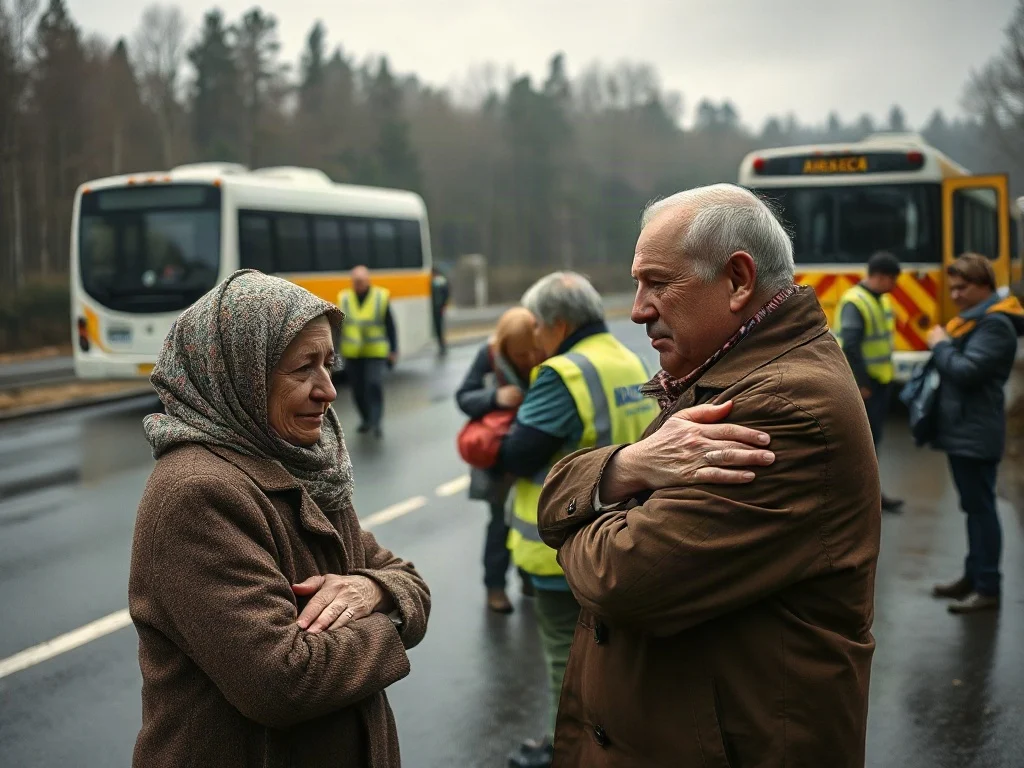
The Oleshky evacuation produced one of the most human images of the war in southern Ukraine in recent weeks: buses and ambulances arriving at the northern Ukrainian border with Belarus, and families who had been separated by front lines embracing on the roadside. According to a BBC report by correspondent Dan Johnson, the Oleshky evacuees reached the border after a temporary ceasefire allowed them to leave. This article does not retell the scenes. It examines what they imply, what the available reporting does not tell us, and why a short pause in fighting is both a significant and a deeply fragile humanitarian instrument.
The source material is brief, so this analysis separates what is established from what is inferred. Where details such as numbers, negotiators, route, and duration of the ceasefire are not confirmed in the report, they are treated as open questions rather than filled with speculation.
What Is Actually Known About the Oleshky Evacuees
The confirmed elements are few but meaningful. Residents of Oleshky were evacuated. They travelled by bus and ambulance, which suggests a mix of mobile and medically vulnerable people. They arrived at Ukraine’s northern border area with Belarus. The movement followed a temporary ceasefire. The BBC’s reporting, published through BBC News, focused on the reunions with relatives waiting on arrival.
What the Brief Does Not Establish
- Scale: the number of people evacuated is not given in the summary available.
- Mediation: who negotiated or monitored the pause is not stated.
- Route: the journey from a town in the south to Ukraine’s northern frontier covers a very long distance, and the path taken is not described here.
- Duration and terms: how long the ceasefire lasted and whether it has been extended is unknown.
These gaps matter. An evacuation is only as credible and repeatable as its mechanics, and the mechanics are exactly what emotional reporting tends to leave out.
Why Oleshky Is a Special Case
Oleshky is a town in Kherson Oblast on the left bank of the Dnipro river, across from the regional capital. It had roughly 24,000 residents before the war. Russian forces took control during the early phase of the full-scale invasion, and when Ukrainian forces retook Kherson city in late 2022, the left bank stayed under Russian control.
Geography as a Humanitarian Trap
The river turned a frontline town into a nearly sealed one. After the Kakhovka Dam was destroyed in June 2023, flooding hit low-lying communities along the lower Dnipro, and Oleshky was among the affected places. Infrastructure damage, a thinned-out population, and difficult access then compounded one another. Ukrainian officials and humanitarian organisations have repeatedly described conditions in occupied areas near the river as hard for remaining civilians to endure. Independent verification inside occupied territory remains limited, so such assessments should be read with that constraint in mind.
This is the core reason the Oleshky evacuation carries weight beyond one town. It shows that a population living under military occupation, near an active front, can only be moved out when both sides tolerate a narrow window of safety.
How a Temporary Ceasefire Enables Civilian Evacuation
A local ceasefire is the simplest form of what international practice calls a humanitarian corridor: a defined route and time frame in which fighting is suspended so civilians can leave. The concept is easy to state and hard to execute.
The Three Conditions That Make It Work
- Agreement on the route. Both sides must accept the same roads, checkpoints, and timings. A corridor that one party considers a military risk will not hold.
- A trusted intermediary. Organisations such as the International Committee of the Red Cross often provide neutral monitoring, although the report available here does not say whether any such body was involved.
- Voluntary departure. Evacuees must be able to choose where to go. This is the point at which humanitarian logistics and politics collide.
The Credibility Problem
Past corridor attempts in this war have been marred by disputes over who violated the pause. A critic’s reading, therefore, is that the successful arrival of buses and ambulances is evidence of a functioning arrangement at least once, not proof that it can be replicated. Successful single events can build trust, but they can also be treated by either side as exceptions rather than precedents.
The Legal and Ethical Frame
International humanitarian law, including the Fourth Geneva Convention, protects civilians in occupied territory. It permits evacuation for the security of the population or for imperative military reasons, but it prohibits forced displacement. The distinction depends on consent and destination, not on the vehicles used.
That is why the direction of travel is analytically important. People who arrive in government-controlled Ukraine and are met by relatives are clearly in a different position from people moved against their will elsewhere. The reunions described by the BBC are consistent with voluntary movement toward family, but a single report cannot establish how many residents chose to leave, how many wanted to leave but could not, or how many chose to stay.
Evacuation is a humanitarian act only when the evacuee has a meaningful choice. Everything else is logistics.
Reading Emotional Reporting Critically
Reunion scenes are powerful journalism, and they are legitimate evidence of human cost. They also have limits as evidence.
What Emotional Scenes Do Well
- They make an abstract policy outcome, a ceasefire window, tangible.
- They confirm that people actually arrived, which official statements alone cannot.
- They document the separation that occupation and front lines impose on families.
What They Cannot Show
- The people who did not get on a bus.
- The conditions that made departure necessary.
- The terms under which the pause was agreed.
Informed readers should treat such reports as the visible end of a long chain of negotiation, risk, and waiting, and should look for follow-up coverage on the rest of that chain.
The Human Aftermath for Evacuees
Arrival at a border point is the end of one ordeal and the start of another. Evacuees become internally displaced persons and need housing, documents, medical follow-up, and income. Those who came by ambulance may need continuing treatment. Prolonged exposure to bombardment, flooding, and isolation is a recognised risk factor for psychological trauma, and older evacuees often face the added loss of home and community.
The UN Office for the Coordination of Humanitarian Affairs publishes situation updates on Ukraine at unocha.org, and the ICRC maintains operational information at icrc.org. Both are better sources than social media for tracking the scale of displacement and the response.
What Observers and Aid Professionals Should Monitor
- Repeatability: whether further evacuations from Oleshky or neighbouring left-bank settlements follow, and on what terms.
- Neutral verification: whether an independent humanitarian body confirms the mechanics.
- Medical capacity: whether reception points can handle patients arriving by ambulance.
- Family reunification support: whether registration and tracing services keep pace with arrivals.
- Official statements: consistency between Ukrainian, Russian, and international accounts of the same event.
Common Mistakes in Interpreting Events Like This
The first mistake is treating a local pause as a sign of wider de-escalation. A ceasefire limited by place and time is a tool, not a trend. The second is assuming that arrival numbers describe the whole population in need. The third is ignoring geography: the northern border of Ukraine neighbours Belarus, and the length and complexity of the route from the south underline how much logistics sits behind a few hours of footage.
Frequently Asked Questions
What happened in Oleshky?
Residents of Oleshky, a town in Kherson Oblast on the Dnipro’s left bank, were evacuated during a temporary ceasefire and arrived by bus and ambulance at the northern Ukrainian border with Belarus, according to the BBC. Further details were not provided in the summary available.
Who are the Oleshky evacuees?
They are civilians who left a town that has been under Russian occupation since the early days of the full-scale invasion. The report does not give their number or demographic breakdown.
Does a temporary ceasefire mean the fighting is ending?
No. A temporary ceasefire of this kind is a limited arrangement to allow safe passage. It carries no automatic implication for the broader Russo-Ukrainian war.
What is a humanitarian corridor?
It is an agreed route and time window in which hostilities are suspended so civilians, aid, or both can move safely. Its success depends on trust, verification, and voluntary participation.
The Unanswered Question Behind the Reunions
The most important insight from this episode is that evacuation proves feasibility, not sufficiency. The fact that buses and ambulances completed a long journey during a pause shows that even in a war marked by broken corridors, narrow arrangements can occasionally function. The reunion scenes show what is at stake when they do.
The harder question is what happens to those who remain. If Oleshky can be partly emptied under a short ceasefire, the same mechanism could in principle be extended to other isolated left-bank communities. Whether it will depends on factors the current reporting does not reveal: who brokered this window, whether it can be formalised, and whether neutral monitors are allowed to see the process from start to finish.
Watch for three signals over the coming weeks: independent confirmation of how the evacuation was arranged, evidence of a second movement of civilians, and any change in access for international humanitarian organisations. If all three appear, the roadside embraces at the Belarus border may mark the first step of a repeatable model. If none do, they will remain a moving exception, and the people still waiting in Oleshky will be the measure of how much that exception was worth.