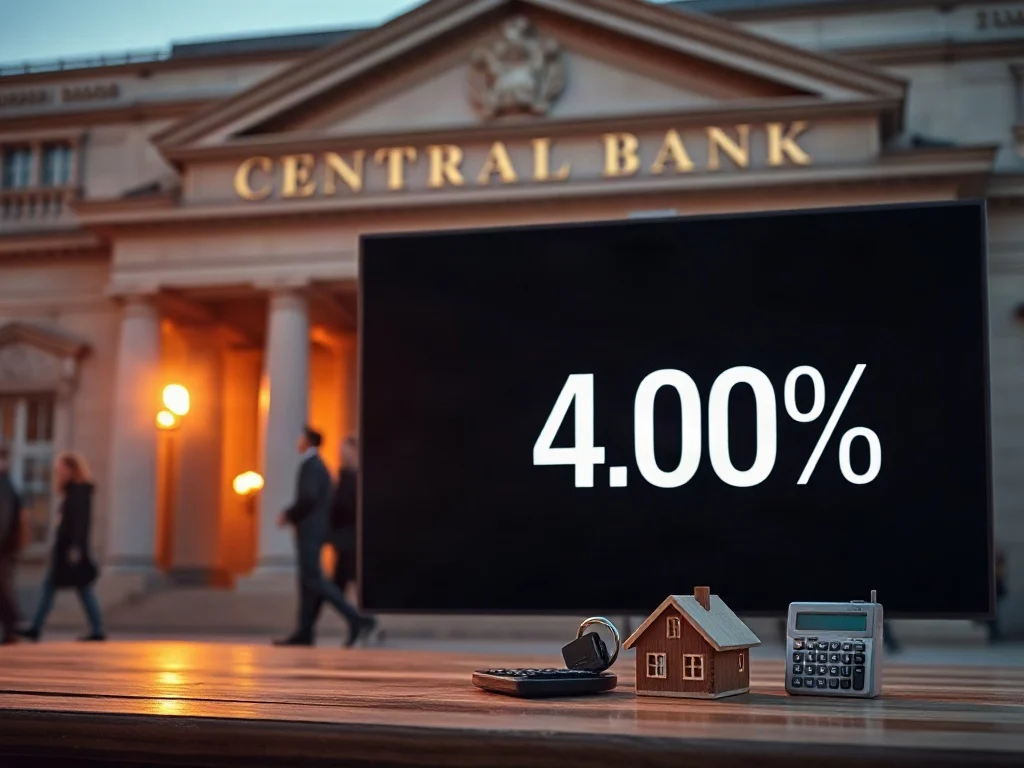
An interest rate rise from 3.75% to 4% would be the first increase in more than three years, and most analysts expect it. A quarter-point change looks small on paper. After a long period of cuts or holds, though, a hike changes the direction of policy, and that shift matters more than the size of the move. This article separates what the forecast says from what it implies, and it shows who pays and who benefits when borrowing costs go up.
The report summarized here does not name the central bank, so this analysis stays general. The mechanics apply to any economy that runs an inflation-targeting regime. Where the article makes assumptions, it says so.
What the Forecast Actually Says
The core claim is narrow. Most analysts predict the policy rate will move from 3.75% to 4%, an increase of 25 basis points. A basis point is one hundredth of a percentage point, so the change is a quarter of one percentage point, not a quarter of the rate itself. Proportionally it is about a 6.7% increase in the cost of overnight money.
Two limits on the claim are worth keeping in mind:
- Analyst consensus is not a decision. Forecasts reflect economists’ reading of data and past communication. The rate-setting committee can surprise them.
- “Most” is not “all.” A minority view that favors holding rates implies real disagreement about the economic outlook.
The phrase “first increase in more than three years” is also informative. It implies the last tightening cycle ended, rates were then held or lowered, and policymakers now think the stance needs to turn. Reversals like this are usually harder to explain to the public than a continuation of an existing trend.
Why a Quarter-Point Move Matters More Than Its Size
Economists treat the first move in a new direction as a signal. Central banks use forward guidance to shape expectations about future rates. A hike tells households, lenders and investors that the next move may not be a cut. Markets often reprice the whole path of future rates, not just the next meeting.
That is why a 25-basis-point increase can affect fixed-rate loan pricing, bond yields and exchange rates well beyond its arithmetic weight. It is also why the wording of the decision statement can matter as much as the number.
How an Interest Rate Rise Moves Through the Economy
The monetary transmission mechanism describes how a change in the policy rate reaches prices and output. It works through several channels at once, and each has its own lag.
Mortgages and Household Borrowing
Households feel the hike most through mortgage costs, but the exposure is uneven. Borrowers on adjustable-rate mortgages or trackers see payments change almost immediately. Borrowers on long fixed terms are shielded until they refinance.
Here is an illustrative calculation. It is simple arithmetic, not a forecast of actual mortgage pricing, because lenders do not pass policy changes through one-for-one. Take a 200,000 repayment mortgage over 25 years. At 3.75% the monthly payment is about 1,028. At 4% it is about 1,056. The difference is roughly 27 to 28 per month, or about 330 per year. That is manageable for many households, but it falls hardest on those already stretched by rent, food and energy costs.
Savers
Savers are the obvious beneficiaries, but only partly. Banks tend to raise lending rates faster than deposit rates, and the gain depends on competition between providers. A saver’s real interest rate, meaning the nominal rate minus inflation, is what determines whether purchasing power is preserved. A 4% savings rate is a loss in real terms if inflation runs higher.
Businesses and Governments
Firms with floating-rate debt, thin margins or heavy refinancing needs are the most exposed. Higher rates raise the hurdle rate for new investment, so marginal projects get shelved. Governments with large debt stocks face higher servicing costs as maturing debt is rolled over at higher yields. That is a slow-burning effect, not an overnight one.
Bond Markets and Currency
A hike usually pushes short-term government yields up and can reshape the yield curve. Prices of existing bonds fall when yields rise. Higher relative rates can also support the currency by attracting capital, which affects the exchange rate and, through import prices, inflation itself.
Why Are Interest Rates Rising? Competing Explanations
The report does not state why analysts expect a hike, and speculating would be irresponsible. Economists generally cite a handful of drivers when a central bank reverses course. Treat them as hypotheses to test against the official statement, not as established causes here.
- Persistent inflation. If the consumer price index and core measures stay above target, the committee may judge that inflation expectations are at risk of drifting up.
- A tight labor market. Strong wage growth can keep services inflation elevated even when goods prices ease.
- Rule-based pressure. Simple guides such as the Taylor rule suggest a higher rate when inflation exceeds target and output runs above potential. Central banks use such rules as reference points, not mandates.
- Credibility. After an earlier period of high inflation, policymakers may prefer to over-tighten slightly than risk losing public trust in the target.
A reasonable critique is that hiking after a long pause is a bet on forecasts. Policy acts with long and variable lags, so a rate raised today may do most of its work after the underlying inflation pressure has already faded. The risk of overshooting is real, and no model removes it.
Winners and Losers From an Interest Rate Rise
The distributional effects are the part of this story that headlines tend to skip. The table below summarizes the typical direction of impact. Actual outcomes depend on contract terms, balance sheets and lender behavior.
| Group | Typical effect | Key variable |
|---|---|---|
| Variable-rate borrowers | Higher payments soon | Share of income spent on debt service |
| Fixed-rate borrowers | Delayed impact | Date of next refinancing |
| Savers | Higher nominal returns | Bank pass-through and inflation |
| Exporters | Possible headwind | Currency strength |
| Highly leveraged firms | Margin pressure | Floating-rate exposure |
| Bond holders | Short-term price losses | Duration of holdings |
Practical Steps for Households and Businesses
Advice built on generalities is useless here, so the steps below are specific.
For Households
- Check your reset date. Know exactly when a fixed rate ends and what the standard variable rate would be.
- Stress-test your budget. Model payments at one full percentage point above today’s rate, not just the 0.25-point move. Rates can keep rising after the first hike.
- Prioritize expensive debt. Credit card balances and other variable-rate debt usually cost more than any savings account earns.
- Compare deposit rates actively. Banks rarely raise savings rates as generously as loan rates.
For Businesses
- Map your floating-rate exposure and consider whether hedging is worth its cost.
- Recalculate investment thresholds. A higher cost of capital changes which projects clear the bar.
- Plan refinancing early. Lenders reprice risk when rates rise, and covenants can tighten alongside.
Common Mistakes
The most frequent error is assuming one hike is the whole story. Another is ignoring the second-order effects, such as weaker demand for your product or a tighter credit supply. A third is treating the headline policy rate as the rate you will actually pay.
Risks, Edge Cases and What Could Go Wrong
Three scenarios deserve attention.
- The hike is already priced in. If markets expected it, financial conditions may barely move on the day. The surprise, if any, lies in the guidance about further moves.
- The hike is a one-off. Some central banks describe a single move as a calibration. Others begin a cycle. Reading the difference correctly is worth more than predicting the number.
- Growth weakens. If tightening coincides with a slowdown, the economy faces the risk of a recession or, in a worse case, stagflation. Neither is a prediction here. Both are tail outcomes that policymakers weigh when deciding how fast to move.
There is also an asymmetry in political economy. Cuts are popular and hikes are not, so a central bank that raises rates after years of easing is accepting criticism in exchange for what it believes is long-term stability. That is the defining logic of monetary policy run by an independent central bank.
Frequently Asked Questions
Why are interest rates rising?
Central banks raise rates to slow demand and keep inflation near target. The report does not give the specific reasons behind this expected move. The official decision statement and the published meeting minutes are the authoritative sources.
How much will a 0.25% rate rise cost me on a mortgage?
On a 200,000 repayment mortgage over 25 years, moving from 3.75% to 4% adds roughly 27 to 28 per month. That is an arithmetic illustration only. Your lender’s actual pricing and loan terms decide the real figure.
Does a rate rise help savers?
Usually, but only if banks pass the increase on and only if the new rate exceeds inflation. Many savers see smaller gains than borrowers see costs.
Is an interest rate rise good or bad for the economy?
It depends on the starting point. It is intended to cool inflation, which benefits the economy over time, but it raises costs for debtors in the short run. Whether it is the right call depends on whether inflation is persistent or already fading.
What to Watch After the First Hike in Three Years
The most important insight is that the 25-basis-point figure is the least informative part of this story. The path matters more than the step. The hike will be judged on three things: whether the central bank signals more increases, whether inflation data confirms its diagnosis, and whether lenders pass the cost on faster than they raise deposit rates.
Watch the vote split in the committee, the updated inflation and growth projections, and how fixed-rate mortgage pricing moves in the weeks after the decision. These show whether the market believes this is a pause in easing or the start of a new tightening cycle.
A reasonable prediction, though not a certainty, is that the next few months will matter more than the hike itself. If inflation cools quickly, critics will ask why policymakers moved at all. If it does not, the question will be why they moved so little. The unanswered question is whether a quarter-point is enough to change anything, or whether it only marks the point where the easing cycle ended.
Frequently Asked Questions
Is a rise from 3.75% to 4% a 0.25% increase or a 6.7% increase?
Both descriptions are correct, but they measure different things. The policy rate rises by 0.25 percentage points, or 25 basis points. Relative to the starting rate of 3.75%, that is roughly a 6.7% increase in the cost of overnight money. Headlines usually use the percentage-point figure.
Why does the first hike after years of cuts or holds matter so much?
The first move in a new direction signals that policy has turned. Central banks use forward guidance to shape expectations, so a hike suggests the next move may not be a cut. Markets often reprice the whole expected path of rates, which can affect loans, bond yields and currencies beyond the quarter point itself.
Will my mortgage payment rise by the amount in the example?
Not necessarily. The example of about 27 to 28 extra per month on a 200,000, 25-year loan is simple arithmetic, not a pricing forecast. Lenders do not pass changes through one-for-one. Tracker and adjustable-rate borrowers feel it quickly, while people on long fixed terms are protected until they refinance.
Do savers automatically gain when the central bank raises rates?
Only partly. Banks tend to lift lending rates faster than deposit rates, and the benefit depends on competition among providers. What matters is the real interest rate, meaning the nominal rate minus inflation. A 4% savings rate still loses purchasing power if inflation is running above 4%.
Does analyst consensus guarantee the rate will actually go up?
No. Consensus reflects economists' reading of data and past central bank communication, not the decision itself. The rate-setting committee can surprise forecasters. Also, "most analysts" is not "all": a minority favoring a hold points to genuine disagreement about the economic outlook.
How does a rate rise affect governments and businesses over time?
Firms with floating-rate debt, thin margins or large refinancing needs are most exposed, and marginal investment projects may be shelved as the hurdle rate rises. Governments with large debt face higher servicing costs as maturing debt is rolled over at higher yields, but that effect builds slowly rather than overnight.