
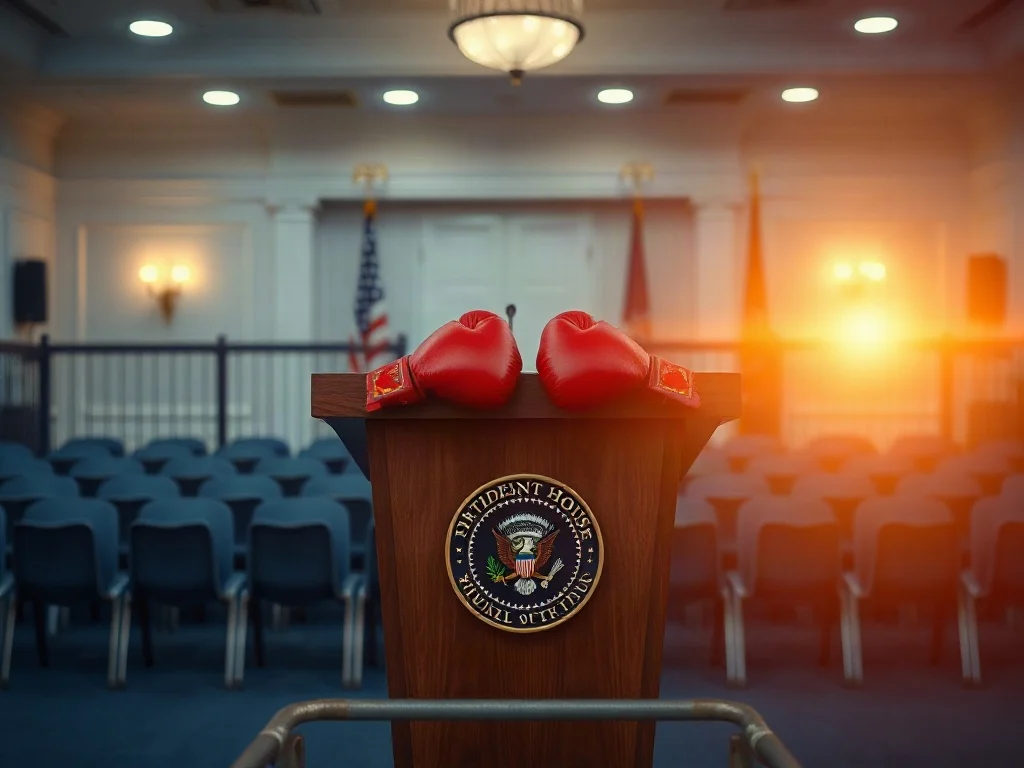
The Dana White press secretary offer is one of the strangest staffing announcements in recent White House history, and it deserves analysis rather than just amusement. According to a Business Insider report, Donald Trump said on Saturday that he had offered the UFC chief executive the job of White House spokesperson, calling him a ‘violent Fighter and Warrior’ and urging him on Truth Social to ‘please take the job.’ This article separates what is confirmed from what is performance. It also looks at what the job requires, why the choice is unusual, and what it could mean for the relationship between the presidency and the press.
What Trump Actually Announced
Per the Business Insider account, Donald Trump posted the offer on Truth Social. He said Dana White should bring along some of his ‘assistants,’ all of them mixed martial artists, ‘even though some are not from our country.’ The stated rationale was that ‘we need these people to defend us against the Lunatic Left.’
Three details matter here:
- The framing is combative, not informational. The post describes the job as defense against opponents, not as communication with the public.
- No formal acceptance has been reported. Neither White nor the White House responded immediately to the outlet’s request for comment.
- White’s own response was ambiguous. He reportedly posted an Instagram story photo of himself behind the briefing room lectern, captioned ‘Onto the next chapter.’ That could be a joke, a tease, or a yes.
The timing is notable. The report says the offer came days after midterm elections in which Democrats took control of both houses of Congress and several key governorships. It also followed a short, chaotic stretch in the press office, discussed below.
What Does a White House Press Secretary Do?
To judge the offer, it helps to understand the job. The White House press secretary is the president’s principal spokesperson. The role is not Senate-confirmed, so the president can fill it with almost anyone.
Core Functions
- Daily messaging: translating policy and presidential statements into usable public language.
- Briefings: taking questions in the James S. Brady Press Briefing Room, where precision matters because errors become headlines.
- Press relations: managing access and relationships with outlets, including members of the White House Correspondents’ Association.
- Internal translation: telling the president how the press will react and keeping the staff aligned.
The Skills That Usually Matter
Past holders such as Sean Spicer, Sarah Huckabee Sanders, Kayleigh McEnany and Jen Psaki came from campaign, party or political communications backgrounds. They had experience with policy detail, hostile questioning and the pace of a news cycle. White’s expertise is different: promotion, spectacle and brand-building. Those are real communication skills, but they are not the same as answering questions under adversarial scrutiny several times a week.
A Press Office in Turmoil
The report places the offer after the departure of Karoline Leavitt. It says Katie Zacharia replaced her and was pushed out five days later, which it describes as the shortest tenure on record. That would beat the 11-day stint of Anthony Scaramucci, who served as communications director rather than press secretary, so the comparison is imperfect. I am relying on the Business Insider account for these details and have not independently verified them.
Assuming the account is accurate, the instability matters analytically. A spokesperson role that turns over in days suggests unclear authority, a mismatch between the president’s expectations and what staff can deliver, or both. Offering the job to a celebrity friend rather than a communications professional would signal that loyalty and public presence now outweigh institutional experience.
Trump and White: A Friendship Built on Spectacle
The relationship is real and long-standing, which makes the offer less random than it first appears. According to the report, it dates to the early 2000s. In the 1990s the Ultimate Fighting Championship had been forced out of Las Vegas for being too violent. Trump, then a casino owner, offered the promotion his Taj Mahal in Atlantic City as a venue. The new owners, Zuffa, had made White president a month before that event. White has said: ‘Nobody took us seriously. Except Donald Trump.’
That origin story explains the loyalty. White has since been a vocal and financial supporter of Trump’s campaigns, and the report notes that Trump hosted a UFC event on the White House lawn in June. For Trump, White is both a longtime ally and a symbol of the culture he wants to be associated with: combat, entertainment and defiance of elite norms.
Why the Dana White Press Secretary Idea Is Risky
The Credibility Problem
A press secretary’s value depends on the press and the public believing that what is said at the podium reflects the administration’s actual position. A spokesperson chosen for combativeness can energize supporters. The same person may struggle to hold the trust of reporters who need to treat the briefing as a reliable source. An adversarial posture can also reduce the information a White House gets out of the press corps, because journalists respond to access and tone.
Conflicts of Interest
White runs the UFC, which operates within a large publicly traded sports and entertainment business, TKO Group Holdings. Federal employment brings ethics and disclosure obligations, and the Hatch Act restricts certain political activity by government employees. I have seen no reporting on whether White would leave his business roles, divest, or serve in some other arrangement. That is the largest unanswered practical question, and it would determine whether the offer can become an appointment at all.
The Staffing Contradiction
Trump’s remark about bringing assistants ‘even though some are not from our country’ sits awkwardly with the administration’s usual political emphasis on immigration. It is a small detail, but it shows that the announcement works as a performance rather than a policy-aware personnel plan. Foreign nationals generally cannot simply be installed in White House posts, and security clearance and employment rules apply. Any realistic version of the plan would look quite different from the post.
Is the Offer Real? Reading the Ambiguity
There are three plausible interpretations, and the evidence cannot yet separate them.
- A serious offer. Trump has a history of unconventional hires and a close bond with White. The briefing-room photo may be a nod of acceptance.
- A media stunt. The all-caps, combat-themed phrasing resembles entertainment promotion, which is White’s own craft. The announcement may be designed to dominate a news cycle after a bad election night.
- A message to the press corps. Even if White never takes the job, the post signals that the White House sees the briefing room as a battleground and wants reporters to believe that.
My assessment, which is interpretation rather than fact, is that the second and third readings are at least as likely as the first. Whatever the intent, the announcement has already done its work by redirecting attention.
What Communications Professionals Should Take From This
For political communicators and press-relations specialists, the episode offers practical lessons:
- Watch formal steps, not posts. An official announcement, a start date, ethics filings and a briefing schedule are the real signals. A social media post alone is not an appointment.
- Track briefing frequency and format. A shift away from regular on-camera briefings would say more about the White House’s press strategy than who stands at the lectern.
- Distinguish performance from process. Treat dramatic personnel announcements as one input, and cross-check them against reporting from several outlets.
- Prepare for tonal change. If the role is filled by a showman, expect more confrontational exchanges and more content built for clips and social platforms than for substantive Q&A.
Frequently Asked Questions
Did Dana White accept the press secretary job?
Not publicly. According to the Business Insider report, neither White nor the White House responded immediately to requests for comment. White posted an Instagram story photo of himself at the briefing room lectern with the caption ‘Onto the next chapter,’ which does not amount to a formal acceptance.
Does the White House press secretary need Senate approval?
No. The position is a presidential appointment that does not require Senate confirmation, which is why the president can fill it quickly and unconventionally.
Why does Trump trust Dana White?
The two have been friends since the early 2000s. Trump hosted one of the UFC’s early events at his Atlantic City casino, and White has supported Trump’s campaigns ever since, both vocally and financially, according to the report.
Could a UFC executive legally serve as press secretary?
Nothing in the available reporting says he could not. Federal ethics and disclosure rules would apply, and his business interests would likely need to be addressed before he could serve.
The Podium Is Not a Cage
The most important insight is that this episode is less about Dana White than about what the briefing room is for. A mixed martial arts event succeeds when the audience is entertained by conflict. A press briefing succeeds when information moves reliably between a government and the public. Trump’s post treats the two as interchangeable, and that conflation is the real story.
Watch for three things next. First, whether an official announcement or a formal start date appears. Second, whether White addresses his business roles and ethics obligations. Third, whether the White House changes how often it holds briefings and in what format. If White does take the job, the likeliest result is more spectacle and less information, followed by a press corps that adapts by relying on other sources.
If he does not, the unanswered question stays: after a press office reportedly lost a spokesperson in five days, who will the administration trust to speak for it? The answer will say more about how the next phase of this presidency intends to talk to the country than any post on Truth Social.
Frequently Asked Questions
¿Es un hecho confirmado que Dana White aceptó el puesto de portavoz de la Casa Blanca?
No. Según el informe citado, ni White ni la Casa Blanca respondieron de inmediato a las solicitudes de comentarios. White publicó en Instagram una foto tras el atril de la sala de prensa con el texto 'Onto the next chapter', que puede ser una broma, una insinuación o una aceptación. Por ahora no hay confirmación formal.
¿Necesita Dana White la aprobación del Senado para ser secretario de prensa?
No. El cargo de secretario de prensa de la Casa Blanca no requiere confirmación del Senado, de modo que el presidente puede nombrar a casi cualquier persona. Por eso una oferta pública a una figura del espectáculo, como el director del UFC, es posible desde el punto de vista institucional, aunque resulte inusual.
¿Qué diferencia a Dana White de anteriores portavoces como Psaki o McEnany?
Los anteriores portavoces procedían de campañas, partidos o comunicación política, con experiencia en detalles de políticas y preguntas hostiles. White destaca en promoción, espectáculo y construcción de marca. Son habilidades reales, pero no equivalen a responder con precisión ante el escrutinio de la prensa varias veces por semana.
¿Por qué la comparación con Anthony Scaramucci es imperfecta?
El informe señala que Katie Zacharia habría estado cinco días en el cargo, un récord de brevedad, frente a los 11 días de Scaramucci. Pero Scaramucci fue director de comunicaciones, no secretario de prensa, así que los cargos no son idénticos. Además, el autor aclara que no verificó estos datos de forma independiente.
¿Qué sugiere la oferta sobre la relación entre la presidencia y la prensa?
Trump describió el puesto como una defensa frente a la 'izquierda lunática', no como una vía para informar al público. Eso apunta a un enfoque combativo y no informativo, donde la lealtad y la presencia pública pesarían más que la experiencia institucional en la comunicación con los periodistas.