
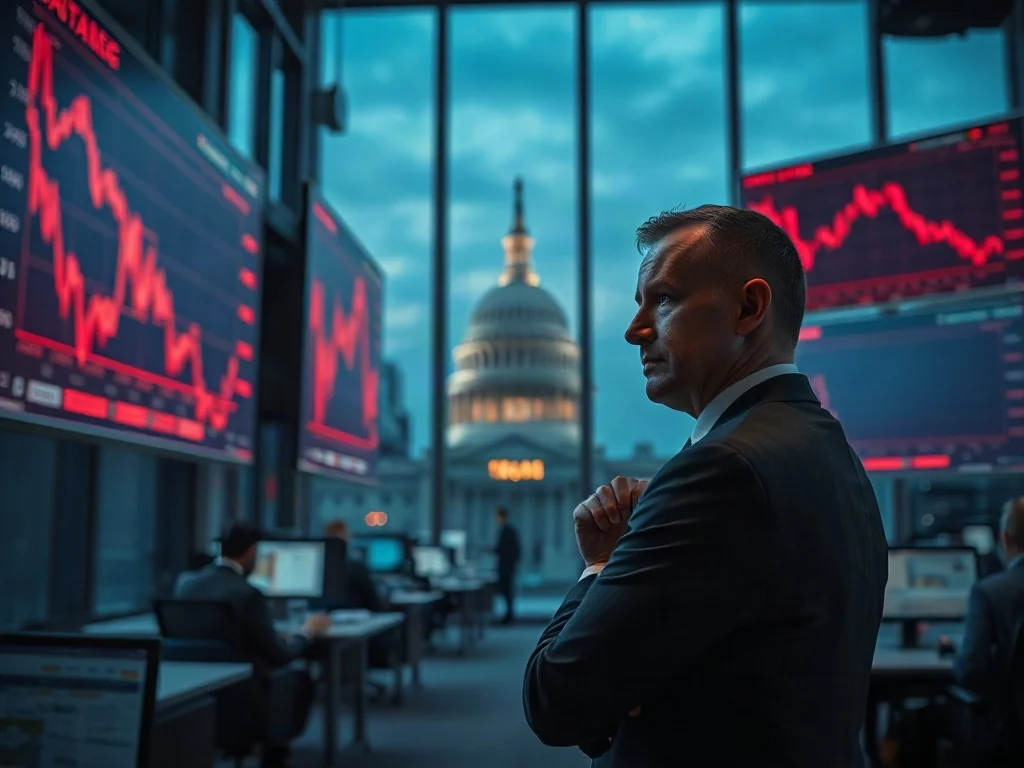
The AI stock selloff that followed the US midterms looks like a simple story: voters spoke, investors feared tighter rules, and shares of artificial intelligence companies fell. The reporting behind that story supports a narrower claim. Fears of more AI regulation appear to have triggered the move, but concerns about the industry have been building for some time. This analysis separates the trigger from the underlying vulnerability, because the difference determines whether the drop is a policy repricing or an early warning about valuations.
One caveat applies throughout. The available reporting does not give a precise decomposition of the selloff, and no one can cleanly attribute a single day’s price action to a single cause. What follows is analysis of mechanisms and plausible explanations, not a verdict.
What the Reporting Establishes, and What It Does Not
The core claim is that political developments around the midterm election prompted investors to reassess the regulatory risk facing AI companies. The second claim is that unease about the sector predates the election. Both can be true at once, and the second matters more.
A market that falls sharply on a political catalyst usually had little cushion to begin with. A sector priced for flawless execution has no room for new uncertainty. In that sense, the election may have been the occasion for the selloff rather than its cause.
Why Elections Move AI Valuations
Regulation as a Hit to Future Cash Flows
The valuation of a growth company is mostly a bet on cash flows years away. Standard valuation logic makes those distant earnings very sensitive to anything that raises costs, delays products, or caps revenue. New regulation can do all three through compliance burdens, liability exposure, testing requirements, and restrictions on data use.
Regulatory risk is not binary. Investors are not pricing the end of AI; they are pricing a modestly higher cost of doing business and a wider range of outcomes. When the range widens, high-multiple stocks, measured by a metric such as the price–earnings ratio, are hit hardest.
Divided Government and the Legislative Signal
Midterms rarely change policy overnight. They change probabilities. A shift in congressional control alters which committees set the agenda, which investigations get launched, and which bills can pass. Under divided government, sweeping legislation is harder to pass, but oversight hearings, subpoenas, and pressure on agencies become easier. For a sector already facing scrutiny over copyright, child safety, energy use, and market concentration, more oversight is a real cost even without new statutes.
The Regulatory Landscape Investors Are Pricing
The US has no comprehensive federal AI statute. Policy has swung between executive actions, voluntary frameworks, and state legislation, and this inconsistency is itself a source of risk.
- Executive action: Executive Order 14110, issued in 2023, set safety-testing and reporting expectations for advanced models. It was rescinded in January 2025, which showed how quickly federal AI policy can reverse.
- Voluntary standards: The NIST AI Risk Management Framework offers guidance but carries no legal force.
- State laws: States have pursued their own AI rules. A proposed moratorium on state AI laws was removed from a 2025 budget bill by the Senate, so the question of federal preemption remains unresolved.
- International pressure: The EU’s Artificial Intelligence Act sets a risk-based regime that multinational firms must follow regardless of US policy.
For investors, the problem is not that regulation is severe today. It is that its direction is unpredictable. A patchwork of state rules, shifting federal priorities, and foreign mandates makes compliance costs hard to model, and markets penalize what they cannot model.
The Concerns That Were Already There
The standfirst’s second clause is the more important one. Several pressures on the sector built up well before the election.
Valuation and Concentration
AI enthusiasm has concentrated gains in a small group of firms, many of them listed on the Nasdaq Composite. Chipmakers such as Nvidia, whose graphics processing units underpin model training, became proxies for the entire theme. Concentration works in both directions: when a handful of stocks carry index performance, a shock to sentiment spreads quickly.
Capital Expenditure Without Proven Returns
The largest technology firms have committed heavily to data center buildouts. This capital expenditure assumes that demand for generative AI will grow fast enough to repay the investment. That is a forecast, not a fact. Revenue from AI products has grown, but whether it will justify the spending is still debated among analysts.
Physical Constraints
Power availability, chip supply, and construction timelines limit how fast capacity can expand. These constraints are less visible than a regulatory headline but can hurt earnings just as much.
Regulation Scare or Bubble Anxiety? Competing Explanations
The debate over the AI stock selloff reduces to a few explanations that are not mutually exclusive.
| Explanation | Core argument | What would support it | Weakness |
|---|---|---|---|
| Regulatory repricing | Investors raised the odds of costly new rules | Losses concentrated in firms with the most policy exposure | Midterms seldom produce fast legislative change |
| Valuation correction | Prices outran fundamentals and needed a trigger | Declines spread to firms with little regulatory exposure | Hard to time; valuations stayed high for long periods |
| Positioning and liquidity | Crowded trades unwound once sentiment turned | Sharp, brief moves with quick partial recovery | Hard to verify without trading-flow data |
The most defensible reading is a combination: stretched valuations created fragility, and the political event supplied a narrative for selling. Comparisons to the dot-com bubble are tempting, but they need care. Today’s leading firms have substantial earnings and cash flow, unlike many of the companies that failed in 2000. Still, history shows that a real technology can coexist with an economic bubble in its stocks. The internet transformed commerce, and many investors still lost heavily.
How Investors and Professionals Should Read the Signal
A single downturn tells you little. A few practical checks help separate noise from information.
- Look at dispersion. If only regulation-sensitive firms fell, the policy story gains weight. If everything with AI exposure fell together, sentiment and positioning are the likelier cause.
- Track concrete policy actions. Committee agendas, agency rulemakings, and state legislation matter more than campaign rhetoric.
- Watch company disclosures. Risk-factor language in filings and commentary on compliance costs show how managements assess exposure.
- Monitor capex guidance and AI revenue. Changes in spending plans reveal how confident the biggest buyers are.
- Measure volatility against fundamentals. A market that swings on headlines is telling you about its fragility, not about the headlines.
Common mistakes include treating an election as a regulatory event, extrapolating one session into a trend, and ignoring the fact that regulation can benefit incumbents. Compliance costs fall hardest on small challengers, so strict rules can entrench the largest firms. The sector is not uniformly harmed by oversight, and some competition law actions could cut against dominant players in particular.
What Could Change Over the Next Few Years
These are reasonable expectations, not confirmed outcomes.
- Regulatory fragmentation will probably persist. Without a federal framework, state and international rules will keep shaping compliance obligations, and the preemption fight is likely to return.
- Scrutiny will broaden beyond safety. Energy consumption, copyright, labor effects, and market power are all active areas of political interest.
- Investors will demand evidence. The market’s patience for spending without matching revenue is finite, and earnings reports will matter more than product demonstrations.
- Regulation may become a differentiator. Firms with strong governance and documented risk management may be valued as safer holdings.
Frequently Asked Questions
Why did AI stocks fall after the midterms?
Reporting suggests investors feared more AI regulation after the election. The same reporting notes that concerns about the industry had been growing for some time, so valuation worries probably amplified the reaction.
How do midterm elections affect AI stocks?
They shift the odds of future legislation, oversight, and investigations. Because AI valuations rely on distant cash flows, even a small increase in regulatory uncertainty can push prices down.
Is the AI stock selloff a sign of a bubble?
Not on its own. A single selloff cannot confirm a bubble. It does show that sentiment is sensitive, which is consistent with high valuations but not proof of overvaluation.
Does more AI regulation always hurt AI companies?
No. Costs fall unevenly, and large incumbents with deep compliance resources can sometimes benefit relative to smaller rivals. The effect depends on how the rules are written.
The Question the Selloff Leaves Open
The most important lesson is that the election did not create the fragility; it exposed it. A sector that can lose value on the mere prospect of regulation is a sector priced for an unusually benign environment, and benign environments rarely last.
The decisive test is not the next political headline. It is whether AI revenue grows fast enough to justify the infrastructure being built on its promise. If it does, regulatory fears will look like a passing discount. If it does not, regulation will be remembered as the excuse rather than the reason. Watch the gap between capital spending and monetization, and watch whether Washington produces actual rules or only rhetoric. That gap will tell you more than any single day’s selloff.
Frequently Asked Questions
Did the midterm elections actually cause the AI stock selloff?
Not necessarily on their own. The reporting suggests fears of more AI regulation triggered the drop, but concerns about the sector had been building for some time. The election may have been the occasion for the selloff rather than its root cause, and no single day's move can be cleanly attributed to one factor.
Why does regulatory risk hit high-valuation AI stocks harder than other shares?
Growth stocks are valued on cash flows expected years from now, so any factor that raises costs, delays products or caps revenue changes their value sharply. Investors are not pricing the end of AI, but a wider range of outcomes, and high price–earnings stocks suffer most when that range widens.
Can a midterm result change AI policy right away?
Rarely. Midterms change probabilities rather than laws. Under divided government, sweeping legislation is harder to pass, but oversight hearings, subpoenas and pressure on agencies become easier. For a sector already under scrutiny, that added oversight can be a real cost even without any new statutes.
Is US AI regulation currently strict?
Not really. The US has no comprehensive federal AI law. Executive Order 14110 was rescinded in January 2025, the NIST framework is voluntary, and state rules vary. The investor concern is less about severity today and more about unpredictable direction, which makes compliance costs difficult to model.
Why does the lack of a federal AI law create risk for investors?
Without one, policy swings between executive actions, voluntary guidelines and state laws. The unresolved question of federal preemption, after a proposed moratorium on state AI laws was removed from a 2025 budget bill, leaves a patchwork. Markets tend to penalize costs and rules they cannot model.
Does the EU AI Act matter to US-listed AI companies?
Yes. The EU's Artificial Intelligence Act sets a risk-based regime that multinational firms must follow regardless of US policy. It adds another layer of compliance obligations, so US companies operating in Europe face regulatory costs that Washington's decisions alone cannot remove.