
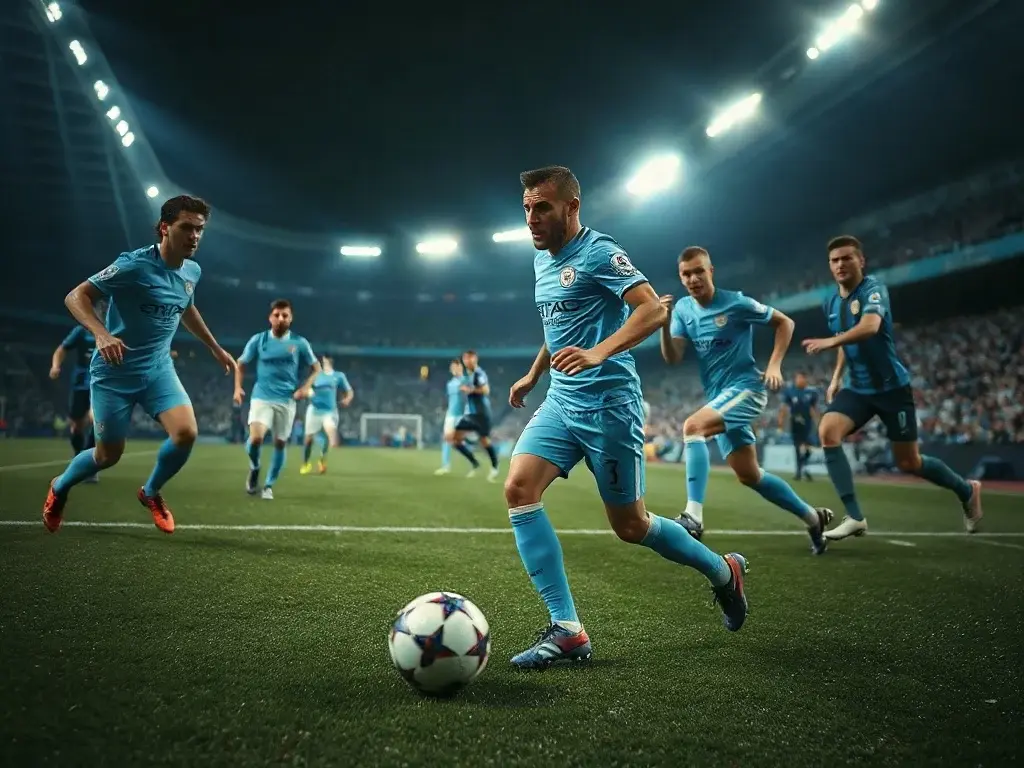
The Man City Napoli draw in the UEFA Champions League has revived a question that used to be unthinkable: is the most fluent passing side of the last decade losing its rhythm? The match was described as laborious, and the phrase ‘pass, pass, slow, slow’ captures the complaint. Manchester City still have the ball, but it no longer seems to move with the speed and menace that overwhelmed opponents for years. This analysis looks at what that slowdown means, which explanations are credible, and what to watch next. Where the evidence is thin, it says so rather than guessing.
What the Man City Napoli draw actually showed
The central criticism is about tempo, not possession. City have rarely struggled to dominate the ball under Pep Guardiola. What made them exceptional was how quickly circulation turned into penetration. Passes arrived at the right moment, and the opposition shape was stretched until a gap opened.
A sluggish version of the same approach looks different. Passes go sideways or backwards, and the ball is recycled without forcing defenders to commit. Opponents then have time to reset their lines and hold a compact shape. A draw against a well-organised Italian side fits that pattern, but a single result does not prove a trend. The sensible reading is that the Napoli game is a symptom to investigate, not a verdict.
Possession versus progression
Pundits often treat possession as a proxy for control. Analysts increasingly separate it from ball progression, meaning how quickly and how far a team advances the ball into dangerous zones. A team can hold 65 per cent of possession and still create little if most of it happens in front of a deep defensive block. Metrics such as expected goals help show whether territorial dominance is producing real chances. The Napoli game should be judged on chance quality, not on possession alone.
The Guardiola system and why tempo matters
Guardiola’s style is rooted in positional play and has often been compared to tiki-taka, although he has long distanced himself from that label. In his best City teams, tempo was a weapon. The ball moved quickly enough that defenders could not shift their weight in time. Players occupied specific zones so that a pass into the half-space always had an option behind it.
The system depends on three conditions:
- Fast circulation: short, sharp passing that pulls defenders out of position.
- Structural balance: enough players behind the ball to win it back immediately, in the manner of gegenpressing.
- Individual excellence: players who can receive under pressure and play forward with one touch.
If any of the three weakens, the whole structure becomes slower and easier to defend. That is why a ‘slick machine’ can look so different after relatively small changes.
Is this a Man City slow passing problem or a personnel problem?
There are several competing explanations for City’s reported slowdown. They are not mutually exclusive.
The loss of key midfield control
Rodri won the Ballon d’Or in 2024 and then suffered a serious knee problem, which was widely reported as an anterior cruciate ligament injury. A holding midfielder of his quality does more than defend. He sets the tempo, recognises when to speed up or slow down, and protects the team from counter-attacks. When a player like that is absent or still regaining form, teams often become more cautious in possession.
The departure of a creative engine
Kevin De Bruyne left City in 2025 and joined Napoli, so the opposition at the Etihad Stadium included the man who spent a decade supplying City’s most incisive passes. That adds narrative colour, but it also points to a real tactical issue. Few players can reliably play the vertical, defence-splitting pass that turns patient possession into a clear chance. When that quality is missing, circulation can stall in front of a compact block.
Ageing cycles and squad transition
Dominant teams eventually go through transition. A squad that won four consecutive Premier League titles between 2021 and 2024 carries accumulated wear, and replacing leaders is difficult. New signings need time to learn a demanding positional system. During that period, players may choose the safe pass over the risky one, and the safe pass is usually the slower one.
Opponents have learned the solution
City’s methods have been studied for years. Many opponents now defend in a deep, narrow block, concede the wide areas and wait for a mistake. Coaches such as Antonio Conte, who manages Napoli, are known for building disciplined, physically demanding defensive structures. Against that kind of setup, a team that does not accelerate the ball can look ponderous even when it is doing everything ‘correctly’.
The attacking questions around Haaland and the wide players
A slower build-up affects the forwards directly. Erling Haaland thrives on quick service, clean cut-backs and balls played into space behind the defence. When circulation is laboured, he receives fewer high-quality passes, and defenders can concentrate on him. The same applies to creators such as Phil Foden and Bernardo Silva, who need space and tempo to operate between the lines.
Wide dribblers such as Jérémy Doku offer a different solution. They can disrupt a settled defence through one-on-one ability rather than structured passing. The tension between a controlled system and individual unpredictability is one of the most interesting tactical questions at the club.
What are the risks if the slowdown continues?
The consequences differ by competition. In the Premier League, a team can often grind out results through quality alone. In the Champions League, the margins are narrower and the opposition tends to be better organised and more clinical. The league-phase format also means that dropped points can complicate qualification and increase the chance of a harder knockout route. The official UEFA website publishes the standings and fixtures for anyone tracking the maths.
There is also a psychological risk. Teams built on rhythm can become hesitant when it breaks. Players start to doubt the pass they would once have played automatically, and the hesitation feeds the slowness the team is trying to escape.
How City can restore tempo: practical solutions
Based on how elite teams usually respond to this kind of problem, several adjustments are plausible. These are analytical suggestions, not reported club plans.
- Raise the speed of the first pass. Quicker circulation in the first phase forces the opposition to move earlier and creates gaps.
- Use more direct passes into the forwards. Playing earlier into a striker’s feet breaks a compact block more effectively than lateral passing.
- Rotate positions more aggressively. Interchanges between midfielders and wide players make marking harder.
- Protect the counter-pressing structure. If risks are taken, enough players must stay behind the ball to win possession back quickly.
- Manage the workload of key players. Rhythm often suffers when leaders are overplayed or returning from injury.
Common mistakes to avoid
One common error is overreacting to a single match. Another is assuming that more possession equals more control. A third is abandoning the system entirely when a few adjustments might be enough. Guardiola has changed his approach before, and his record suggests he is willing to adapt when necessary.
Frequently asked questions about City’s form
What is wrong with Man City right now?
There is no single cause. Commentary points to slower tempo in possession, the loss of key creative and midfield control, squad transition and opponents defending deeper. The relative weight of each factor is open to debate.
Why is Man City playing so slowly?
Slow circulation usually means players are choosing safe passes because the forward options are covered. Missing leaders, new teammates and compact opposition blocks all encourage that behaviour.
Is Guardiola’s system outdated?
There is no strong evidence that it is. His style has been influential for over a decade, and the underlying principles remain sound. What may have changed is the quality of execution and the way opponents defend against it.
Can Man City still win the Champions League?
Yes, but it is far from guaranteed. City have experience of winning the competition and the squad has high-level talent, yet the knockout stages punish inconsistency. Improvement in tempo and chance creation will be decisive.
The real test is whether City can find another gear
The most important insight is that City’s problem may be less about possession than about acceleration. The team that dominated English football did so because it could change speed, calmly circulating the ball and then striking in seconds. A side that keeps the first gear but loses the second becomes predictable, even if it still wins the statistics.
Several things deserve attention in the coming weeks. Watch how often City play forward passes into the final third within a few touches. Watch whether midfield control stabilises as key players regain fitness and new signings settle. Watch whether Guardiola alters the structure or simply trusts the process. Chance quality in the Champions League will be a more reliable guide than the scoreline.
A reasonable prediction is that City will adapt, as they have in previous seasons, but that adaptation may mean a different kind of team from the one that won the treble. The unanswered question is whether a coach who built an era around control can embrace a little more chaos, and whether this squad has the players to make that work.