
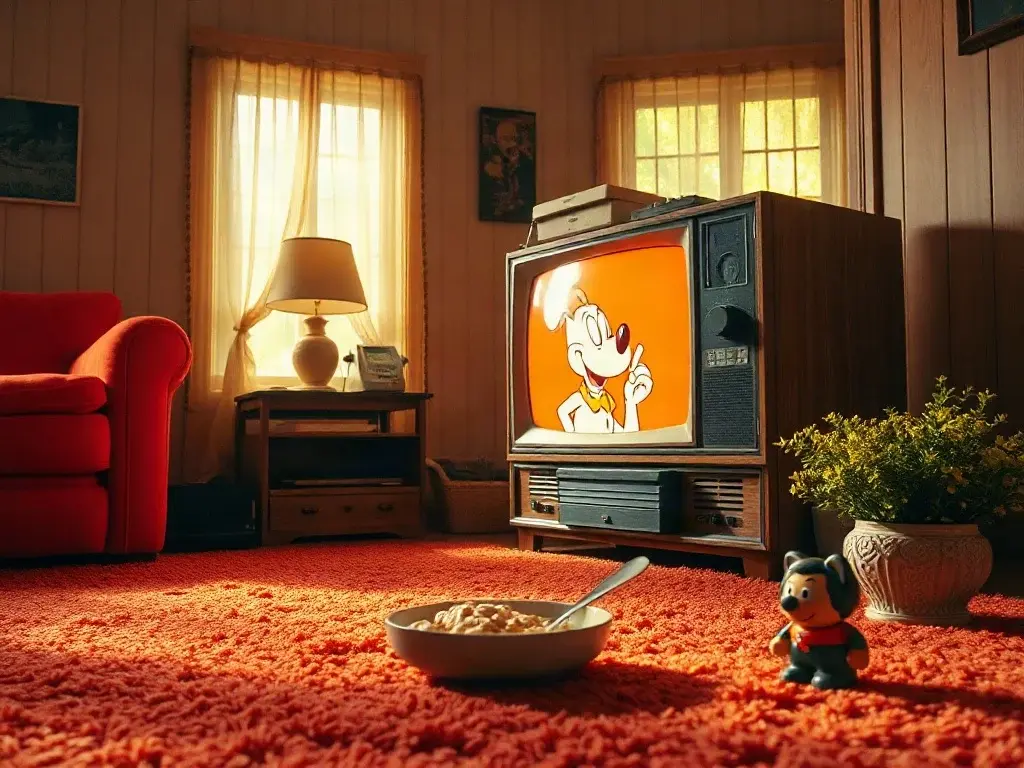
Not every animated series from the decade holds up, and that is the useful starting point for anyone revisiting 1970s cartoons. The decade produced a great deal of disposable, assembly-line television, along with a smaller group of series whose design, writing, and ambition still work on a modern screen. A recent roundup argues that ten of these series remain worth watching. This article does not simply repeat such a list. It explains why some seventies animated series survive and others do not, so you can judge any recommendation for yourself.
Why Most 1970s Cartoons Don’t Age Well
The weak spots of 1970s animation come from economics, not a lack of talent. The Saturday-morning cartoon block was a cheap, high-volume product. American studios such as Hanna-Barbera, Filmation, and DePatie–Freleng Enterprises relied heavily on limited animation. That meant recycled backgrounds, repeated movement cycles, and characters who moved only the parts of the body that had to move.
Two other pressures shaped the output. Advocacy groups such as Action for Children’s Television campaigned against violence and commercialism in children’s programming. Networks responded by softening conflict and adding prosocial messages, which often made the writing toothless. Many shows also used a laugh track, which now reads as an instruction to laugh at jokes that were not funny enough to earn it.
The formula problem
Formula is the main reason the decade’s weaker series feel interchangeable today. A team of teenagers, a talking animal, a chase, and a tidy resolution worked as a production template, and it was reused until the characters lost distinct personalities. A series survives when it either transcends that template or bends it in an interesting way.
A Practical Test for Cartoons That Still Hold Up
Nostalgia is an unreliable guide because it rewards familiarity, not quality. A more rigorous test asks four questions:
- Is the visual design distinctive? Strong character silhouettes and confident color choices outlast animation budgets.
- Do the characters have recognizable motivations? Personality that drives the plot ages better than catchphrases.
- Does the show respect its audience? Series that avoid talking down to children remain watchable for adults.
- Is the premise adaptable? Concepts that can be remixed, as the mystery-solving format has been repeatedly, stay culturally alive.
Applying this test sorts the decade quickly. Plenty of shows pass one criterion. Very few pass all four.
The Best 1970s Cartoons: Titles That Earn Their Reputation
Which series count as the best 1970s cartoons is partly subjective, but a handful recur in serious discussion for defensible reasons. The table below compares several well-documented examples, with my own assessment of why each endures. These picks are mine, not a reproduction of any published ranking.
| Series | Debut | Origin | Why it endures |
|---|---|---|---|
| Scooby-Doo, Where Are You! | 1969 (dominant through the 1970s) | Hanna-Barbera, US | Durable mystery structure and ensemble chemistry |
| Schoolhouse Rock! | 1973 | ABC, US | Music-driven education that respects its audience |
| Super Friends | 1973 | Hanna-Barbera, US | Early mainstream presentation of a shared superhero universe |
| Hong Kong Phooey | 1974 | Hanna-Barbera, US | Parody of martial-arts and detective tropes with a bumbling hero |
| Heidi, Girl of the Alps | 1974 | Japan | Patient, naturalistic storytelling and detailed settings |
| Mobile Suit Gundam | 1979 | Sunrise, Japan | War drama that treated giant robots as military hardware |
Scooby-Doo and the durability of structure
Scooby-Doo is technically a 1969 premiere, but its 1970s incarnations, including the celebrity-guest format of The New Scooby-Doo Movies, defined its cultural footprint. The show endures because its core joke is structural. The supernatural is always explained away, so the protagonists are skeptics who are periodically terrified. That tension is easy to read, easy to parody, and hard to ruin.
Schoolhouse Rock! as an outlier
Schoolhouse Rock! may be the most unambiguous success of the decade because it was short, musical, and uncompromising about craft. It proved that educational content did not need to be condescending, and its songs are still widely remembered.
Fat Albert and the problem of context
Fat Albert and the Cosby Kids shows how a series can hold up artistically while becoming harder to recommend. It debuted in 1972 and stood out for its urban setting and its moral-of-the-week storytelling. Its creator and host, Bill Cosby, was later convicted of sexual assault, a conviction overturned in 2021 on procedural grounds. Many viewers now find the show inseparable from that history. A fair assessment keeps the work and its creator’s legacy in view at the same time.
Japanese Imports and the Long View
The most significant shift of the decade happened outside the American Saturday-morning ecosystem. Japanese television anime was developing richer serialized storytelling, and several landmark works from the 1970s have aged better than their American contemporaries.
- Mazinger Z (1972) established conventions of the mecha genre, including a pilot entering a giant robot.
- Lupin the Third (1971) pairs a gentleman-thief premise with a jazz-inflected, adult sensibility.
- Space Battleship Yamato (1974) brought a serialized, high-stakes space epic to television.
- Heidi, Girl of the Alps was directed by Isao Takahata, with Hayao Miyazaki among its key creative contributors, which explains why it looks and feels more patient than most Western children’s television of the period.
Western audiences often met these works in altered form. Battle of the Planets (1978) was a heavily re-edited American adaptation of the Japanese series Science Ninja Team Gatchaman, with content changes made for US broadcast. If you want to evaluate such a show, seek out the original version, not the localized one.
Why Are 1970s Cartoons Still Popular?
The question of why 1970s cartoons are still popular has three overlapping answers, and they should not be conflated.
Nostalgia and generational memory
Viewers who grew up with Saturday-morning television associate it with weekends and childhood routine. This is real, but it explains attachment, not quality.
Distribution and rediscovery
Streaming services and classic-television channels have made decades-old series easy to sample. A show that once required waiting for a rerun can now be judged in a single evening, and weak series are exposed quickly.
Design and craft
The strongest explanation is aesthetic. Limited budgets forced designers to rely on bold shapes, clear character types, and memorable music. Those constraints produced a visual shorthand that modern creators continue to reference and revisit. Nostalgia sustains the audience, but craft gives it a reason to stay.
How to Watch Classic Seventies Cartoons Wisely
Revisiting classic Saturday-morning cartoons works better with a few ground rules.
- Sample, don’t binge. Repetitive structure is tolerable in single episodes and punishing in marathons.
- Start with a pilot or a well-regarded early episode. Many series are strongest before formula takes over.
- Check which version you are watching. Edited broadcasts, dubbed adaptations, and remastered releases can differ in content, pacing, and picture quality.
- Read the era in context. Some portrayals of gender, race, and violence reflect period attitudes and censorship rules. Context helps without excusing.
- Compare across traditions. Watching an American series next to a Japanese one from the same year shows how differently each system handled storytelling.
Common mistakes
The most common mistake is trusting memory over evidence. Childhood favorites are often far weaker than recalled, while forgotten series are sometimes better. A second error is treating every older cartoon as equally sophisticated or equally primitive. The decade was uneven, and a critical eye is more useful than a sentimental one.
Frequently Asked Questions
Which 1970s cartoons hold up best today?
Series with strong structure, distinctive design, and respect for their audience tend to hold up. Schoolhouse Rock!, Scooby-Doo in its early form, and several Japanese works such as Lupin the Third and Mobile Suit Gundam are frequently cited for those reasons.
Why did 1970s cartoons look so limited?
Television budgets were small and output was high, so studios used limited animation to cut costs. Reused movements and simplified designs let a studio produce many episodes quickly.
Are 1970s cartoons appropriate for children now?
It depends on the series. Many are mild, but some contain dated stereotypes or slapstick violence. Previewing an episode before sharing it with younger viewers is a sensible approach.
Where can I watch classic 1970s cartoons?
Availability changes often by region and platform. Check current streaming catalogs, official studio channels, and licensed physical releases, which often offer better picture quality than informal uploads.
What the Next Wave of Rediscovery Will Reveal
The most important insight from this decade of animation is that survival is not random. The cartoons that endure are those that solved a creative problem under severe constraints: a clever structure, a memorable sound, a confident design, or a serious dramatic premise. The ones that fail were usually efficient but empty.
Watch the restoration and licensing side of the market next. As rights holders digitize older film elements and release cleaner editions, viewers will be able to compare the original productions with the heavily edited versions many people first saw. My own prediction, which is an interpretation and not a certainty, is that this will raise the standing of Japanese serialized works and of the American shows that took formal risks, while exposing the weakest formula series. The unresolved question is whether audiences will keep returning to these shows for their craft once the generation that remembers them from childhood is gone. If they do, the decade’s best work has earned a lasting place beyond nostalgia.
Frequently Asked Questions
¿Por qué muchos dibujos animados de los años 70 se ven tan repetitivos hoy?
Se debe sobre todo a la economía de producción. Estudios como Hanna-Barbera o Filmation usaban animación limitada, con fondos reciclados y ciclos de movimiento repetidos. A eso se sumó una fórmula fija de adolescentes, animal parlante y persecución que se reutilizó hasta que los personajes perdieron personalidad propia.
¿Influyeron los grupos de defensa infantil en la calidad de las series de los 70?
Sí. Organizaciones como Action for Children's Television criticaron la violencia y el comercialismo en la programación infantil. Las cadenas respondieron suavizando los conflictos y añadiendo mensajes prosociales, lo que a menudo dejó guiones sin mordiente y con poco riesgo, algo que hoy se nota al revisarlas.
¿Cómo puedo saber si una serie antigua merece verse sin dejarme llevar por la nostalgia?
El artículo propone un test de cuatro preguntas: si el diseño visual es distintivo, si los personajes tienen motivaciones reconocibles, si la serie respeta a su audiencia y si la premisa es adaptable. Muchas series cumplen un criterio, pero muy pocas superan los cuatro, y eso permite filtrar con rigor.
¿Por qué se incluye Scooby-Doo si se estrenó en 1969?
Aunque debutó en 1969, sus versiones de los años 70, como The New Scooby-Doo Movies con invitados famosos, definieron su huella cultural. Además, su estructura resiste el paso del tiempo: lo sobrenatural siempre se explica, así que los protagonistas son escépticos que a veces se aterrorizan, una tensión fácil de parodiar.
¿Son las recomendaciones del artículo un ranking oficial de los mejores dibujos de los 70?
No. El autor aclara que la tabla refleja su propia valoración y no reproduce ninguna lista publicada. Admite que decidir cuáles son los mejores es en parte subjetivo, aunque las series elegidas aparecen con frecuencia en debates serios, y ofrece criterios para que cada lector juzgue por sí mismo.
¿Solo las series estadounidenses de los 70 siguen siendo dignas de verse?
No. La tabla incluye producciones japonesas como Heidi, la niña de los Alpes, valorada por su narración paciente y sus escenarios detallados, y Mobile Suit Gundam, que trató a los robots gigantes como material militar dentro de un drama bélico. Ambas muestran enfoques distintos al de la fórmula de Saturday morning.