
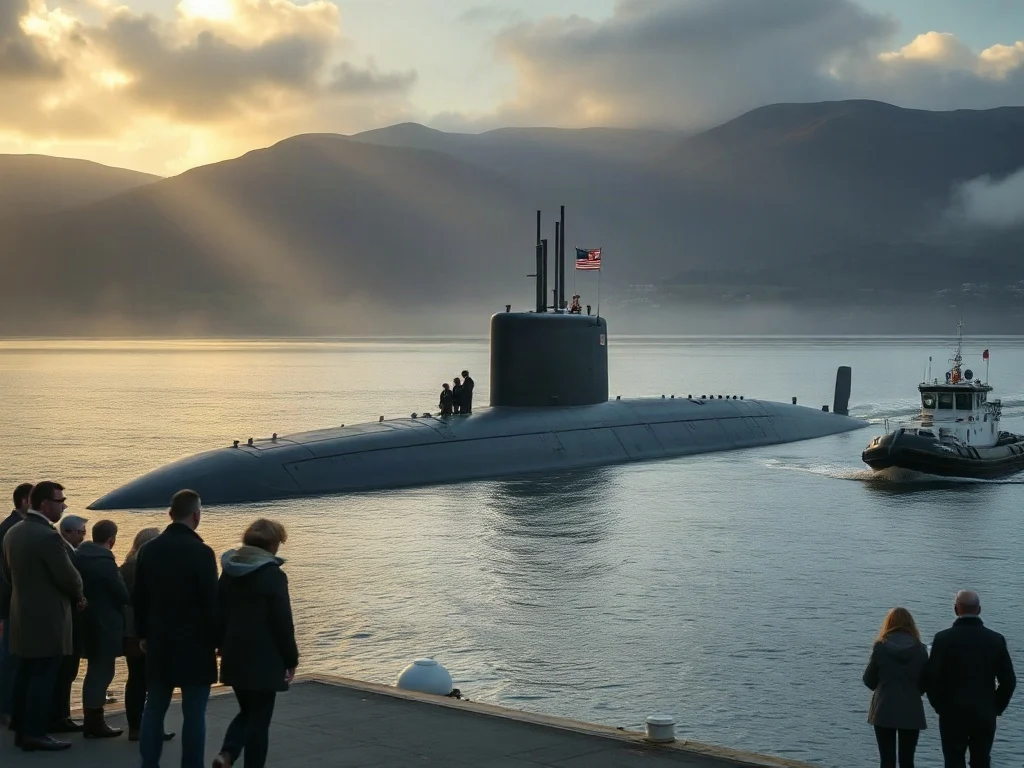
A Trident submarine patrol is normally invisible by design, which is why the return of a Royal Navy boat after a record-breaking deployment drew attention. Defence Secretary Wes Streeting was at HM Naval Base Clyde to welcome the crew home after what was reported as the longest deployment at sea ever completed by a British vessel. This article does not simply repeat the headline. It treats the patrol as a process, from preparation to the moment the boat is alongside again, and explains what a record patrol tells us about the readiness, strain and future of the UK’s nuclear deterrent.
The public announcement gave few operational details, and for good reason. The name of the boat and the exact duration should be confirmed against the official Ministry of Defence statement. What can be explained with confidence is how these patrols work, why length matters and what pressures sit behind the milestone.
What a Trident Submarine Patrol Actually Is
Britain’s nuclear deterrent rests on the Trident nuclear programme. It combines the Vanguard-class submarine fleet, Trident II D5 missiles and the UK’s own warheads. Each boat is a ballistic missile submarine powered by nuclear marine propulsion. That means its endurance is limited by food, maintenance and people rather than fuel.
The operation that keeps one boat at sea at all times is known as continuous at-sea deterrence (CASD). It has run without interruption since 1969, when the Royal Navy took over the nuclear mission under the Polaris Sales Agreement. The logic is rooted in deterrence theory. A submarine that cannot be found cannot be destroyed in a first strike, so any adversary must assume a retaliatory capability always exists.
How Does Continuous At-Sea Deterrence Work? A Step-by-Step Process
Understanding the record requires understanding the cycle. Each stage is a point where a patrol can be shortened, extended or disrupted.
Stage 1: Preparation and Load-Out
Before departure, the boat completes maintenance, certification and stores loading. Provisioning is a logistical exercise in its own right. The submarine must carry food for the whole crew for the planned patrol plus a margin for extension. Reserve capacity is the first factor that makes a longer patrol possible.
Stage 2: Departure and Transit
The submarine leaves the Clyde submerged at the first practical opportunity. It then moves into deeper water and begins to “go quiet”, reducing acoustic and electromagnetic signatures. The aim is to leave no pattern that an adversary’s sensors can exploit. The Royal Navy Submarine Service treats this stage as a defining skill of the force.
Stage 3: Patrol on Station
For most of the deployment the boat is in what is effectively a held state of readiness. It maintains a secure communications link, holds a stable depth and speed profile and runs engineering routines. Crews live without regular outside contact. Welfare policy, mail systems that allow only limited inbound messages and strict routines all matter here. The patrol’s length is limited less by the machinery than by endurance of the people aboard.
Stage 4: Relief and Return
Another boat sails to take over the mission, which keeps CASD unbroken. The returning submarine comes home, and the Vanguard-class crew rotation system, with separate Port and Starboard crews, then takes effect. One crew steps off while the other prepares for the next cycle. The boat itself goes into maintenance.
Why the Record-Breaking Length Matters
Patrols have traditionally been described as lasting around three months, although the Navy has long said that duration depends on operational needs. A significantly longer deployment is therefore not just a bragging right. It shows several things at once.
- Engineering reliability: The reactor, propulsion plant, air-purification systems and hull systems ran without a forced early return.
- Logistical depth: The boat was stocked and supported well enough to extend the mission.
- Human resilience: The crew, of roughly 130 people on a boat of this class, sustained performance over an exceptional period.
- Operational flexibility: Planners can lengthen a patrol when a relief boat or the maintenance schedule requires it.
There is a less comfortable reading too. Longer patrols can reflect pressure on a stretched, ageing fleet. The Vanguard-class entered service in the 1990s with a design life that has since been extended. When refit schedules slip or availability tightens, extending patrols is one of the few levers available. An expert reading should treat the record as both a capability signal and a possible stress indicator. The announcement alone cannot tell us which weighs more.
The Human Side of the Longest Deployment at Sea
The most underappreciated part of any longest Royal Navy submarine deployment is the personal cost. Crew members are away from family for months, with minimal communication and no certainty about when they will return. Medical care, mental health support and strict shipboard routines are as important as engineering.
The ministerial welcome at the base serves a practical purpose as well as a ceremonial one. It acknowledges a workforce whose service is largely unseen and unrecognised by the public. Retention is a serious concern for the Submarine Service, because specialist nuclear-trained personnel take years to train and cannot easily be replaced. Visible recognition, along with pay, housing and career support, forms part of the retention equation.
The Strategic and Political Context
The Replacement Programme
The Dreadnought-class submarine is being built by BAE Systems at Barrow-in-Furness to replace the Vanguard class. The first boat is expected to enter service in the early 2030s, which means the Vanguard fleet must keep delivering until then. That is the central context for the record patrol. Any Vanguard-class submarine replacement timetable that slips would raise the burden on the older boats.
Nuclear Policy and Deterrence Commitments
The UK’s 2021 Integrated Review announced a rise in the cap on the overall nuclear warhead stockpile to 260, reversing a long-standing policy of reduction. Britain remains a nuclear-weapon state under the Treaty on the Non-Proliferation of Nuclear Weapons, and it commits its deterrent to NATO defence. Submarine capacity is also tied to wider industrial and allied programmes such as AUKUS, which competes for the same skilled workforce and shipyard capacity.
Critics and Supporters
Supporters argue that a continuous deterrent is a stable insurance policy in a more dangerous security environment. Critics, including the Campaign for Nuclear Disarmament, argue that the programme is costly, morally problematic and based in Scotland against the wishes of many Scottish politicians. Both camps can point to a record patrol as evidence. One sees proof of competence, the other a reminder of the scale of an enduring commitment. Because the deployment details are classified, the public debate usually has to work from limited information.
Risks, Limitations and Edge Cases
- Single points of failure: CASD depends on the availability of a small fleet. A delay in one boat’s maintenance affects the whole cycle.
- Missile reliability: Trident II D5 test launches are rare. A 2024 test from HMS Vanguard was reported to have malfunctioned, a reminder that confidence rests on the wider US-UK missile pool and testing record rather than frequent firing.
- Detection technology: Advances in sensing, data processing and uncrewed systems may in time make stealth harder to maintain. Experts disagree on how quickly this could happen. Predictions of an “transparent ocean” remain contested rather than established.
- Workforce strain: Longer patrols can raise fatigue and retention risks if they become routine instead of exceptional.
What Readers Should Monitor
Anyone trying to judge the significance of this event should look past the headline to four indicators:
- Official statements from the Ministry of Defence and the Royal Navy on patrol length and boat availability.
- Progress reports from the National Audit Office and Parliament’s Defence Committee on the Dreadnought programme.
- Submarine Service retention and recruitment data.
- The maintenance and refit schedule at the Clyde and Devonport.
Frequently Asked Questions
How long do Trident submarines stay at sea?
Patrols have traditionally been described as lasting around three months, but the length depends on operational and maintenance requirements. The reported record shows that a boat can remain deployed for far longer when required.
Where are Britain’s Trident submarines based?
The Vanguard-class boats are based at HM Naval Base Clyde, at Faslane on the Gare Loch in Scotland, which is also the base welcoming the returning crew.
How does continuous at-sea deterrence work?
One nuclear-armed submarine is always on patrol, undetected and ready. Relief boats and rotating crews maintain the cycle without a gap, as has been the case since 1969.
Will Dreadnought-class submarines replace the Vanguard class?
Yes. Four Dreadnought-class boats are under construction, with the first expected in the early 2030s, though timelines on such complex programmes can change.
What the Record Patrol Tells Us About the Next Decade
The most important insight from this event is that endurance has become a strategic variable. The Vanguard-class boats are proving they can do more than their original planners may have expected, but each extension draws on a margin that cannot be extended forever. The record is evidence of capability today and, quietly, a measure of how much pressure rests on the fleet before Dreadnought arrives.
Watch the schedule, not the ceremony. If the first Dreadnought boat keeps to its timetable and Vanguard maintenance runs smoothly, long patrols will remain a demonstration of strength. If either slips, the next record may be a warning disguised as a triumph. The unanswered question is whether Britain can sustain both an uninterrupted deterrent and the industrial base to renew it, while competing demands from AUKUS and conventional defence grow.
Frequently Asked Questions
Why does the length of a Trident submarine patrol depend more on the crew than on the machinery?
Because the boat is nuclear powered, fuel is not the limiting factor. Endurance is set by the food carried, the maintenance the systems can sustain and the wellbeing of the crew, who live with little outside contact and strict routines for the whole deployment.
What is continuous at-sea deterrence and how long has it been running?
Continuous at-sea deterrence (CASD) means that one British ballistic missile submarine is always on patrol. It has run without interruption since 1969, when the Royal Navy took over the nuclear mission. Because the boat cannot be located, any adversary must assume that a retaliatory strike is always possible.
Does a record-long patrol mean the submarine was at risk or in trouble?
Not necessarily. A longer patrol suggests the reactor, propulsion, air-purification and hull systems worked without a forced early return, and that stores and support were sufficient. The article presents it as evidence of reliability and logistical depth, although the exact figures should be checked against the official Ministry of Defence statement.
How does the Royal Navy keep a submarine at sea if one boat returns home?
Another boat sails to relieve the returning one, so the mission is never broken. The returning submarine then goes into maintenance, while the Vanguard-class system of separate Port and Starboard crews lets one crew step off as the other prepares for the next cycle.
Why were so few details released about the record deployment?
Trident patrols are invisible by design, and publishing the boat's name, exact timings or operational details could help an adversary build a pattern. Only limited information is normally released, so readers should rely on the official Ministry of Defence statement for confirmed facts.
How long is a normal Trident patrol, and why can it change?
Patrols have traditionally been described as lasting around three months. The Navy has long said that the duration depends on operational needs rather than a fixed rule, which is why an extension is possible if the boat carries enough reserve provisions and is in good condition.