
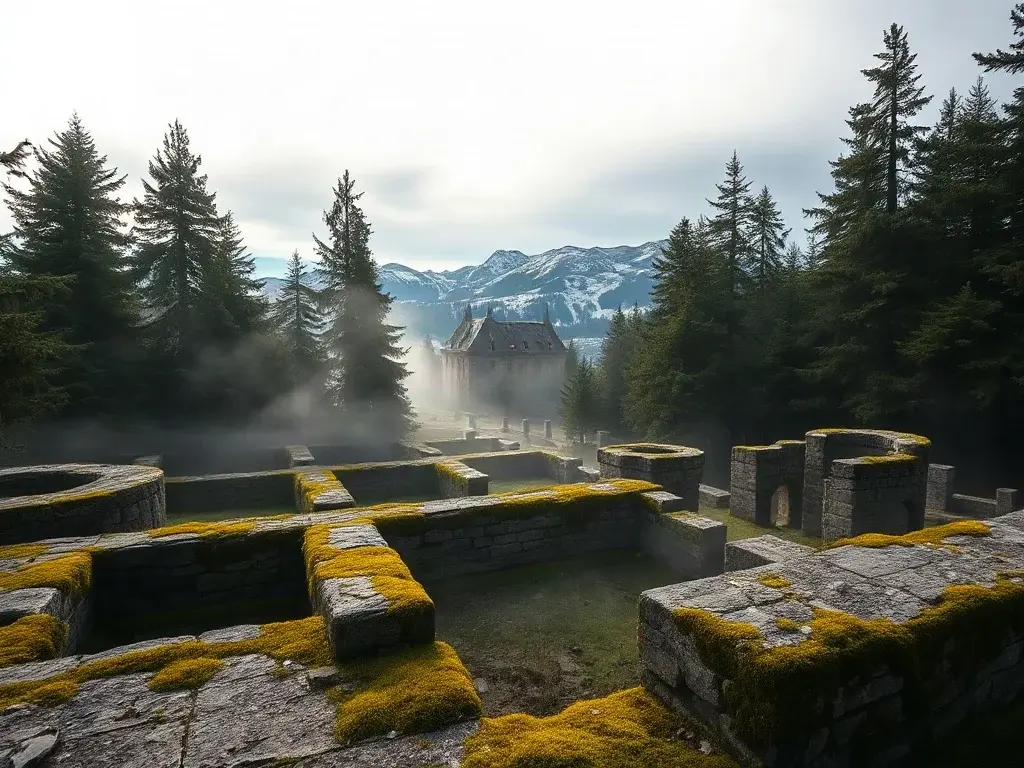
Hitler’s Eagle’s Nest is one of the most misunderstood sites of the Nazi era, and the current German argument over its fate shows why. Recent coverage describes a split between those who want parts of the destroyed Obersalzberg retreat rebuilt and those who want the site abandoned and its Nazi past allowed to fade. That framing needs correcting at the outset. The Kehlsteinhaus, the mountaintop building known in English as the Eagle’s Nest, still stands. What was destroyed was Hitler’s actual residence below it, the Berghof. This analysis separates the two, examines each position, and asks which approach holds up under scrutiny.
What Happened to Hitler’s Eagle’s Nest and the Berghof?
The question is less simple than it looks, because popular usage merges two different places on the Obersalzberg, above the Bavarian town of Berchtesgaden.
The Kehlsteinhaus: survived, commercialized
The Kehlsteinhaus was built in 1937 and 1938 on a summit at roughly 1,800 metres. It was a diplomatic and ceremonial lodge, commissioned through Martin Bormann and presented to Adolf Hitler as a gift. Historians generally note that Hitler used it sparingly, partly because he disliked the altitude. Its survival was almost accidental, as Allied bombers focused on the lower complex. Today it is a seasonal mountain restaurant reached by a dedicated road and a brass-lined lift, and it is a major tourist draw.
The Berghof: bombed, burned, demolished
The Berghof was Hitler’s real mountain residence. It grew from a modest chalet into a heavily guarded compound in the 1930s. It was where he received foreign leaders, and where much of the regime’s day-to-day political theatre was staged. On 25 April 1945 the Royal Air Force bombed the area, and retreating SS units set further fires. The Bavarian authorities removed the remaining ruins in 1952. Forest now covers much of the footprint, and only fragments are visible.
The core problem is that the building most people want to talk about is gone, while the building tourists can visit was always peripheral to Hitler’s daily life.
Why the Obersalzberg Nazi History Still Matters
The Obersalzberg was a secondary seat of power. After 1933 the regime seized private property across the district, expelled residents, and built a closed zone for the leadership. Hermann Göring and Bormann built residences there, and Albert Speer worked there. Decisions of national consequence were made, or staged, in these rooms. The site matters because it shows how Nazi Germany fused leader worship, dispossession, and architecture into one landscape.
This is also why the place resists neutral treatment. A ruined bunker can be read as a warning or as a relic. The same stones can serve a classroom or a pilgrimage, depending on who frames them and who arrives.
The Case for Rebuilding: Three Arguments
Proposals to rebuild some part of the complex are provocative, but the arguments behind them deserve a fair hearing.
- Historical legibility. Advocates argue that visitors cannot understand the scale of the compound from empty forest. A partial reconstruction or marked outline would, in this view, make the geography of power concrete.
- Precedent from other reconstructions. Germany has rebuilt historic structures before, such as the Frauenkirche in Dresden and the Berlin Palace, now home to the Humboldt Forum. Supporters ask why a site of perpetrator history should be treated differently.
- Controlled interpretation. If the site draws visitors anyway, the argument runs, it is better to own the narrative than leave a vacuum for others to fill.
Where the argument weakens
The precedents are poor matches. The Frauenkirche was a victim of war, and its reconstruction was an act of repair. The Berghof was an instrument of the regime. Rebuilding it, even partially, risks recreating the object of admiration rather than the object of study. Historians of memory also warn that authenticity cannot be manufactured. A reconstruction is a modern building, however faithful its plans, and it teaches visitors about the present as much as the past.
There is also a practical risk. Any rebuilt Hitler residence would become an obvious destination for neo-Nazi sympathizers. Germany’s post-war authorities removed the ruins in 1952 largely to deny exactly that outcome.
The Case for Abandonment and Forgetting
The opposite camp argues that the site should be left to the forest and that public attention should be withdrawn. Its logic is straightforward: what is not marked cannot be worshipped. In this reading, the 1952 demolition was not a failure of memory but a deliberate act of denial to extremists.
The argument has force in a narrow sense. Unmarked ground cannot host a shrine. It fails on a broader historical and civic basis, however.
- Forgetting is not neutral. The German tradition of Vergangenheitsbewältigung, the effort to come to terms with the past, was built on the premise that silence benefits perpetrators. The early post-war decades of avoidance are now widely regarded as a failing, not a model.
- Abandonment does not stop tourism. People already visit the Obersalzberg. If official interpretation disappears, visitors rely on guidebooks, social media, and guides of uneven reliability.
- It invites historical revisionism. An unexplained place becomes a canvas for myth, including the persistent confusion between the Eagle’s Nest and the Berghof.
The Middle Path Already in Place
Germany has, in practice, taken a third route that neither camp fully describes. The Documentation Centre on the Obersalzberg, operated by the Institut für Zeitgeschichte in Munich, opened in 1999 and was substantially redesigned and expanded later. It uses the site to explain perpetrator history rather than to display relics. Its public information is available through the official Obersalzberg documentation site. The centre sits partly over surviving bunker tunnels, so visitors encounter authentic material without a reconstruction.
The model resembles those at other perpetrator sites, including the Topography of Terror in Berlin and the Nazi Party Rally Grounds in Nuremberg. Both preserve ruins, add documentation, and avoid any suggestion of restoration. The principle is simple: stabilize, document, contextualize, but do not complete.
Dark Tourism in Germany: The Commercial Tension
Dark tourism in Germany is a delicate market. Visitors to former Nazi sites range from history students to casual sightseers and, occasionally, people with extremist sympathies. The Obersalzberg sits where all three meet, in an Alpine region that also depends on conventional tourism.
The economic reality
The local economy benefits from visitors, and that creates pressure that is rarely stated openly. A reconstructed Berghof would almost certainly raise visitor numbers, and that is precisely the reason for caution. Public bodies that finance memorials are expected to prioritize education over revenue, while the commercial operators nearby have no such obligation. I would argue that the Kehlsteinhaus restaurant, a cheerful alpine tea house on Hitler’s gift, already sits uncomfortably close to that line. Credible interpretation at the summit matters more than any rebuilding project below it.
Practical benchmarks for any decision
Rather than choosing between rebuilding and forgetting, decision-makers can apply tests that are more useful in practice:
- Does the measure add documented knowledge, or only visual spectacle?
- Can the site be secured against extremist use, including unofficial gatherings and online mythmaking?
- Are historians, survivors’ descendants, and local residents involved, not just developers and tourism boards?
- Is the intervention reversible? Landscape markers can be removed, while reconstructed buildings cannot easily be undone.
What Experts Disagree On
The disagreement among historians is mostly about method, not values. Almost none argue that the regime’s sites should be celebrated. The dispute is over whether physical absence teaches or erases. One side holds that ruins and empty ground carry moral weight, because the absence itself is evidence of a rejection. The other holds that a generation raised on screens needs spatial anchors, and that empty forest says nothing to someone who does not already know the story.
Both claims are plausible, and I do not think empirical research yet settles them. Studies of memorial effectiveness are limited and mostly measure visitor satisfaction, not changes in attitude or knowledge. Anyone claiming certainty here is speculating.
Frequently Asked Questions
Is Hitler’s Eagle’s Nest still standing?
Yes. The Kehlsteinhaus survived the war and is open to visitors in the summer season. The Berghof, Hitler’s residence on the slope below, was destroyed.
Did Hitler actually live at the Eagle’s Nest?
No. He lived and worked at the Berghof when staying on the Obersalzberg. The Kehlsteinhaus was a ceremonial retreat that he is recorded as using only occasionally.
Should Hitler’s Berghof be rebuilt?
Most historians and German memorial professionals oppose full reconstruction, because it risks creating a shrine and falsely suggesting authenticity. Documentation, marked remains, and education are the more widely accepted approach.
Can you visit the Obersalzberg today?
Yes. The Documentation Centre is open to the public, and the Kehlsteinhaus is accessible by a regulated bus and lift service during the season. Check official sources for current opening times.
The Real Question the Obersalzberg Is Asking
The most important insight is that the rebuild-or-forget framing is a false choice. Neither option answers the question that matters, which is who controls the meaning of a place once its builders are gone. Rebuilding hands the narrative to architecture. Abandonment hands it to rumour. Documentation, as practised at the existing centre, hands it to evidence, and that is the only option that scales with the passing of the last living witnesses.
Watch three developments over the next several years. The first is whether German and Bavarian authorities can keep the interpretive side of the Obersalzberg independent of its commercial side. The second is how digital reconstruction, such as augmented reality overlays that show the compound without building anything, changes the debate. This is a reasonable prediction, not a confirmed plan. The third is whether the confusion between the Eagle’s Nest and the Berghof, which this very controversy keeps alive, ever gets corrected in the public mind.
The unanswered question is uncomfortable. If a generation grows up knowing the Nazi era only through screens, will a mountainside of silence feel like moral clarity, or like permission to forget?
Frequently Asked Questions
Is the Eagle's Nest the same building as Hitler's Berghof residence?
No. The Eagle's Nest, or Kehlsteinhaus, is a separate mountaintop lodge at about 1,800 metres that still stands. The Berghof was Hitler's actual residence lower down on the Obersalzberg. It was bombed in 1945 and its ruins were cleared in 1952, so the two are often wrongly merged.
Did Hitler actually spend much time at the Eagle's Nest?
Not much. Historians generally note that Hitler used the Kehlsteinhaus sparingly, partly because he disliked the altitude. It was built as a diplomatic and ceremonial lodge and presented to him as a gift through Martin Bormann, so it was peripheral to his daily life compared with the Berghof.
Why did the Eagle's Nest survive when the Berghof did not?
Its survival was almost accidental. Allied bombers concentrated on the lower complex, where the Berghof and other leadership residences stood. The RAF raid of 25 April 1945 and fires set by retreating SS units destroyed the Berghof area, while the remote summit building was left largely untouched.
Why are comparisons with the Dresden Frauenkirche or Berlin Palace considered weak?
The Frauenkirche was a victim of war, so rebuilding it was an act of repair. The Berghof was an instrument of the regime. Reconstructing it, even partially, risks recreating an object of admiration rather than one of study, and a rebuilt structure is always a modern building.
Why is the Obersalzberg historically significant beyond Hitler's house?
It served as a secondary seat of power. After 1933 the regime seized private property, expelled residents and created a closed zone for its leaders, including Göring, Bormann and Speer. The site shows how leader worship, dispossession and architecture were fused into a single Nazi landscape.
What do advocates of rebuilding say, and what is the main risk they face?
Supporters argue that empty forest cannot convey the compound's scale, that Germany has rebuilt other landmarks, and that controlling the narrative beats leaving a vacuum. The main risk is that the same stones can serve either education or pilgrimage, depending on who frames them and who visits.