
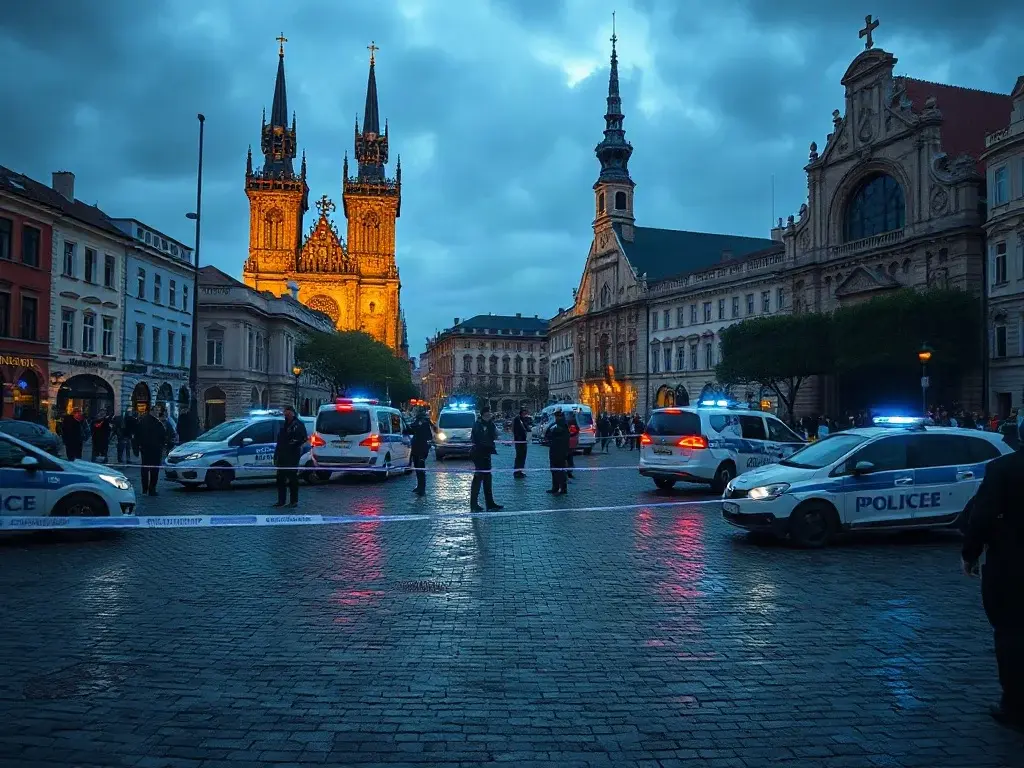
The Krakow shooting in the city’s Main Market Square has been reported with a compact set of claims: six people dead, including a British national; an attacker who, according to police, drove onto the square and then fired at people at random; and a ‘far-right’ characterisation attached to the case. Early reporting of this kind is often repeated faster than it is verified. This analysis separates what the available reporting supports from what it leaves open, examines why the political label matters, and considers what the attack means for public-space security and for travellers in Kraków.
The article relies only on the information in the initial report. It does not supply names, timelines, weapons or motives that have not been established. Where context is added, it comes from documented precedents and general security analysis, and it is flagged as such.
What the Krakow Shooting Reports Actually Establish
The initial account contains four points of substance:
- Six people were killed.
- One of the dead is British.
- Police say the attacker drove onto the Main Market Square and then fired randomly at people.
- The attack has been described as ‘far-right’, a term the headline places in quotation marks.
Several basic facts are not in that summary. We do not know whether the six dead include the attacker, whether the victims were mostly tourists or residents, what weapon or weapons were used, or how the attacker was stopped. The identity and background of the suspect are also absent. A careful reader should treat all of this as unknown, not assume it.
The significance of the quotation marks
The quotation marks around ‘far-right’ are an editorial signal. They indicate that the label comes from a source, such as police, officials or investigators, and that the publication is not asserting it in its own voice. This is standard practice early in an investigation. It also means the label is a working description, not a finding of fact or a legal classification. Charges, a prosecutor’s statement or documented evidence of ideology would carry more weight than a first-day characterisation.
Why the ‘Far-Right’ Label Matters, and Where It Misleads
Calling an attack far-right shapes how the public, politicians and security services respond. It can steer attention toward extremist networks, online communities and the policing of ideology. It can also create a false sense of certainty about motive.
Ideology versus motive
Violent attackers rarely act from a single, clean motivation. Researchers of right-wing terrorism have long noted that grievance, personal crisis, mental health problems and ideological language can overlap. Ideology may supply a justification for violence, not its sole cause. A label applied in the first hours may therefore describe the attacker’s stated or displayed beliefs without explaining why the attack happened.
Hate crime, terrorism or something else
The legal and analytical categories differ. A hate crime typically requires that victims were targeted because of a protected characteristic. Terrorism usually requires an intent to intimidate a population or influence politics. A mass shooting can fall into neither category. The report says the attacker fired ‘randomly’. If that holds, investigators will have to explain how random fire fits an ideological targeting model. Random violence in a crowded tourist space can still be terrorism if the aim was to spread fear, but that must be shown by evidence and not assumed from the setting.
The Main Market Square as a Setting
The Main Market Square is the centre of the Historic Centre of Kraków, a UNESCO World Heritage Site, and it is one of the largest medieval town squares in Europe. It is dominated by the Cloth Hall and by St. Mary’s Basilica. It is a place where residents, students and visitors mix, with cafés, street performers and heavy foot traffic.
That openness is what makes such squares both valuable and vulnerable. Pedestrianised historic centres were designed for people, not for security. Many have narrow access points that can be blocked, but others have service lanes, tram routes or delivery corridors that a vehicle can use. The report that the attacker ‘drove on to’ the square suggests that some vehicle access existed or that barriers were bypassed. That is a factual question investigators will need to answer, and it is one the public should expect to see addressed.
Vehicle Plus Firearm: A Hybrid Method
Combining a vehicle with a firearm is unusual enough to deserve separate analysis. The vehicle-ramming attack became a recognised tactic in Europe after the 2016 Nice truck attack, which prompted many cities to install bollards and barriers around crowded public spaces. Those measures address vehicles. They do not address a person who has already reached the crowd, or who uses the vehicle only to get close.
If the Krakow account is accurate, the vehicle served as a means of access and the firearm as the killing instrument. That would illustrate a broader weakness in physical-barrier strategies: they reduce one threat, and attackers adapt. Effective protection depends on layered measures, including access control, visible patrols, rapid emergency response and training for venue staff, in addition to hard barriers.
Where This Fits in Europe’s Pattern of Far-Right Violence
If investigators ultimately confirm an extremist motive, the case would join a documented, though uneven, European record. The 2011 Norway attacks and the Hanau shootings in Germany are examples of far-right violence in Europe. The Christchurch mosque shootings in New Zealand showed how such attackers can draw on transnational online subcultures.
Those cases support a few cautious observations. Many perpetrators acted alone or with minimal organisational support, which is why the lone wolf concept is used, though many analysts criticise it because such attackers are often embedded in online communities. The path of radicalisation is also often visible online before an attack. Comparisons should not be pushed too far, however. Each case has its own context, and nothing in the Krakow report yet allows a comparison of methods, ideology or planning.
The Polish Context
Reaction in Poland will involve the police, prosecutors and the Internal Security Agency, which handles counter-terrorism intelligence. Cooperation with Europol is likely to follow if cross-border links emerge, although the report gives no sign of that yet. Polish police publish operational information through their official portal, and official statements there should be preferred over social media rumour.
Poland has relatively restrictive firearms rules compared with some countries, with licensing requirements for civilian ownership. How the attacker obtained a weapon, whether legally or not, will be one of the most politically consequential questions. The answer will either point to a licensing failure or to illegal acquisition, and each leads to a different policy debate.
The British Dimension
The death of a British national triggers consular involvement. UK authorities typically provide assistance to bereaved families and liaise with local police. The Foreign, Commonwealth and Development Office keeps official travel advice for Poland, which is the right place to check for any change in guidance. The report does not say whether other foreign nationals were among the victims, and that should not be assumed.
Travel Safety in Krakow After the Attack
Single attacks, however shocking, should not be over-read as proof that a city has become unsafe. Statistically, violent crime of this kind remains rare in European tourist centres, though the available reporting does not allow a quantified comparison. Sensible readers can take a few practical steps:
- Check official advice from your government’s foreign ministry before and during travel, and register for alerts where available.
- Identify exits and open routes when entering a crowded square or event, a habit security professionals recommend in any large public space.
- Follow police instructions promptly if areas are cordoned off, and expect temporary changes in access to the old town.
- Treat unverified social media footage with caution, because early circulating claims about the attacker and victims are frequently wrong.
These steps reduce uncertainty. They are not a guarantee against a rare event, and they should not be presented as one.
How Media Coverage Should Be Judged
Early coverage of attacks like this tends to fail in predictable ways. Outlets adopt a label before it is confirmed, treat first-hour casualty figures as final, and fill gaps with speculation about the perpetrator. A useful test is whether a report distinguishes what police said from what the outlet itself verified. The headline here does so in part by quoting ‘far-right’ and attributing the account of the shooting to police. That is a reasonable standard. What it cannot do is answer the questions its short length leaves open.
Frequently Asked Questions
What happened in Krakow Main Market Square?
According to the initial report, police say an attacker drove onto the Main Market Square and randomly fired at people. Six people were killed, including a British national. Further details had not been confirmed in the source material.
Was the Krakow shooting a terrorist attack?
The report describes it as ‘far-right’, but that is not the same as a formal terrorism classification. Prosecutors determine legal categories, usually after evidence on intent and ideology is gathered.
Is it safe to visit Krakow?
Nothing in the available reporting suggests a general, ongoing threat to visitors, but conditions can change. Check your government’s current travel advice and follow local police guidance.
How do police usually investigate far-right shootings?
Investigators typically examine the suspect’s digital footprint, writings, contacts and weapon acquisition, and they may seek links to wider networks. The process takes weeks or months, and early statements are often revised.
The Question the First Reports Cannot Answer
The most important insight is also the least comfortable: the label has arrived before the evidence. ‘Far-right’ may prove accurate, incomplete or misleading, and the difference will determine whether Poland and its European partners confront an ideological threat, a failure of weapons control, a gap in public-space protection, or all three. A random attack in one of Europe’s best-known squares also challenges the assumption that hard barriers alone can protect open cities.
Readers should watch three things in the coming days: whether prosecutors announce specific charges and a motive, how the attacker obtained a weapon, and how the vehicle reached the square. Those answers will say more about the attack, and about what must change, than any headline. A reasonable prediction is that the debate will move quickly from the label to the access routes and weapon sourcing. The unanswered question is whether cities will invest in the less visible work of early detection, which prevents attacks before a vehicle ever reaches a crowd.
SEO DATA
Primary Focus Keyphrase: Krakow shooting
Related Keyphrase 2: far-right shooting in Poland
Related Keyphrase 3: Briton killed in Krakow shooting
Related Keyphrase 4: what happened in Krakow Main Market Square
Related Keyphrase 5: travel safety in Krakow
Primary Keyphrase Synonyms: Krakow attack, Kraków shooting attack, Main Market Square shooting, Krakow gun attack, Krakow shooting incident
SEO Title: Krakow Shooting: What We Know and What Remains Unconfirmed
Meta Description: Krakow shooting analysis: six dead, including a Briton, after an attack on Main Market Square. What is confirmed, what the ‘far-right’ label means.
URL Slug: krakow-shooting-main-market-square
Image Filename: krakow-shooting-main-market-square-police-cordon.jpg
Image ALT Text: Police cordon and emergency vehicles at the edge of Krakow’s Main Market Square at dusk
Image Title: Police cordon at Krakow Main Market Square
Image Caption: Emergency services secure Krakow’s Main Market Square following the shooting.
Search Intent: News/current event with informational elements
Suggested internal link anchors: European terrorism trends; travel safety in Europe; Poland travel guide; public-space security.
Frequently Asked Questions
Why is 'far-right' placed in quotation marks in the headline?
The quotation marks show the label comes from a source, such as police or officials, and the publication is not asserting it in its own voice. It is a working description from the first day of an investigation, not a legal classification or a proven finding about the attacker's motive.
Does a 'far-right' label mean the attack was terrorism or a hate crime?
Not automatically. A hate crime generally requires victims to be targeted for a protected characteristic, while terrorism usually requires intent to intimidate a population or influence politics. A mass shooting can fit neither. Prosecutors would need evidence of intent, such as charges or documented ideology, before using those categories.
How can random shooting be reconciled with an ideological motive?
Investigators will have to explain it. Random fire in a crowded tourist space can still be terrorism if the aim was to spread fear, but that must be shown by evidence, not assumed from the location. Ideology may also supply a justification without being the sole cause of violence.
What basic facts about the Krakow shooting are still unknown?
The initial report does not say whether the six dead include the attacker, whether victims were mostly tourists or residents, what weapons were used, or how the attacker was stopped. The suspect's identity, background and motive are also missing, so readers should treat these points as unknown.
Why was the Main Market Square vulnerable to this kind of attack?
The square is one of Europe's largest medieval town squares, a UNESCO-listed space with cafés, performers and heavy foot traffic. Pedestrianised historic centres were designed for people, not security, so their openness, which makes them valuable, also leaves them exposed to attackers, including those arriving by vehicle.
Should early reports about the attacker's ideology be trusted?
Treat them cautiously. Early reporting is often repeated faster than it is verified, and a first-hours label may describe displayed or stated beliefs without explaining why the attack happened. Charges, a prosecutor's statement or documented evidence carry far more weight than an initial characterisation.