
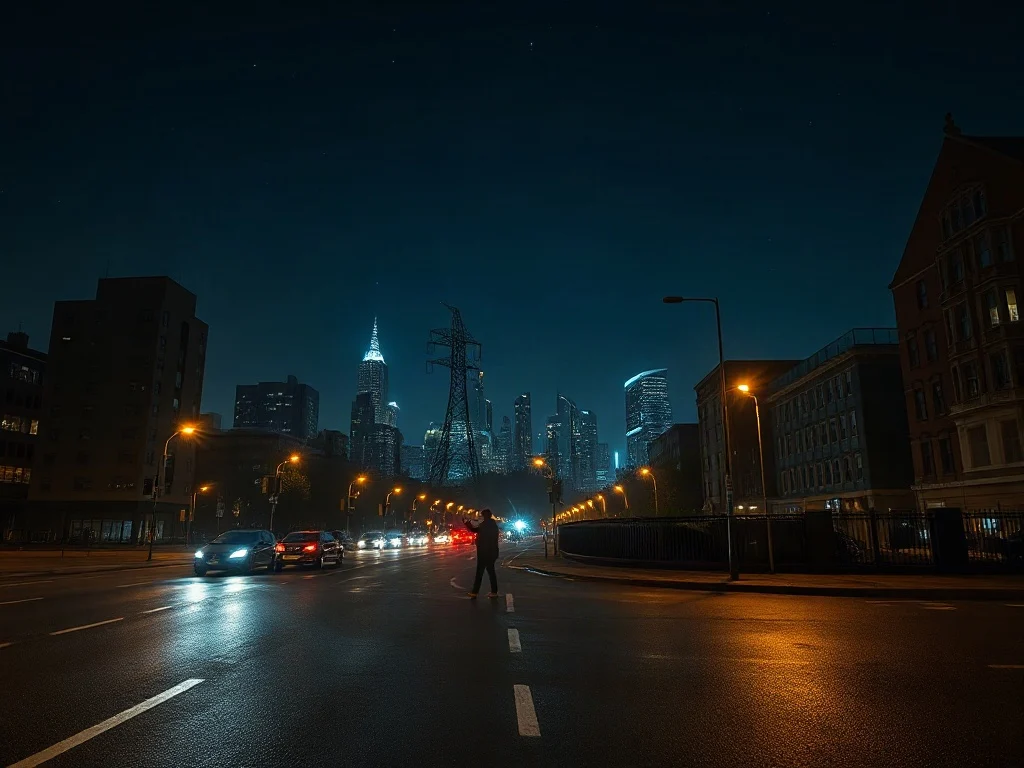
A Black Sky event is the term resilience planners use for a catastrophic, prolonged loss of electricity that cascades into water supply, communications, fuel distribution and payments. It is not a legal category, but it describes a scenario the UK government takes seriously enough to list in its National Risk Register. This analysis separates what is formally planned from what is merely assumed, and asks whether the UK’s preparations match the severity of the risk. A short blackout is an inconvenience. A multi-day collapse is a different kind of problem, and the UK’s plans are noticeably stronger for the first than for the second.
What a Black Sky Event Actually Means
The phrase is often confused with a routine power outage. The difference is scale, duration and cause. A regional outage caused by storm damage is repaired by crews working on a known network. A Black Sky event implies simultaneous failure across large areas, possibly with physical damage that cannot be fixed quickly.
Plausible Triggers
- Severe space weather: a major geomagnetic storm comparable to the Carrington Event of 1859 could induce currents that damage high-voltage transformers.
- Cyberattack: state or criminal actors targeting grid control systems, as seen in the 2015 Ukraine power grid cyberattack.
- Physical or electromagnetic attack: sabotage of substations, or a high-altitude electromagnetic pulse, which is the least likely and most contested scenario.
- Cascading technical failure: a fault that spreads through an interconnected electrical grid faster than operators can contain it.
These triggers differ sharply in likelihood and in recovery time, and that distinction drives most of the analysis below. Planners generally treat a total, short-lived grid shutdown as far more probable than permanent hardware destruction. The planning effort, however, has to cover both.
How the UK Plans for Total Grid Failure
The foundation of the UK’s response is the black start capability: the ability to restart the transmission system from a total shutdown without drawing power from the grid. A black start uses designated generators able to self-start, which energise sections of the network and gradually reconnect demand and other power stations. Responsibility for this sits with the system operator, now the National Energy System Operator (NESO), which took over functions from the former ESO within National Grid.
The Restoration Standard
Government and the regulator, Ofgem, have set an Electricity System Restoration Standard. As published, it requires the system to be able to restore most demand within about 24 hours at regional level and essentially all demand within five days, with delivery targeted by the end of 2026. This is a design objective for a black start scenario. It is not a guarantee for any event involving widespread physical damage.
The Civil Protection Framework
Under the Civil Contingencies Act 2004, responders in England, Scotland and Wales are organised into local resilience forums. Coordination at national level runs through the Cabinet Office. The government publishes its risk assessments in the National Risk Register, which treats a national power outage as a high-impact risk with a low but real likelihood. The central planning assumption is that local responders, not Whitehall, will carry most of the burden during the first days.
The Cascade: Why Electricity Is Only the First Failure
Modern critical infrastructure is interdependent, and the weak links are often outside the energy sector. The table sets out how quickly key services typically degrade. The timings are general planning assumptions rather than guarantees, and they vary by location and operator.
| Service | Dependency on grid power | Typical vulnerability |
|---|---|---|
| Mobile and broadband networks | Masts and exchanges rely on battery backup | Backup is often limited to hours, so communications can degrade before power returns |
| Water and sewage | Pumping and treatment need electricity | Pressure loss, especially in hilly or high-rise areas |
| Fuel distribution | Forecourt pumps and depots need power | Generators cannot be refuelled if pumps fail |
| Healthcare | Hospitals have standby generators | Generators depend on finite fuel stocks and working logistics |
| Payments and retail | Card terminals, ATMs and tills need power and data | Cash dependence returns almost immediately |
The critical point is sequencing. Restoring generation does not instantly restore the services built on top of it. A telecoms network that has exhausted its batteries cannot coordinate its own recovery, and a fuel depot cannot supply the generators keeping a hospital running if the depot itself has no power.
What Real Outages Reveal
The UK, August 2019
On 9 August 2019, a lightning strike and the near-simultaneous loss of generation at Little Barford power station and the Hornsea offshore wind farm triggered automatic load shedding. Roughly one million customers lost supply. Power returned within hours, but the event caused major rail disruption and exposed backup problems at some critical sites. It was a stress test of protection systems, not of black start, and it showed that even brief failures expose hidden assumptions.
International Comparisons
- The 2021 Texas power crisis left millions without electricity during extreme cold, with hundreds of deaths attributed to the wider emergency. It showed how infrastructure interdependence, particularly gas supply and power generation, can compound.
- The 2025 Iberian Peninsula blackout affected much of Spain and Portugal in April 2025. Investigations, including work coordinated through ENTSO-E, have focused on voltage control and cascading disconnections. Power was largely restored within roughly a day, which supports the viability of black start, but it also revealed how much daily life depends on mobile networks and payment systems.
- In Ukraine, repeated attacks on the grid since 2015 show that deliberate targeting can be sustained, and that repair capacity, not generation alone, determines recovery.
None of these is a true Black Sky event. Each was resolved in hours or days with a functioning neighbouring system and intact supply chains. That is the best-case comparison.
Where the UK Plan Looks Thin
The honest critique is not that the UK lacks planning. It is that the plan is calibrated to the more survivable version of the scenario.
- Black start is not Black Sky. A five-day restoration standard assumes the network is physically intact. If large transformers are damaged, replacement can take many months because they are custom-built and manufacturing capacity is limited.
- Communications fragility. Coordination of recovery depends on communications that may fail within hours. Resilient channels exist for responders, but public information is a harder problem.
- Reliance on household self-sufficiency. Official guidance encourages preparation, such as a battery or wind-up radio, but public awareness is uneven. A plan that depends on informed citizens needs consistent, repeated messaging.
- Vulnerable populations. People dependent on powered medical equipment, or those living alone, are most exposed. Registers of vulnerable customers exist, but their completeness in a real emergency is untested.
- Private-sector resilience varies. Fuel retailers, supermarkets and telecoms operators make their own investment decisions, and coordination across them is hard to verify from outside.
Preparedness exercises at national and local level are valuable, but the public findings from such exercises are rarely detailed. Without transparency, outside experts cannot judge whether lessons are being implemented.
Practical Preparation for Households and Organisations
For Households
- Keep a battery or wind-up radio, torches and spare batteries. Mobile networks may not work, but broadcast radio often will.
- Store drinking water, since taps may stop working. Common planning guidance is about three litres per person per day, though you should check current official advice.
- Hold some cash in small denominations and keep power banks charged.
- Keep a supply of essential medicines and know who nearby may need help. Check whether you qualify for your network operator’s priority services.
For Businesses and Public Bodies
- Map dependencies beyond your own site: your supplier’s power, your telecoms provider’s backup duration and fuel delivery routes.
- Test generators and uninterruptible power supply systems under real load, not only in scheduled checks.
- Define manual fallback procedures for payments, access control and communications, and train staff to use them.
A common mistake is to treat backup power as a solution rather than a time-limited bridge. The right question is not whether a generator exists, but how many hours of fuel it holds and how it will be refuelled.
The Next Decade: Risks and Opportunities
Several trends cut in different directions. A grid with more wind, solar and batteries has less traditional inertia, which changes how stability is managed, though it also enables more distributed generation and potentially localised islanding. Increasing digitisation widens the cyber attack surface. Greater electrification of transport and heating raises the cost of any outage. Regulatory attention is likely to remain focused on delivery of the restoration standard and on cyber resilience for operators of essential services. These are reasoned expectations, not confirmed outcomes.
The Real Test Comes After the Lights Return
The most important insight is that the UK’s weakness is not the first hour of a blackout but the sixth day of a damaged system. Black start capability, regulated restoration targets and the local resilience framework make a clean, short, total shutdown manageable. The harder scenario is one in which physical damage, failing communications and exhausted backup fuel interact, and no public evidence shows that this combination has been fully tested.
Watch for three developments: whether the restoration standard is met on time by the end of 2026, whether the government publishes meaningful findings from national exercises, and whether telecoms backup durations lengthen. The unanswered question is whether society will invest in resilience before a crisis, or only after. History suggests the latter, and a Black Sky event would offer little opportunity to learn from it.
Frequently Asked Questions
What is a Black Sky event?
It is a catastrophic, long-lasting loss of electricity, usually combined with failures in water, communications and transport. It differs from ordinary outages in scale and duration.
How long would a national blackout last in the UK?
Planning standards aim for most demand to be restored within about 24 hours regionally and nearly all within five days, assuming the network is physically intact. Physical damage to major equipment could extend that considerably.
Would mobile phones work during a prolonged power cut?
Probably only for a limited time. Many masts have battery backup measured in hours, so a battery-powered radio is a more dependable source of information.
What should I keep at home for a long power cut?
A battery or wind-up radio, torches, drinking water, some cash, charged power banks, essential medicines and non-perishable food.
Frequently Asked Questions
Is a Black Sky event the same as a normal power cut?
No. A normal outage is usually regional, caused by something like storm damage, and fixed by crews working on a known network. A Black Sky event means simultaneous failure over large areas for days, possibly with physical damage, and it cascades into water, communications, fuel and payments.
Does the 24-hour and five-day restoration standard guarantee power will return that quickly?
No. The Electricity System Restoration Standard is a design objective for a black start scenario, where the grid is shut down but hardware is largely intact. It does not guarantee recovery after widespread physical damage, such as destroyed transformers, and its delivery target is the end of 2026.
What is a black start and why does it matter?
A black start is the ability to restart the transmission system after a total shutdown without drawing power from the grid. Designated generators that can self-start energise parts of the network, then gradually reconnect other power stations and demand. NESO is responsible for coordinating this.
Which Black Sky trigger is considered most likely?
Planners generally see a total but short-lived grid shutdown, for example from cascading technical failure or a cyberattack, as far more probable than permanent hardware destruction. A high-altitude electromagnetic pulse is regarded as the least likely and most contested scenario, though plans must cover all of them.
Who would carry most of the response in the first days of a national outage?
The central planning assumption is that local responders, not Whitehall, bear most of the burden early on. Under the Civil Contingencies Act 2004, local resilience forums organise responders, while the Cabinet Office coordinates nationally and the National Risk Register sets out the risk assessment.
Why could communications fail before electricity is restored?
Mobile masts and exchanges depend on battery backup, which is often limited to a few hours. Once those batteries run out, networks can degrade or go down even while the grid is still being restarted, which complicates coordination and public information.