
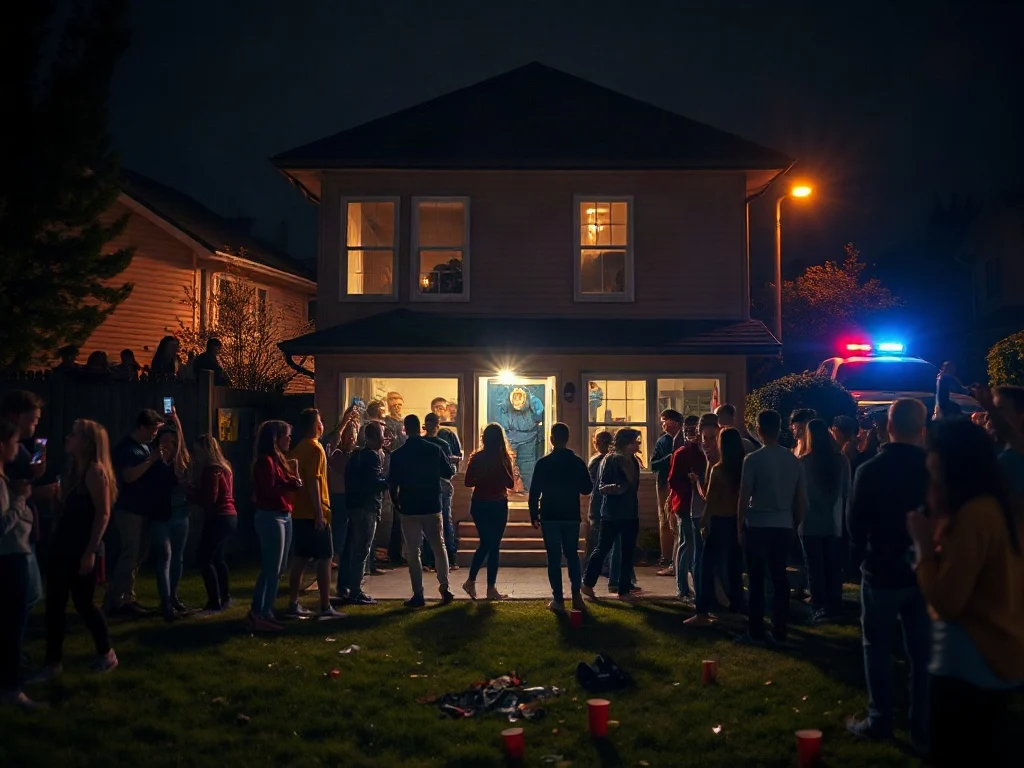
Is Project X based on a true story? Not in any formal sense. The 2012 teen comedy carries no “inspired by actual events” credit, and its plot, a birthday party that mutates into a suburban catastrophe, is fiction. Yet the question persists because the film was built to feel documentary-real, because a notorious Australian party is often cited as its seed, and because the chaos that followed its release was documented, policed and prosecuted. This analysis separates what is established from what is rumor, and asks whether the film merely reflected a youth-culture pattern or helped accelerate it.
Is Project X Based on a True Story? The Short Answer
Project X was directed by Nima Nourizadeh in his feature debut and produced by Todd Phillips, the filmmaker behind The Hangover. Released by Warner Bros. in March 2012, it follows three high-school seniors, played by Thomas Mann and two co-stars, who throw a party intended to boost their social standing. The event escalates beyond control.
The accurate answer has three layers:
- Officially: the story is a work of fiction written for the screen.
- Anecdotally: a widely repeated rumor ties it to a real 2008 party in Melbourne.
- Culturally: the film became a reference point for real parties that spiraled, most notably in the Netherlands.
Anyone claiming a straightforward true-story pedigree is overstating the evidence. Anyone dismissing any real-world connection ignores how the film was marketed and received.
The Corey Delaney Party: The Rumored Real-Life Inspiration
What happened in Melbourne in 2008
The incident most often cited is a January 2008 party in Narre Warren North, a suburb of Melbourne, Australia. A teenager named Corey Delaney held a party at his parents’ house while they were away. Online invitations spread the address, hundreds of uninvited guests reportedly arrived, neighbors complained, and police intervened in force. Australian media covered it intensely, and Delaney became a minor tabloid celebrity, partly through his unrepentant television interviews.
Why the link is plausible but unproven
The parallels are structural: absent parents, an invitation that escaped its intended audience, an overwhelmed property, and a police response disproportionate to a house party. That is why the Corey Delaney party keeps surfacing in discussions of the film. However, a rumor is not a credit. I found no authoritative evidence that the screenwriters formally adapted Delaney’s story, and the film’s characters, setting (Pasadena, California) and events diverge sharply from the Australian case.
A more defensible reading is that Delaney’s party was an early, highly visible example of a phenomenon the film dramatized: social-media-amplified house parties. The film did not need a specific source. By 2012, the pattern was already familiar enough to anchor a script.
How the Film Manufactured Authenticity
The found-footage device
The film’s most effective trick is formal rather than narrative. It uses the found-footage technique, popularized by The Blair Witch Project and later Cloverfield, in which a character with a camera supposedly records everything. In the film, a classmate documents the party, so every shaky pan, drunken confession and blown-out light reads as evidence rather than staging.
The effect is persuasive and, critically, a little dishonest. Handheld footage borrows the credibility of surveillance and home video. Viewers, especially teenagers, can leave with a vague sense that this is what parties “really” look like, or at least what they are allowed to become.
Compared with earlier teen comedies
Earlier entries such as Superbad framed party chaos through conventional cinematography and a moral arc: embarrassment, friendship, a lesson. Project X offers a thinner arc. Its protagonists suffer consequences, yet the film’s tone treats the escalation as spectacle, and the final act plays closer to triumph than to cautionary tale. That ambiguity is the heart of the criticism leveled at it.
The core critique: a film that presents destruction as both thrilling and consequence-light invites imitation more readily than one that punishes its characters.
This is interpretation, not proven fact. But it explains why the film drew more scrutiny than its genre peers.
The Project X Haren Riot: When Fiction Became a Template
What happened in the Netherlands
The most consequential real-world event linked to the movie is the Project X Haren riot of September 2012. A teenage girl in Haren, a village near Groningen in the northern Netherlands, created a Facebook event for her 16th birthday. The invitation was reportedly left public, and it spread far beyond her circle. Thousands of people converged on the village, riot police were deployed, and clashes, looting and property damage followed, with dozens of arrests reported. The event was dubbed “Project X Haren” in Dutch media, a label that explicitly invoked the film.
Film or Facebook: the causation problem
It would be lazy to blame the movie. The decisive mechanism in Haren was invitation leakage: a public event page, viral sharing, and no capacity to filter attendees. The film provided a name and a script of expectations, not the infrastructure. Researchers who study collective behavior generally warn against single-cause explanations for crowd disturbances, and a causal claim about the film’s influence remains unproven.
Still, the film’s role as a cultural cue is hard to dismiss. It supplied a shared reference that made a mass, uninvited gathering feel like a legitimate event rather than a security failure. Cue and mechanism together produced the outcome.
Copycat Parties and the Moral Panic Question
Whenever a film is linked to real disorder, the debate shifts toward moral panic. Critics of the panic framing argue that media has long been blamed for youth behavior, and that policing, urban planning and platform design deserve more scrutiny than a comedy. Those who see a real copycat effect point to the explicit naming of events after the film.
Both positions contain truth. A sober assessment looks like this:
- Well supported: uncontrolled online invitations can turn private gatherings into public-order incidents.
- Plausible: pop-culture references lower the perceived social cost of attending or escalating such events.
- Not established: that the film alone caused any specific riot.
The business context matters as well. The film was produced on a reported budget of roughly $12 million and grossed on the order of $100 million worldwide, according to commonly cited industry figures. Its commercial success reinforced the template, and the studio had an incentive to promote its anarchic energy.
What Parents, Schools and Event Hosts Can Do
The practical value of this story lies in the failure points it exposes. Whether or not the film inspired anyone, the mechanics are repeatable.
Common mistakes
- Public event pages: posting an address on an open social-media event is the single most documented trigger.
- Unverified guest lists: no list, no door control, no ability to remove strangers.
- No exit plan: hosts who wait to call emergency services until a situation is critical lose control of the response.
- Relying on anonymity: sharing a location in group chats means the invitation will travel further than intended.
Better practices
- Use private, invite-only messaging for any gathering and avoid posting addresses publicly.
- Set a firm capacity and a named adult responsible for it.
- Brief neighbors and, in higher-risk cases, local police in advance.
- If an invitation leaks, cancel visibly and quickly, and publicize the cancellation on the same channels that spread the original.
Municipal authorities have a parallel task: monitoring open social-media events tied to local addresses and responding before a crowd forms, not after.
Frequently Asked Questions
Is Project X based on a true story?
No. It is a scripted fictional film. A rumor links it to the 2008 Corey Delaney party in Melbourne, but there is no confirmed official adaptation.
Did Project X cause real riots?
Not demonstrably. The Haren riot in 2012 was nicknamed after the film, but the main driver was a public Facebook invitation that reached thousands. The film acted at most as a cultural reference.
Was the party in Project X real footage?
No. The found-footage style is a filmmaking technique. The events were staged by actors and crew.
Where is the Project X house?
The story is set in Pasadena, California, but the setting is fictional. Filming locations in the Los Angeles area were used for production, and nothing in the film depicts an actual event.
The Real Lesson of Project X: Invitations Travel Faster Than Intentions
The most important insight from this story is that the film’s fictional party and the real ones share a single flaw: loss of control over who is invited. Delaney’s party in 2008 and the Haren riot in 2012 were separated by four years and the rise of mass social media, yet the failure was identical. The movie did not invent that vulnerability. It dramatized it, and then glamorized it.
What deserves attention next is not another teen comedy but the platforms. As event sharing moves toward algorithmic recommendation, short video and location tagging, the distance between a private party and a public gathering is shrinking. A reasonable prediction, not a certainty, is that future incidents will be triggered less by a film reference than by a viral clip and a map pin. The unanswered question is whether platforms, schools and municipalities will treat open invitations as a safety issue before the next crowd forms, or only after.
Frequently Asked Questions
Does Project X carry any official claim of being based on real events?
No. The film has no "inspired by actual events" credit, and its story of a birthday party spiraling out of control in Pasadena, California is fiction written for the screen. The true-story impression comes mainly from its found-footage style and from rumors, not from any formal adaptation.
Was the Corey Delaney party really the source of the Project X script?
That is unproven. The 2008 Melbourne party shares structural similarities, such as absent parents, an online invitation that spread, and a heavy police response. But there is no authoritative evidence the screenwriters adapted it, and the characters, setting and events differ sharply from the Australian case.
Why does Project X look like real footage if it is fictional?
The film uses the found-footage technique seen in The Blair Witch Project and Cloverfield. A classmate supposedly films everything, so shaky pans and chaotic moments read as evidence rather than staging. This borrows the credibility of home video and makes the invented events feel documented.
How does Project X differ from earlier teen party comedies like Superbad?
Superbad used conventional cinematography and a clear moral arc of embarrassment, friendship and a lesson learned. Project X has a thinner arc: characters face consequences, but the tone treats the escalation as spectacle, and the final act feels closer to triumph than to a cautionary tale.
Did the film influence real-life parties that got out of control?
The article describes the film as a cultural reference point for real parties that spiraled, most notably in the Netherlands, where the chaos was documented, policed and prosecuted. It asks whether the film reflected an existing youth pattern or helped accelerate it, without claiming a simple cause.