
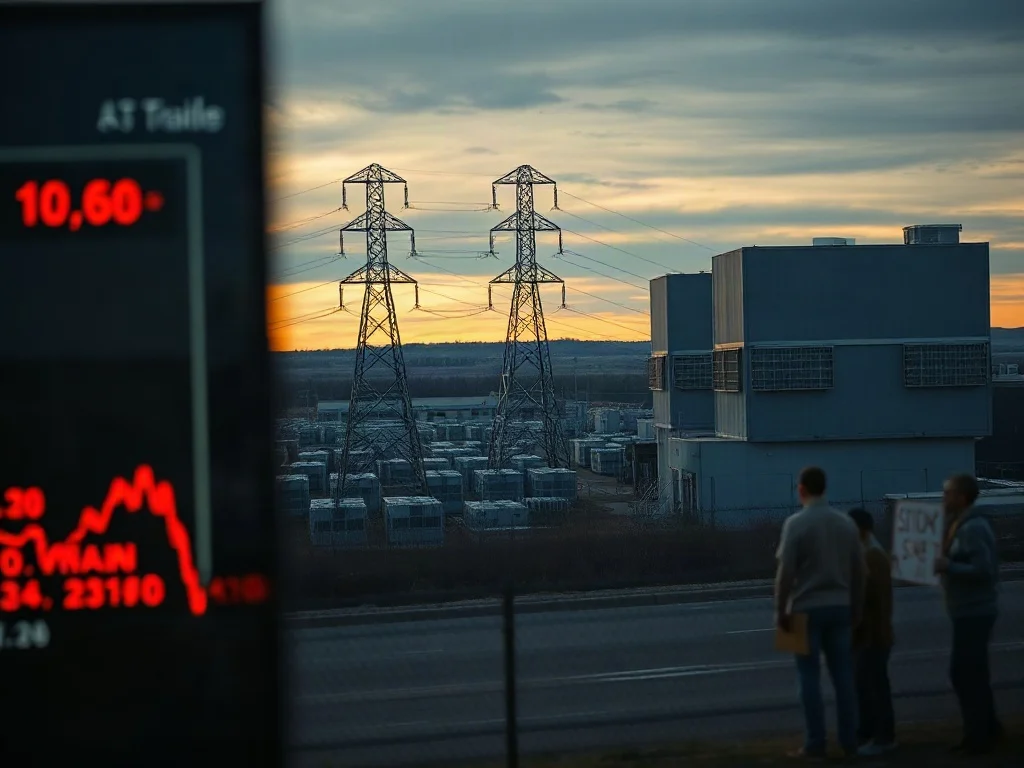
When tech stocks plunge in the days after an election, the cause is usually assumed to be macroeconomic. This time the trigger looks more specific. Reporting indicates that the market is reacting to the prospect of tougher scrutiny of data centre construction and of the AI industry more broadly following the US midterm elections. That is a different kind of risk from a rate shock or an earnings miss, and it deserves a more careful reading than most market commentary offers. This analysis separates what is known from what is inferred, and explains why AI slowdown fears now carry such weight in valuations.
One caveat first. The source reporting is brief, and this article does not invent index levels, percentage drops or company-specific figures that it does not contain. The focus is the mechanism: how political risk can become a valuation problem for companies whose growth story depends on physical infrastructure.
What We Actually Know About the Selloff
The market has been reacting to possible tougher scrutiny of data centre construction and the AI industry following the US midterms.
That is the core claim, and it is carefully worded. The word possible matters. Investors are not pricing in enacted legislation. They are pricing a change in probabilities: the odds that permitting, power access, tax treatment or oversight of AI become harder than they were before the vote.
This is how a tech selloff driven by politics typically works. Markets discount expected future cash flows. If the expected cost of building capacity rises, or the expected speed of deployment falls, the present value of those cash flows falls even though no company has reported weaker results. Large AI-linked names such as Nvidia, Microsoft, Alphabet, Amazon and Meta Platforms are especially exposed because so much of their market value rests on assumptions about future AI demand.
Why the Midterms Matter to AI Valuations
Midterms rarely change policy overnight. They change the balance of power in Congress, and with it the capacity to hold hearings, issue subpoenas, shape appropriations and block or advance legislation. For a sector that has operated with relatively little federal constraint, even the possibility of sustained oversight is a regime change in how risk is priced.
Data centre permitting and local opposition
The data centre buildout is the physical foundation of the AI boom, and it is where politics bites first. Large facilities need land, water, zoning approval and, above all, electricity. Local resistance to them has grown into a recognisable political pattern, a modern form of NIMBYism. Residents object to noise, land use and utility costs, and elected officials respond.
A more scrutiny-minded Congress, or state governments emboldened by the election, could add reporting requirements, environmental reviews or conditions on tax incentives. Each is individually manageable. Together they lengthen project timelines, and in a market where speed is the competitive advantage, delay is a cost.
Electricity prices and the grid
Power is the sharpest pressure point. The International Energy Agency has projected in its Energy and AI report that global data centre electricity consumption could roughly double to around 945 terawatt-hours by 2030. That growth lands on an electrical grid that was not designed for it.
The political consequence is direct. In the territory served by PJM Interconnection, the largest US grid operator, recent capacity auctions have produced sharply higher prices, and data centre demand has been widely cited as a contributing factor. Voters see this on their bills. Candidates in both parties have noticed. Whether or not the link is as strong as campaign rhetoric suggests, a plausible narrative that AI is raising household electricity costs is politically potent, and markets treat it as such.
Federal versus state AI rules
The second channel is formal regulation of artificial intelligence. The industry has pushed for a single federal framework that would pre-empt a patchwork of state laws. Congress has so far been unwilling to simply bar state action; the Senate voted overwhelmingly in 2025 to strip a proposed moratorium on state AI laws from a budget bill. A shifted balance of power after the midterms could make a light-touch national standard harder to pass while leaving states free to legislate, the worst combination for companies seeking regulatory certainty.
Why AI Slowdown Fears Hit Valuations So Hard
Political risk alone would not produce a sharp reaction if valuations were modest. The reaction is amplified by the scale of expectations already embedded in prices.
The capital expenditure bet
The largest technology companies have committed enormous capital expenditure to AI infrastructure, with spending on chips, hyperscale data centres and power contracts. That spending is justified only if demand for generative AI services grows fast enough to earn a return. Anything that slows the buildout, or raises its cost, attacks the thesis from both sides: lower future revenue and higher required investment.
Fragile sentiment, not just fragile fundamentals
Markets have shown before how quickly sentiment around this theme can turn. In January 2025, the emergence of the Chinese model DeepSeek triggered a record one-day loss in Nvidia’s market value, even though little had changed in the near-term demand for chips. The lesson is that AI-linked valuations are sensitive to narrative shifts, and a political narrative can do the same work as a technical one.
Comparisons with the dot-com bubble are common and often lazy. Today’s leaders are profitable and generate real cash, which the 1999 cohort largely did not. The more defensible parallel is structural: a build-out of shared infrastructure financed on the expectation of demand that has not yet fully materialised. Whether that amounts to an economic bubble is a matter of interpretation, not established fact, and serious analysts disagree.
The Policy Channels Compared
Not all political risks are equal. The table below ranks the main channels by how directly they affect AI economics, based on this analysis rather than any published model.
| Policy channel | Who acts | Speed of impact | Severity for AI buildout |
|---|---|---|---|
| Local zoning and permitting | Counties, municipalities | Immediate | Moderate, project-specific |
| Grid access and power pricing | State regulators, grid operators | Months to years | High, a structural constraint |
| Tax incentives for data centres | State legislatures | Next budget cycle | Moderate |
| Congressional oversight and hearings | Congress | Reputational, near-term | Low directly, high on sentiment |
| Federal AI legislation | Congress, White House | Slow and uncertain | Uncertain, depends on content |
Rational Repricing or Overreaction?
The honest answer is that it is probably both. The rational component is that political risk to infrastructure is real and was arguably underpriced during a period of bipartisan enthusiasm for AI. Power constraints are a physical fact, not a talking point, and no election result changes the arithmetic of grid capacity.
The overreaction component is the assumption that scrutiny equals prohibition. Legislative gridlock is the default in Washington, and demand for AI services does not disappear because a committee chair changes. Historically, regulatory scrutiny of dominant technology firms has increased costs and slowed specific business practices without halting the industry’s growth. Markets have often priced the headline and the aftermath separately.
There is also a distinction between the stock market and the underlying business. A fall in the Nasdaq Composite reflects changed expectations, not changed revenue. Until companies report weaker demand or cut capital spending plans, the slowdown remains a forecast, not an observation.
What Investors and Executives Should Monitor
- Capital expenditure guidance. The next earnings cycle will show whether hyperscalers are trimming or maintaining buildout plans. A cut would confirm the fear; reaffirmation would weaken it.
- Utility interconnection queues. Delays here are a harder constraint than any statute.
- State-level data centre bills. Incentive rollbacks and new disclosure rules tend to appear in state legislatures before Washington.
- Valuation multiples. A compressed price-to-earnings ratio without earnings revisions suggests sentiment, not fundamentals, is driving the move.
- Committee agendas. The topics chosen for hearings reveal which concerns, whether energy, competition, child safety or labour, will drive actual legislation.
For executives, the practical lesson is to treat community relations and utility partnerships as core strategy rather than public relations. Projects that fund their own power generation or grid upgrades face less political friction than those that appear to shift costs onto ratepayers.
Frequently Asked Questions
Why are tech stocks falling after the US midterms?
Reporting links the decline to expectations of tougher scrutiny of data centre construction and the AI industry. Investors are repricing the risk that building capacity becomes slower or costlier, which would weaken the growth assumptions behind AI-linked valuations.
Does a tech selloff mean the AI boom is over?
Not necessarily. A price decline reflects revised expectations, not collapsing demand. The signals that matter are capital spending guidance, cloud revenue growth and actual deployment, none of which a stock move alone can confirm.
How does data centre regulation affect AI companies?
Data centres supply the computing power AI needs. Rules on permitting, energy use, water and tax incentives can raise costs and delay capacity, which limits how quickly companies can serve growing demand.
Is this the start of an AI bubble bursting?
That is an interpretation, not a fact. Some analysts see stretched valuations; others point to strong earnings and real demand. One political shock does not settle the question.
The Question the Selloff Leaves Unanswered
The most important insight is that the AI trade has quietly shifted from a technology story to an infrastructure and politics story. Algorithms scale at near-zero marginal cost. Power plants, transmission lines and zoning boards do not. The market is only now learning to price that difference.
The next test is concrete: whether the biggest spenders keep their capital expenditure plans intact when they next report, and whether any serious legislative proposal on data centre energy costs emerges with bipartisan support. If both happen, this episode will look like a sentiment correction. If spending guidance softens while power constraints tighten, the current drop may be an early signal rather than an overreaction.
The unresolved question is who will pay for the electricity AI requires: the companies that profit from it, or the public that votes on it. The answer will shape the industry more than any single earnings report.