
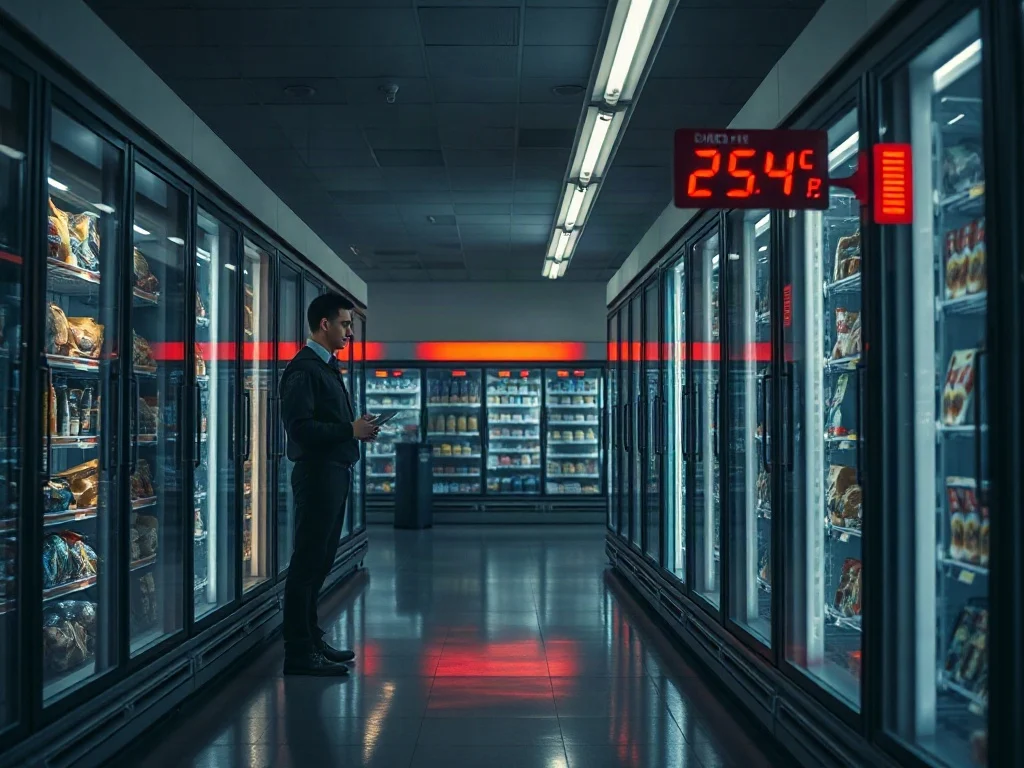
The reported shop freezers cyber attack across six European countries is a striking case because the damage was not data theft or a locked screen. It was physical: freezer temperatures in several shops reportedly climbed as high as 50C. If the suspected cyber-attack is confirmed, it shows how an IT intrusion can spoil stock, trigger food safety obligations and disrupt trading without a single customer record being touched. This analysis separates what has been reported from what is inference, explains how such an incident could plausibly happen, and sets out what retailers should do about it.
The public information is thin. The report describes a suspected attack, six countries and a temperature as high as 50C. It does not, in the material available here, establish the attacker, the entry point, the vendor involved or the number of shops affected. Everything below that goes beyond those facts is labelled as analysis, not established fact.
What was reported and what remains unknown
The confirmed core
The core claim is that freezers in shops in six European countries behaved abnormally, with temperatures reportedly rising to 50C, and that a cyber-attack is suspected. The word suspected matters. Faulty software updates, misconfigured controllers and failed monitoring platforms can all produce mass equipment failures that look like sabotage in the first hours.
The open questions
- Attribution: nothing in the report identifies a criminal group, a state actor or an insider.
- Attack vector: it is not stated whether the cause was a compromised supplier platform, stolen credentials or a vulnerable device.
- Intent: it is unclear whether the aim was extortion, disruption or a test of capability.
- Actual losses: the volume of spoiled food and the financial cost have not been quantified in the report.
Why multi-country failures point to a shared dependency
Six countries do not usually share a single store network, so the pattern invites a structural hypothesis. This is inference, not reported fact. A common point of failure, such as one equipment manufacturer, one remote-management service or one managed service provider, would explain simultaneous effects across borders far better than separate attacks on individual shops.
This is the logic of a supply chain attack: compromise one trusted supplier and inherit access to many customers. The 2017 NotPetya outbreak, which spread through compromised accounting software, remains the standard example of how a single upstream weakness becomes a multinational outage. Whether the freezer incident follows this pattern is unproven.
How hackers can change freezer temperatures
The question many readers will ask is whether it is technically plausible for hackers to alter freezer temperatures. It is, provided the equipment is networked, which modern commercial refrigeration usually is.
The technical path
Commercial cabinets and cold rooms are typically governed by controllers, often a form of programmable logic controller or dedicated refrigeration controller, that manage setpoints, compressor cycles and defrost schedules. These controllers form part of an industrial control system and are increasingly linked to central dashboards so that operators can monitor energy use and receive alarms. This connectivity is part of the wider Internet of Things.
An attacker with access to the management layer could, in principle, do several things:
- Raise setpoints so that cabinets stop cooling to target temperature.
- Trigger prolonged defrost cycles or disable compressors.
- Suppress or falsify alarms so staff are not warned.
- Wipe or corrupt controller firmware so units fail until physically repaired.
The last two options are the most damaging. Altered settings can be reversed, but silent alarms mean spoilage goes unnoticed, and corrupted firmware can turn a software problem into a hardware replacement job.
Why 50C is notable
A reading of 50C is far beyond what a deliberate setpoint change would normally produce in a cabinet that had simply been warmed up, which suggests either that cooling stopped entirely in a hot enclosure or that the reported figure reflects sensor readings under abnormal conditions. This is an interpretation, and the report gives no technical detail to confirm it. It is a reminder to treat single headline figures cautiously until the operators publish logs.
The food safety and cold chain stakes
Frozen food is generally kept at -18C or below. European rules on quick-frozen foodstuffs set that benchmark, with only limited, short fluctuations tolerated during transport and local distribution. A cabinet drifting toward 50C is not a marginal breach. It destroys the product’s safe storage status within hours.
The consequences run through the cold chain. Once thawed and warmed, stock cannot simply be refrozen safely, and shops must judge whether it can be sold at all. The risk is foodborne illness if compromised items are sold, which is why retailers working under HACCP principles treat temperature excursions as critical control failures. In practice, the safest response is destroying affected stock. That makes the cost of such an attack immediate and tangible, in a way that stolen data rarely is.
How this differs from ransomware and data breaches
Most retail cyber incidents involve ransomware or data theft. Those attacks hurt through downtime, reputational damage and regulatory exposure. A cyber-physical attack adds a different lever: it threatens goods and, indirectly, public health.
Precedents exist elsewhere. Stuxnet demonstrated that malware could damage physical equipment, and the Colonial Pipeline ransomware attack showed how an IT compromise can halt a physical operation even when control systems are not directly hit. The freezer case, if confirmed, sits in the same family, but at a retail scale where defenses are usually weaker.
Why retail is a soft target
- Thin security teams: many grocers outsource facilities management and equipment monitoring.
- Long equipment lifecycles: cabinets run for a decade or more, often with unpatched firmware.
- Vendor access: maintenance companies hold remote credentials that are rarely audited.
- Low margins: food retail invests little in operational technology security.
Competing explanations an analyst should weigh
A critical reading of any early incident report keeps alternatives alive. There are at least three explanations:
- Malicious intrusion: an attacker deliberately altered or disabled refrigeration controls.
- Faulty update or configuration push: a vendor error propagated across customers, producing the same symptoms with no hostile actor.
- Collateral damage: malware aimed at a wider target, such as a vendor’s IT estate, disrupted the monitoring or control platform incidentally.
The distinction matters legally and commercially. Liability, insurance coverage and regulatory reporting duties differ depending on whether the cause was an attack, a supplier defect or a retailer’s own failings. Treat the “cyber-attack” label as provisional until forensic findings are published.
Refrigeration systems cybersecurity: practical measures
Whatever the final cause, the incident points to concrete controls. Guidance from bodies such as ENISA, the EU cybersecurity agency, and the UK’s National Cyber Security Centre consistently stresses the fundamentals below.
Technical controls
- Separate operational technology from corporate IT. Proper network segmentation limits how far an intruder can travel.
- Enforce strong authentication. Require multi-factor authentication on every remote management account, especially those held by vendors.
- Remove factory credentials. A default password left on a controller is an open door.
- Inventory and patch. Know which controllers exist, which firmware they run and who can reach them.
Operational controls
- Install independent temperature loggers with their own power and cellular alerts, not routed through the same platform that controls the cabinets. If the control system is compromised, the safety net still works.
- Write a temperature-excursion playbook that states who decides to discard stock, how it is documented and how regulators are informed.
- Test manual fallback. Staff should know how to check cabinets physically and move stock to backup cold storage.
- Audit supplier access and contractually require breach notification and security standards from refrigeration vendors.
Common mistakes
Retailers frequently assume the monitoring vendor is responsible for security, then never verify it. They also rely on a single alerting channel, so an attacker who silences it silences everything. Both mistakes are inexpensive to fix compared with discarding a store’s frozen inventory.
Regulation, insurance and economic consequences
European regulation is tightening around operational resilience for essential sectors, and food supply is increasingly treated as critical infrastructure. Retailers should check whether they fall within national rules that implement the EU’s updated network and information security regime, which can bring incident-reporting duties and management accountability. Whether a specific retailer is in scope depends on size and national implementation, so this should be confirmed with legal counsel.
Cyber insurance adds another complication. Policies differ on whether physical damage or spoiled goods caused by a cyber event are covered, and many contain exclusions. A cyber-physical incident exposes gaps between cyber policies and conventional property or stock-spoilage cover. Risk managers should review these before an incident, not during one.
Frequently asked questions
Can hackers really change freezer temperatures?
Yes, if the refrigeration controllers or their management platform are reachable over a network and poorly secured. Attackers can alter setpoints, disable cooling or suppress alarms. Whether that happened in the reported incident has not been publicly confirmed.
Why would attackers target shop freezers?
Plausible motives include extortion, disruption or demonstrating capability. The report does not establish a motive, so any answer is speculation.
Is food from affected freezers safe to eat?
Food exposed to temperatures far above -18C for an extended period should be treated as unsafe to sell and is usually discarded under food safety procedures. Shoppers should follow guidance from the retailer and national food safety authorities.
How can retailers protect refrigeration systems?
Segment networks, enforce multi-factor authentication, audit vendor access, patch firmware and deploy independent temperature monitoring with separate alerting.
What the freezer incident should change in boardrooms
The most important insight is that cyber risk has moved from the balance sheet to the shelf. A compromised refrigeration platform converts a software weakness directly into destroyed inventory and a potential public health question, and the cost lands within hours. That is a different risk profile from a data breach, and most retailers have not budgeted for it.
Three things are worth watching. First, whether investigators name a common vendor or platform, because that would confirm the shared-dependency hypothesis and put pressure on equipment suppliers. Second, whether regulators treat the event as a reportable incident, which would signal that food retail is being pulled firmly into critical-infrastructure rules. Third, how insurers respond, since changes in cover and pricing often drive security investment faster than regulation does.
A reasoned prediction, flagged as such: as more refrigeration, heating and ventilation systems connect to cloud dashboards, attacks aimed at physical effects in ordinary commercial settings will become more common, and the weakest link will usually be a trusted supplier, not the retailer’s own firewall. The unanswered question is whether retailers will demand verifiable security from their equipment vendors before the next incident, or only after it.
Frequently Asked Questions
Has it been confirmed that hackers caused the freezer temperatures to rise?
No. The report only describes a suspected cyber-attack. Faulty software updates, misconfigured controllers or failed monitoring platforms can cause mass equipment failures that initially look like sabotage. Attribution, entry point, vendor and number of affected shops remain unestablished in the available information.