
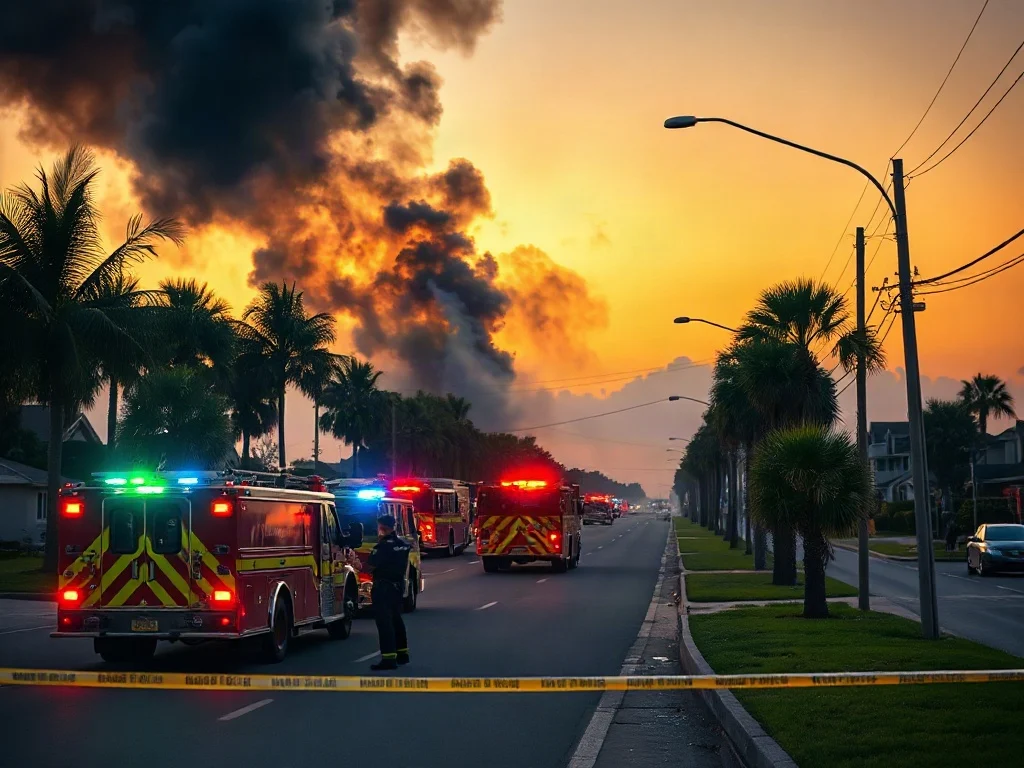
A Florida jet crash near President Donald Trump’s Mar-a-Lago resort has left nine people dead, and the first public reaction has already shaped the story. Transportation Secretary Sean Duffy called it a “horrific tragedy,” and an eyewitness account compared the descent to “a missile coming down.” Both statements are striking. Neither explains why the aircraft fell. This analysis separates what the available reporting supports from what remains unknown, explains how the official inquiry will proceed, and identifies the questions that will determine whether this crash becomes a footnote or a catalyst for change.
What Is Known About the Florida Jet Crash
The confirmed facts are few. The aircraft was a jet, it crashed in Florida near Mar-a-Lago, the fire after impact was intense, and nine people were killed. Mar-a-Lago is located in Palm Beach, part of Palm Beach County, a densely developed coastal area with significant general aviation traffic.
Several details are not established in the source reporting this article relies on: the aircraft type and operator, the origin and destination of the flight, whether the aircraft was arriving or departing, the identities of the victims, whether anyone on the ground was hurt, and whether weather, mechanical failure, or crew action played any role. Any article that states a cause at this stage is guessing. The only responsible position is that the cause is undetermined.
What the Death Toll Implies
Nine fatalities is an inference-worthy number, with caveats. It suggests an aircraft carrying at least nine occupants, or a smaller number of occupants plus people on the ground. That points toward a larger business jet or similar aircraft rather than a typical light piston plane. This is an inference from the number alone, not a confirmed fact, and it should be treated as such until investigators publish specifics.
Why the “Missile” Description Needs Careful Reading
The phrase “like a missile coming down” is vivid, and vivid quotes tend to dominate coverage. It is also a lay description of a steep, fast descent. It is legitimate witness testimony about what the person saw, but it is not technical evidence about the cause.
Witness accounts are valuable to investigators, particularly for establishing the aircraft’s attitude, sound, and any visible fire or smoke before impact. They are also notoriously unreliable on speed, angle, and sequence. A steep descent can result from many scenarios: a loss of control, a structural or engine failure, an incapacitated crew, or an unstabilized approach. The “missile” image tells readers the descent looked steep and violent. It does not discriminate among those possibilities.
The Risk of Narrative Lock-In
Early framing often hardens. Once a crash is described in terms of a dramatic image, or tied to a famous location, speculation about security or sabotage can spread faster than the facts. Nothing in the available reporting indicates anything other than an accident under investigation. Readers should treat claims beyond that with skepticism.
How the NTSB Investigation Will Work
In the United States, civil aviation accidents are investigated by the National Transportation Safety Board (NTSB), an independent agency that operates separately from the regulator. The Federal Aviation Administration (FAA) usually participates as a party to the investigation but does not lead it. The NTSB publishes information about its process on its official website, and the FAA publishes regulatory and safety information at faa.gov.
This separation matters. The agency that licenses pilots and certifies aircraft is not the one that determines why one failed, which reduces the conflict of interest. When a cabinet official such as the Secretary of Transportation comments publicly, the statement carries political weight, but the factual findings belong to the NTSB.
The Evidence Investigators Will Examine
- Wreckage distribution: where parts landed reveals whether the aircraft broke up in flight or on impact.
- Flight recorders: a flight recorder captures flight parameters and, in many aircraft, cockpit audio. Not every business aircraft is required to carry both, so availability will vary.
- Air traffic data: radar tracks and recordings from air traffic control show altitude, speed, and communications in the final minutes.
- Maintenance and operator records: inspection history, prior defects, and the operator’s procedures.
- Crew factors: training, experience, rest, and medical history.
- Weather: conditions at the time and along the route.
A Realistic Timeline
The NTSB typically issues a preliminary report within roughly a month. That document lists facts, not causes. The final report, which includes a probable cause determination, typically takes a year or more. Readers expecting a definitive answer within days will be disappointed, and that gap is where most misinformation grows.
The Mar-a-Lago Factor: Airspace, Security and Politics
The proximity to Mar-a-Lago raises a question that is both reasonable and easy to misuse. Reasonable, because airspace near a site associated with Donald Trump is often subject to special restrictions when the president is present, and those restrictions can complicate air traffic routing. Misusable, because location alone says nothing about causation.
The analytic discipline here is to ask whether any restriction in effect altered the flight’s route, altitude, or timing, and whether it did so in a way that mattered. That is an empirical question investigators can answer from airspace notices and traffic data. Until they do, it is unsupported to claim that the proximity contributed to the crash, and equally unsupported to rule it out.
The location does affect the public reaction. A crash near a presidential property draws more attention, faster official commentary, and more political interpretation than an identical crash elsewhere. That is a feature of the news cycle, not evidence about the accident.
What Typically Causes Fatal Business Jet Accidents
General patterns in aviation safety offer context, not conclusions about this case. Fatal accidents in the approach and landing phases are historically common across aviation. Contributing categories recurrently seen in investigations include:
- Loss of control during maneuvering, often linked to speed management, configuration, or an upset.
- Unstabilized approaches that continue rather than being abandoned with a go-around.
- Mechanical or engine failure compounded by an inadequate response.
- Weather and visibility issues, including low ceilings and wind shear.
- Human factors such as fatigue, workload, and crew coordination.
A related category is controlled flight into terrain, where a functioning aircraft is flown into the ground. The witness description of a steep descent is compatible with several of these categories and does not point to a single one. Applying a pattern from other accidents to this one would be the wrong inference.
Reading Early Crash Coverage: A Practical Guide
For readers, journalists, and professionals trying to interpret a fast-moving story, a few habits improve accuracy.
- Anchor on official sources. Look for NTSB and FAA statements rather than social media summaries.
- Treat witness quotes as testimony, not analysis. They describe perception, not mechanism.
- Watch for aircraft identification. The registration number allows independent verification of type, ownership, and history.
- Distinguish preliminary from final findings. A preliminary report is a factual snapshot, not a verdict.
- Be wary of confident causal claims issued within the first days, regardless of the speaker’s authority.
For those in the aviation sector, a crash like this typically prompts an internal review of approach procedures, maintenance tracking, and crew resource management, regardless of the eventual finding. Operators that wait for the final report to review their own practices lose the most valuable window.
Frequently Asked Questions About the Florida Jet Crash
How many people died in the Florida jet crash near Mar-a-Lago?
Nine people were killed, according to the reporting this article is based on. Details about victims have not been confirmed here.
What did Sean Duffy say about the crash?
The Transportation Secretary described it as a “horrific tragedy.” The reporting does not attribute a cause to him, and his comment should be read as an expression of concern, not a finding.
What caused the crash?
The cause has not been determined. The NTSB leads the investigation, and probable cause is normally established only in the final report.
Who investigates a plane crash in the United States?
The National Transportation Safety Board investigates civil aviation accidents, with the FAA and often the manufacturer and operator participating.
Was the crash connected to Mar-a-Lago or the president?
Nothing in the available reporting suggests that. The location is notable, but proximity is not evidence of a link.
The Question That Will Outlast the Headlines
The most important insight is the distance between the story’s emotional force and its evidentiary base. A fiery crash, nine deaths, a vivid witness line, and a famous location produce a narrative that feels complete, yet the central question, why a jet fell from the sky, is unanswered. The discipline of the next few weeks is to resist filling that gap.
Watch for three things. First, the aircraft’s identification and flight history, which will quickly narrow the plausible scenarios. Second, whether recorder data was recovered and usable, since that largely determines how fast investigators can reconstruct the final minutes. Third, whether the NTSB’s preliminary report flags any systemic concern, such as maintenance practice, approach procedures, or airspace management, that extends beyond this single flight.
A reasonable prediction is that the preliminary findings will be cautious and factual, and that the political commentary will outpace them. The unresolved question is whether this accident reveals something specific to this flight, or something about how aircraft of this class operate in busy coastal airspace. The answer will matter far more than the quote that first defined the story.