
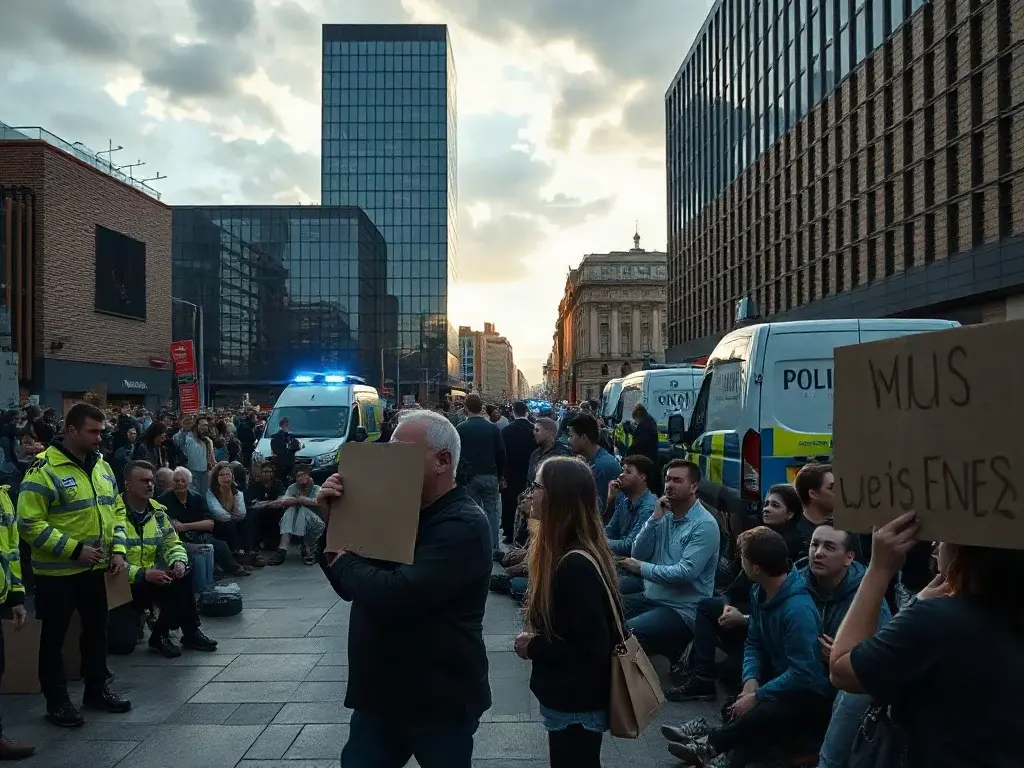
The latest wave of Palestine Action arrests has pushed a legal experiment in Britain into uncomfortable territory. More than 300 people were detained at a protest outside the US embassy in London in support of the group. More than 4,000 people have now been arrested for supporting it since it was proscribed in July 2025. Those figures matter less as protest statistics than as a stress test of how far counter-terrorism law can stretch before policing capacity, public consent and judicial scrutiny begin to push back. This analysis sets out what the arrests mean, why the ban is contested, and what to watch next.
What Happened at the US Embassy Protest
The protest took place outside the US embassy in London, in the Nine Elms district. Demonstrators publicly showed support for a group the UK government treats as a terrorist organisation. The reported total of more than 300 arrests fits a pattern: large, peaceful, deliberately provocative gatherings in which participants hold placards and wait to be detained by the Metropolitan Police.
The embassy is a pointed choice. Palestine Action’s stated target was the arms trade supplying Israel, and the United States is Israel’s most important military backer. Protesting there links the domestic question of free expression to foreign policy. It also puts the arrests in front of an international audience.
Background: Who Palestine Action Is and Why It Was Banned
The group and its methods
Palestine Action was founded in 2020 and became known for direct action against companies it linked to Israel’s military, above all Elbit Systems. Its tactics included breaking into premises, spraying red paint and damaging equipment. Supporters described this as obstruction of complicity in war. Critics, and eventually the government, described it as criminal damage escalating toward something more serious.
The trigger for proscription
The decisive moment came in June 2025, when activists broke into RAF Brize Norton and damaged aircraft of the Airbus A330 MRTT type. Ministers cited that incident, alongside earlier actions, when moving to ban the group. Parliament approved the order, and the proscription took effect in July 2025 under the Terrorism Act 2000. The order was made by the Home Secretary.
Why the Palestine Action Ban Produces Mass Arrests
The mechanism is straightforward, and it explains the numbers. Under section 13 of the Terrorism Act 2000, it is an offence to wear clothing or display an article in a way that arouses reasonable suspicion that a person is a member or supporter of a proscribed organisation. The maximum penalty is six months’ imprisonment. The offence does not require violence, damage or any link to Palestine Action’s past conduct. A sign is enough.
That low threshold creates a structural dynamic:
- Low barrier to offending: holding a placard supporting the group can be an arrestable act.
- Deliberate civil disobedience: organisers invite arrest to expose the law’s reach, so volume is a feature rather than a failure.
- Police obligation: officers who witness the alleged offence face pressure to enforce it consistently, which produces hundreds of arrests per event.
The result is a ban that creates its own offenders. Each large gathering generates a large arrest count, and the cumulative total passes 4,000 without any change in what participants are actually doing.
The Core Disagreement: Terrorism or Protest?
The government’s case
Supporters of the ban argue that a group willing to damage military infrastructure, and whose actions allegedly injured people on some occasions, falls within the statutory definition of terrorism, which includes serious damage to property designed to advance a political cause. They also argue that tolerating open support for a proscribed group would hollow out the proscription regime. On this reading, the arrests are enforcement of a valid law.
The critics’ case
Critics concede that criminal damage is criminal, but argue that it is a different category from terrorism as most people understand it. Human rights organisations such as Amnesty International criticised the ban, and the UN human rights chief, Volker Türk, reportedly described it as disproportionate. Their central argument is that the law treats peaceful expression of an opinion as equivalent to support for terrorism.
This is the strongest critique, and it deserves precision. The problem is not that the state may ban organisations. It is that a broad offence applied to mass peaceful protest strains the proportionality that European Convention on Human Rights protections for freedom of expression and assembly require. The Human Rights Act 1998 makes those rights enforceable in British courts.
The Courts and the Prosecution Problem
The ban has been challenged through judicial review, brought by the group’s co-founder. The outcome of that litigation, and of any appeals, will shape everything else. Readers should check current court records and official reporting for the latest position rather than rely on a single news summary, because the legal status has been moving.
A second pressure point is prosecution. An arrest is not a conviction. The Crown Prosecution Service must decide which of thousands of cases to charge, and courts must hear them. Publicly available reporting has indicated that only a fraction of those arrested have been charged so far. The gap between arrests and charges is itself a signal. It suggests either evidential difficulty, capacity limits or a prosecutorial reluctance to push thousands of otherwise law-abiding people through the criminal courts. I read this as the most important operational weakness in the policy, though the exact figures should be verified against official data.
The Cost of Enforcement
Mass arrests carry real costs, and they are rarely discussed in the abstract rhetoric of the debate.
- Policing resources: processing hundreds of people per protest requires officers, vans, custody suites and paperwork that are diverted from other work.
- Court backlog: if charging accelerates, an already congested system absorbs thousands more cases.
- Legitimacy: arresting elderly and first-time protesters under terrorism legislation risks eroding public trust in counter-terrorism powers generally.
- Criminal records: a conviction under a terrorism offence can affect employment, travel and professional licensing far beyond the sentence.
There is also a strategic cost. Counter-terrorism law works best when it carries broad public legitimacy. A policy that seems to many citizens to criminalise a placard weakens the moral clarity that proscription depends on.
Practical Implications for Protesters, Employers and Journalists
For those considering attending protests
The legal risk is concrete. Displaying support for a proscribed group can lead to arrest, and the distinction between expressing opposition to the ban and expressing support for the group is exactly what is contested. Anyone considering attending should seek independent legal advice and understand that arrest alone has consequences, including possible bail conditions and the seizure of phones.
For employers and institutions
Organisations should avoid treating arrest as proof of guilt. Policies on conduct, vetting and disclosure should wait for charge or conviction and take legal advice about how a terrorism-related offence differs from an ordinary public order matter.
For reporters and researchers
Precision matters. An arrest count is not a conviction count, and a group’s proscription does not settle contested facts about individual incidents. Reporting should separate the group’s actions, the legal definition of terrorism and the separate question of whether the ban is proportionate.
What Could Change Next
Several developments could alter the picture over the coming months. This is analysis rather than confirmed fact.
- Court rulings: a finding that the ban was unlawful, or a narrowing of how section 13 applies to peaceful protest, would undercut the arrest model overnight.
- Charging decisions: a shift toward cautions, fixed penalties or mass discontinuance would signal that enforcement has outrun political appetite.
- Parliamentary pressure: proscription orders can be revisited, and sustained cross-party criticism could force a review of the offence’s scope.
- Escalation: if the group’s networks or successors resume property attacks, the government’s case strengthens and the arrests become easier to defend.
Frequently Asked Questions
Why was Palestine Action banned?
The government proscribed it under the Terrorism Act 2000 in July 2025, citing a pattern of direct action causing serious property damage. The break-in at RAF Brize Norton in June 2025 was the major trigger.
Can you be arrested for supporting Palestine Action?
Yes. Under section 13 of the Terrorism Act 2000, displaying articles or wearing clothing that arouses reasonable suspicion of support for a proscribed group is an offence carrying up to six months in prison.
How many people have been arrested?
Reporting says more than 4,000 people have been arrested for supporting the group since the July 2025 ban, including more than 300 at the protest outside the US embassy.
Does an arrest mean a criminal conviction?
No. Arrest is the start of the process. Charges, trials and convictions are separate stages, and the number charged has been far lower than the number arrested.
The Number That Matters Is Not 4,000
The headline figure is striking, but the more revealing statistic is the ratio between arrests and outcomes, which has yet to be fully established in the public record. A law that can detain thousands but cannot convincingly prosecute them is functioning as a deterrent and a political signal rather than as criminal justice. That is a fragile basis for a terrorism offence.
Watch three things: how the courts resolve the challenge to the ban, whether the Crown Prosecution Service continues to charge at scale, and whether the protests keep growing or fade under legal risk. If arrests keep rising while convictions stay low, the unanswered question is whether the state will narrow the law, or whether it will accept that its most severe powers are being used against a form of dissent it cannot easily stop.
Frequently Asked Questions
Why does holding a placard lead to arrest if the person has done nothing violent?
Section 13 of the Terrorism Act 2000 criminalises displaying an article in a way that arouses reasonable suspicion of support for a proscribed organisation. It does not require violence, damage or any link to the group's past actions, so a sign alone can meet the threshold for arrest.
What is the maximum penalty for supporting Palestine Action under the ban?
The section 13 offence carries a maximum of six months' imprisonment. Being arrested is not the same as being convicted, though. Outcomes depend on whether prosecutors charge, what the evidence shows, and how courts interpret the law, which is one reason the ban is closely scrutinised.
Why did protesters choose the US embassy in London?
The choice is symbolic. Palestine Action targeted the arms trade supplying Israel, and the United States is Israel's most important military backer. Protesting at the embassy links the domestic free-expression dispute to foreign policy and gives the arrests an international audience.
Are the mass arrests a sign that the ban is failing?
Not necessarily, but they show how the law operates under deliberate civil disobedience. Organisers invite arrest to expose its reach, and officers who witness the alleged offence face pressure to enforce it consistently. The total therefore rises without any change in what participants actually do.
What event led the government to proscribe Palestine Action?
The decisive trigger was the June 2025 break-in at RAF Brize Norton, where activists damaged Airbus A330 MRTT aircraft. Ministers cited it alongside earlier actions. Parliament approved the order, and the Home Secretary's proscription took effect in July 2025 under the Terrorism Act 2000.
On what grounds do supporters of the ban say it counts as terrorism?
Supporters argue the statutory definition of terrorism includes serious damage to property designed to advance a political cause. They also say that tolerating open support for a proscribed group would hollow out the proscription regime, so the arrests are simply enforcement of a valid law.