
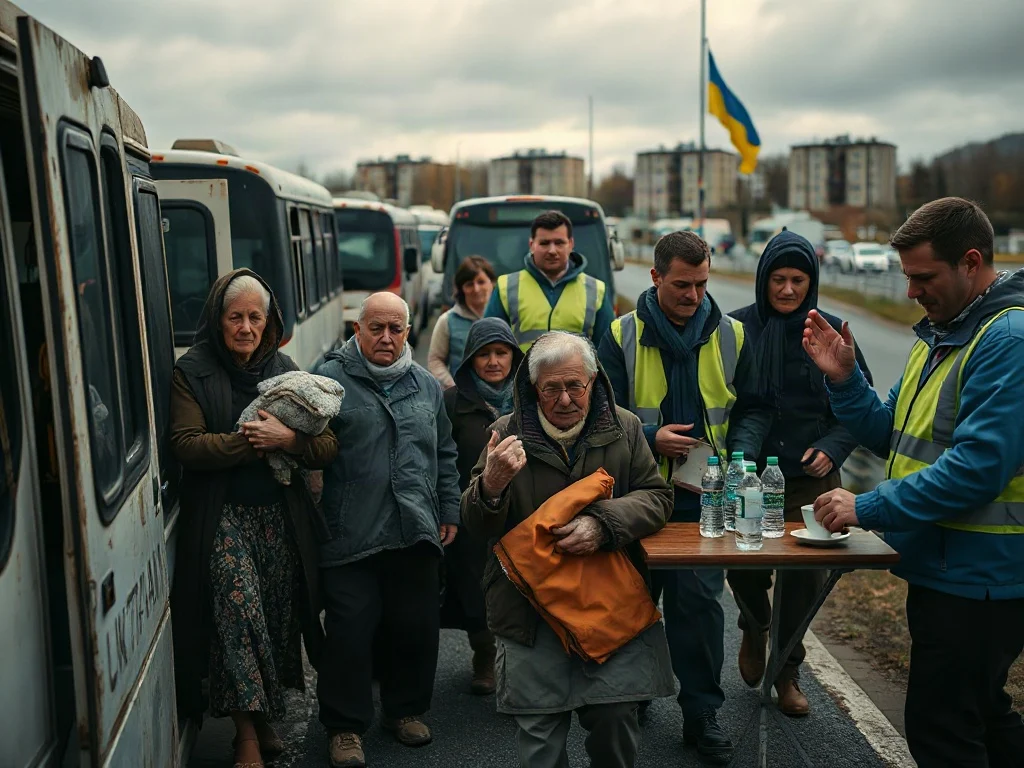
The Ukraine evacuation ceasefire that allowed evacuees to leave a devastated, Russia-occupied city on Friday is a major humanitarian event and a diplomatic anomaly. According to the initial report, residents who had reportedly been reduced to eating weeds arrived in Ukrainian-controlled territory after a truce brokered by US First Lady Melania Trump. Several details are not yet public: the number of evacuees, the route, the duration of the truce and the parties’ commitments. This analysis separates what is reported from what is unverified and asks what the episode says about how civilian rescues are negotiated in this war.
What Has Been Reported, and What Has Not
The available reporting supports four claims. The city is under Russian occupation and has been devastated. Residents were reportedly so short of food that they ate weeds. A ceasefire was brokered by the US First Lady. Evacuees then arrived in Ukraine on Friday.
Several things are not established in the source material:
- The total number of people evacuated and whether more remain.
- The precise terms of the ceasefire, including its duration and monitoring.
- Which intermediaries, if any, besides Melania Trump handled logistics.
- Independent verification of the food conditions described.
Treating these as open questions matters. Early accounts of humanitarian operations in wartime often change as more testimony and documentation emerge.
Why Civilians Resort to Eating Weeds
Foraging for wild plants is a recognized sign of acute food insecurity. It usually follows the collapse of supply chains, the destruction of markets and the loss of income. In a city cut off by front lines, residents cannot reach farmland or functioning shops, and aid convoys may be blocked or delayed. Prolonged shortages lead to malnutrition, and the elderly, children and people with chronic illness are hit first.
The Legal Dimension
Under the Fourth Geneva Convention, an occupying power has obligations toward the civilian population. These include ensuring food and medical supplies to the fullest extent of its means. Whether those obligations were met in this case is a legal and factual question that investigators, not press headlines, must answer. The wider framework is international humanitarian law, which also prohibits starvation of civilians as a method of warfare. Reports of residents eating weeds will likely draw scrutiny from organizations documenting conditions in occupied areas, though no formal finding should be assumed from the headline alone.
Why a First Lady Brokering a Ceasefire Is Unusual
Ceasefires for civilian evacuations are normally arranged by militaries, foreign ministries or neutral humanitarian bodies. The International Committee of the Red Cross has long served as a neutral intermediary in such operations. A First Lady of the United States holds no formal executive power, so a brokered truce attributed to her points to informal channels rather than conventional state-to-state negotiation.
Informal Diplomacy: Strengths
- Low political cost: A non-official figure can float proposals without committing governments to concessions.
- Narrow scope: A humanitarian ask, such as safe passage for civilians, is easier to accept than a broader political settlement.
- Access: Proximity to a head of state can speed approvals that bureaucracies would delay.
Informal Diplomacy: Weaknesses
- No institutional follow-through: Without monitors, a truce depends on goodwill.
- Accountability gaps: If the ceasefire is violated, there is no clear mechanism for response.
- Instrumentalization risk: Any party may use a humanitarian gesture for propaganda, and critics may question motives on every side.
This approach resembles what scholars call Track II diplomacy, informal contacts that complement official negotiation. Whether this episode fits that model depends on details not yet disclosed. The First Lady’s earlier public engagement on children affected by the conflict has been reported, but the scale of this role would be a notable step beyond it, and independent confirmation of how the arrangement worked is needed.
How a Humanitarian Corridor Works in Practice
A humanitarian corridor is a negotiated route, usually with a defined time window, along which civilians can leave a conflict zone or aid can enter. Success depends on several conditions:
- Agreed route and timing: Both sides must confirm the same road, checkpoints and hours.
- Verification: Neutral observers reduce the risk of attacks and disputes over violations.
- Transport and reception: Buses, fuel, medical staff and registration points must be ready at the destination.
- Voluntary participation: Civilians must be free to choose whether to leave, and where to go.
The last condition is the most contested. The rules on forced displacement require that evacuations not become coerced transfers. Since the evacuees here reached Ukrainian-controlled territory, the direction of travel is consistent with a voluntary choice, though the conditions at departure still deserve independent examination.
Why Corridors Often Fail
Over the course of the Russian invasion of Ukraine, several announced corridors reportedly collapsed because of disputes over routes, alleged shelling or lack of coordination. A truce that actually delivers people to safety is therefore the exception, which is why this event deserves attention and careful verification.
What Happens After Arrival
Evacuees become internally displaced persons if they remain in Ukraine, and their needs are immediate and layered:
- Medical triage: Prolonged hunger requires careful refeeding, because rapid reintroduction of food can be dangerous for severely undernourished people.
- Documentation: People leaving occupied areas may lack identity papers, which blocks access to benefits and housing.
- Psychological support: Trauma care is as urgent as food and shelter.
- Family tracing: Separated relatives must be located, especially if some residents stayed behind.
Reception capacity is a quiet determinant of whether future evacuations are feasible. Even with a ceasefire, the process stalls if receiving regions lack housing and funding. International humanitarian aid agencies typically carry much of this burden, and their funding is neither guaranteed nor politically neutral.
Critical Perspectives
The Optimistic Reading
One reading holds that a small success can build trust. If both sides honored a limited truce for civilians, the precedent shows that narrow agreements are possible even without a wider political settlement. Advocates of this view argue that humanitarian steps can open space for further exchanges.
The Skeptical Reading
A skeptic would point to scale. Evacuating one city’s residents, however vital, does not change conditions elsewhere in occupied territory. If an informal channel produced this outcome, the question is why formal channels did not, and whether the result can be repeated. There is also the risk that high-profile gestures substitute for sustained pressure to grant aid agencies consistent access.
The Accountability Question
If civilians were left to forage for weeds, the underlying issue is responsibility for their conditions, not only their rescue. A single evacuation does not answer who controlled access to food and medicine, and the incident should not be allowed to close the matter.
Practical Lessons for Humanitarian Planners
- Document early: Testimony from evacuees, medical records and satellite imagery become evidence for later review.
- Pre-position reception services: Truces can be brief, so transport and medical capacity must be ready before the window opens.
- Keep neutral monitors involved: Even when brokered informally, evacuations are safer with organizations such as the Red Cross present.
- Avoid overstating outcomes: Premature claims of success can damage credibility if the truce later breaks down.
Frequently Asked Questions
Who brokered the ceasefire?
According to the report, US First Lady Melania Trump brokered it. Details of how the agreement was reached have not been independently detailed in the source material.
Why were residents eating weeds?
The report indicates severe food shortages in the occupied city. Such conditions typically follow disrupted supply lines and a lack of access to markets and aid, though the specific causes here require verification.
How does a humanitarian corridor work?
It is a negotiated safe route with an agreed time window, ideally monitored by neutral parties, allowing civilians to leave or aid to enter a conflict zone.
Are more evacuations expected?
The initial report does not say. Any follow-up depends on whether the truce terms cover further departures and whether both sides keep their commitments.
The Real Test Comes After the Buses Stop
The most important insight is that this evacuation matters less for who brokered it than for whether it can be repeated and verified. A single successful truce proves feasibility, not reliability. The people who remain in occupied territory, if any, are the measure of success, and so is the willingness of all parties to allow independent monitors in.
Watch for four developments. First, publication of the ceasefire’s terms and the evacuee count. Second, testimony and independent assessments of conditions in the city. Third, whether humanitarian organizations gain regular access to occupied areas. Fourth, whether the informal channel produces further agreements or fades without institutional backing. A reasonable prediction is that, without formal mechanisms, similar truces will stay sporadic and dependent on personalities. The unanswered question is whether this episode will push governments toward sturdier, monitored arrangements or remain a one-off exception in a conflict where such exceptions have been rare.