
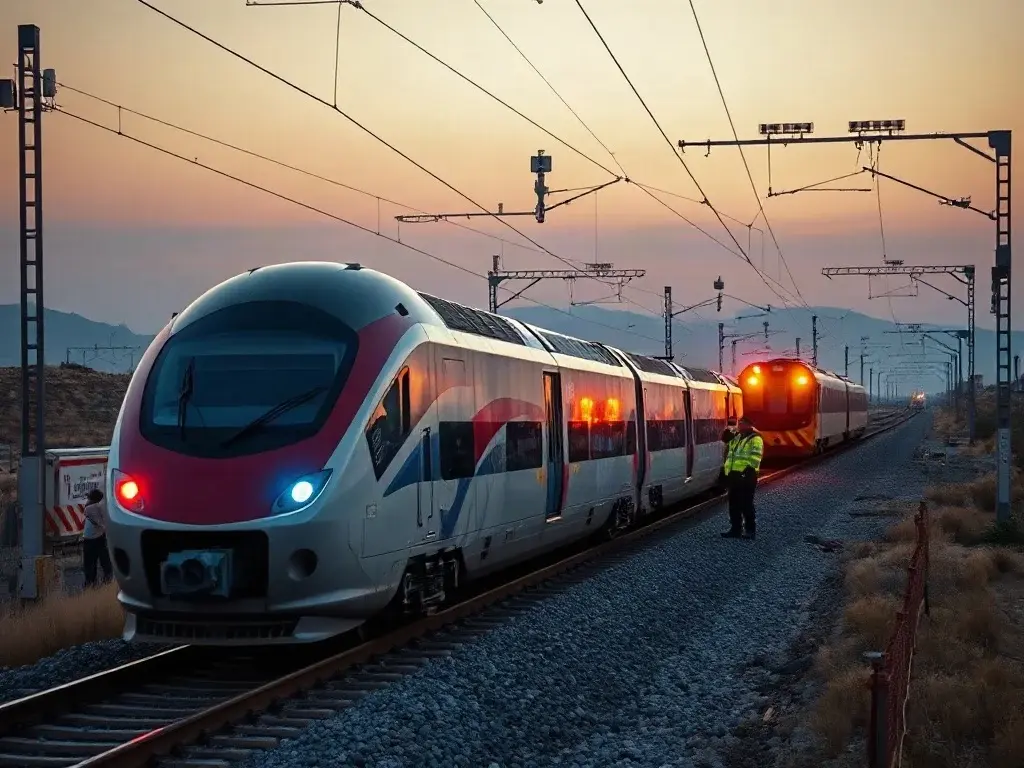
A high-speed train collision in Spain has killed at least 68 people, making it one of the deadliest rail accidents in the country’s modern history. According to the transport minister, the crash occurred between a moving train and another that had stopped further up the track, and was triggered by an error the minister described as “inexplicable.” The description matters: a stopped train on a high-speed line should be protected by layered safety systems, so the failure of several safeguards at once is the central question for investigators. This article examines what is known about the collision, the systems designed to prevent such events, and the broader consequences for high-speed rail safety.
What Is Known About the Collision
The accident involved two trains on the same line. One was moving at speed while the other had come to a halt farther along the track. Official statements have so far attributed the event to a human or systemic error that the transport minister characterized as inexplicable, a term that signals authorities have not yet identified a single clear cause. Early reporting therefore should be treated as provisional. Investigators typically examine signalling records, train event data recorders, communications logs, track condition, and the actions of operating staff before drawing firm conclusions.
The Meaning of “Inexplicable” in Accident Investigation
In transport accident analysis, an error described as inexplicable usually means that the event contradicts the expected operation of the system rather than that no explanation exists. Investigators work through a sequence of hypotheses: whether a signal was displayed incorrectly, whether an automatic train protection system failed to intervene, whether a driver responded to a signal or instruction, and whether a control centre issued conflicting authorizations. Each possibility points to a different category of responsibility, from individual operator action to engineering design or maintenance failure. Until these are separated, public attribution of blame is premature.
How High-Speed Rail Prevents Collisions
Modern high-speed networks rely on overlapping protections rather than a single barrier. Understanding these layers is essential to evaluating how a collision of this scale could occur.
Signalling and Train Control
The core mechanism is the signalling system, which tells a driver whether the track ahead is clear and what speed is permitted. In Europe, the European Train Control System is the standard framework designed to enforce speed limits and stop trains automatically when they approach danger. Spain’s high-speed network uses variants of this and related national systems. Where they function as intended, a train that approaches an occupied section should be braked automatically, regardless of driver response.
Block Sections and Track Occupancy Detection
Lines are divided into block sections, and the system tracks whether each section is occupied. Occupancy detection relies on track circuits or axle counters. A failure in detection, or a misconfigured block, can present a clear track where a train is in fact stationary. This is one of the most technically demanding areas of rail safety because it depends on continuous electrical or electronic verification.
Human Factors and Operational Procedures
Even with automated protection, humans remain involved in authorizing movements, responding to alarms, and managing disruptions. Procedures for halting trains, reporting incidents, and handling degraded signalling exist precisely because the automation is not infallible. Human factors research consistently shows that operators can be overloaded during disruptions, and that complex interfaces can obscure critical information. Investigations often reveal that a chain of small deviations, rather than one dramatic mistake, produced the outcome.
Historical Context and Comparative Safety
Spain’s rail network has expanded rapidly since the Madrid–Seville high-speed line opened in 1992, and it now ranks among the largest high-speed networks in the world. High-speed rail has a strong safety record overall, and fatal accidents on these networks are historically rare relative to passenger volume. Comparing the scale of this incident with previous European rail disasters, such as the Eschede train disaster in Germany, shows that major losses of life in modern rail usually result from a combination of technical failure and operational breakdown rather than from a single cause. Such comparisons are useful, but they should not be used to pre-judge the present investigation.
Competing Explanations and Expert Considerations
Analysts generally weigh three broad explanations. The first is individual operator error, where a driver or controller acted against procedure. The second is technical failure, where signalling, detection, or braking systems did not perform as designed. The third is organizational, where maintenance, training, staffing, or communication gaps created conditions in which an error could propagate. Experts in rail safety often argue that the third category is underweighted in initial public discussion, because it addresses why a single mistake was not caught by redundancy. Independent investigators also face the challenge of accessing proprietary system data, which can slow the process.
Regulatory and Economic Dimensions
Any serious accident prompts questions about regulation, maintenance budgets, and the pace of network expansion. Critics of rapid rail development argue that investment can outstrip maintenance and workforce capacity. Defenders counter that high-speed rail remains safer per passenger-kilometre than road travel and that accidents are best addressed through upgrades rather than retrenchment. Both positions depend on data that will only become clear after the official findings are published.
Implications for Passengers and Operators
For passengers, the immediate lesson is that high-speed travel remains statistically very safe, but that confidence rests on the integrity of systems that must be audited continuously. For operators, the practical priorities include verifying that automatic protection cannot be bypassed without detection, testing degraded-mode procedures, reviewing staff response under disruption, and ensuring that incident data is recorded and shared with investigators. Common mistakes in safety management include treating redundancy as a substitute for regular testing and assuming that automation removes the need for active human oversight.
Future Developments in Rail Safety
The most important development to watch is the investigation’s final report, which will determine whether the failure was isolated or systemic. Over the coming years, several trends are likely to shape the response. Predictive maintenance using sensor data may reduce reliance on scheduled inspection. Enhanced train control and cross-border interoperability projects in Europe are expected to add protection layers, though their deployment timelines are long. Regulators may also tighten requirements for incident reporting and staff competency. These are reasonable expectations based on past responses to rail accidents, but their specific form will depend on what the investigation finds.
Frequently Asked Questions
What caused the high-speed train crash in Spain?
Officials have said the collision resulted from an error described as inexplicable by the transport minister. The precise technical and human causes have not been confirmed and will depend on the formal investigation.
How many people died in the Spanish train crash?
At least 68 people were reported killed. Figures may change as investigators and authorities confirm details.
Are high-speed trains safe?
High-speed rail has a strong overall safety record, and fatal accidents are rare relative to the number of passengers carried. Safety depends on signalling, maintenance, and operational discipline working together.
The Question the Investigation Must Answer
The phrase “inexplicable error” leaves the central issue open: how a stationary train on a protected high-speed line could be struck by a moving one when multiple safeguards are designed to prevent exactly that outcome. The answer will reveal whether the failure lay in a single decision, in the detection and signalling chain, or in the organizational conditions that allowed small faults to align. Readers should watch for the published preliminary findings, any statements on signalling data, and whether authorities announce audits across the network. If the cause proves systemic rather than individual, the consequences for Spanish and European rail policy could extend well beyond this single tragedy.
Frequently Asked Questions
Why did the transport minister call the error inexplicable?
In accident analysis, calling an error inexplicable usually means the event contradicts how the system was supposed to work, not that no explanation exists. Authorities have not yet identified a single clear cause, so investigators are still testing hypotheses about signals, automatic protection, driver actions and control-centre instructions before assigning responsibility.
Why is it so serious that a stopped train was not protected?
A stopped train on a high-speed line should be shielded by several overlapping safety layers, including signalling, automatic train protection and occupancy detection. If all of them failed at once, the event points to a systemic weakness rather than a single mistake, which is why investigators focus on how multiple safeguards broke down simultaneously.
What does the European Train Control System do to prevent collisions?
It enforces speed limits and can stop a train automatically when it approaches danger, regardless of the driver's response. Spain's high-speed network uses variants of this framework alongside national systems, so when it works as intended, a train approaching an occupied section should be braked automatically.
How can a track appear clear when a train is actually stationary on it?
Lines are divided into block sections, and occupancy is detected by track circuits or axle counters. A detection failure or a misconfigured block can show a section as empty even when a train is there. This is one of the most technically demanding areas of rail safety because it requires continuous verification.
Could human error alone explain a crash like this?
Rarely, because automated protections are designed to catch individual mistakes. Investigations of rail accidents often find a chain of small deviations, such as overloaded operators, unclear information or procedural gaps, combining with technical faults. Attributing the crash to one person before that analysis is complete would be premature.