
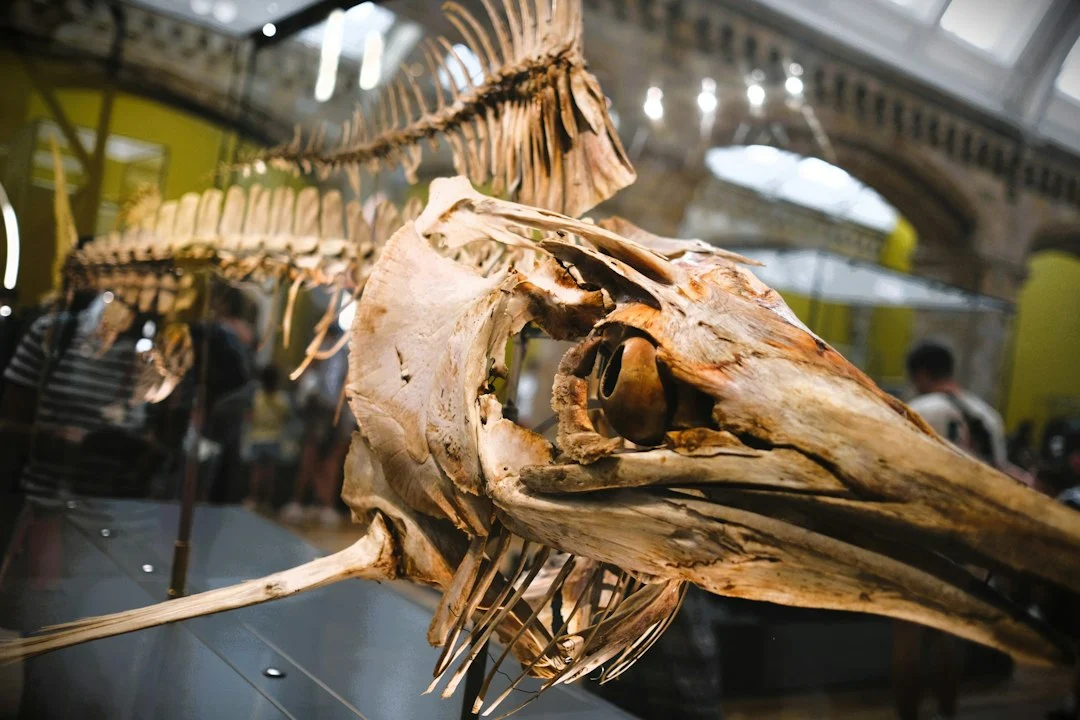
The discovery of a giant ichthyosaur fossil on a UK beach is the kind of story that invites easy spectacle and lazy mythmaking. The phrase sea dragon is irresistible, but it also blurs the scientific point: a 10-metre ichthyosaur is not a monster from folklore. It is a highly adapted marine reptile from the Jurassic, preserved through accident, erosion, and luck. What makes the find important is not only its scale. It is the fact that a large vertebrate skeleton has moved from the shore, where the fossil might have been destroyed by the next tide, into a controlled setting where paleontology can study it.
That transition from beach to museum matters because fossils are evidence, not trophies. The specimen can help reconstruct the anatomy, ecology, and preservation conditions of an animal that lived roughly 174 million years ago. It can also show how the Mesozoic seas worked: who ate whom, what the water chemistry looked like, and how sediments trapped remains before scavengers or waves could erase them. In that sense, the article is not just about a big skeleton. It is about the thin line between a once-in-a-century discovery and ordinary coastal erosion.
Why the beach discovery matters more than the headline
The public reaction to a giant fossil is predictable: size grabs attention, and the idea of a sea dragon sells itself. But the scientific meaning of a find like this depends on context, not drama. If the bones were found embedded in the right layer of rock, recorded accurately, and lifted with care, the specimen could become a meaningful data point. If not, it risks becoming little more than a showpiece. That distinction matters in paleontology, where the surrounding deposits can be as important as the bones themselves.
Britain is unusually familiar with this tension. The Jurassic Coast has made coastal fossil finds part of the national imagination, and places such as Lyme Regis remain central to that history. The tradition goes back to Mary Anning, whose work helped turn fossil collecting from curiosity into science. The modern version is less romantic but more rigorous: document the find, stabilise it, and ask what it can prove.
The setting also matters because the geology of the United Kingdom is especially rich in exposed marine strata. Many coastal cliffs and foreshore platforms cut through sedimentary rock, so erosion does not just destroy fossils. It also reveals them. This is why beach finds can appear suddenly, and why trained observers are essential. A fossil can spend millions of years hidden in stone, then become accessible for only a few days before the sea takes it back.
What an ichthyosaur actually was
Reptile, not dinosaur
The first correction is simple but necessary: an ichthyosaur was not a dinosaur. It was a marine reptile that evolved a streamlined body, flippers, and a tail built for efficient swimming. The convergence with dolphins is obvious, but the resemblance is functional rather than genealogical. Different lineages arrived at similar body plans because water rewards speed, balance, and reduced drag.
That distinction matters because headlines often flatten evolutionary history into a single label. Calling the fossil a sea dragon is fine as a rhetorical shorthand. Calling it a dinosaur would be wrong. The animal belongs to a broad marine branch of reptiles that flourished during the Mesozoic, when the oceans hosted a diverse cast of predators. The fossil therefore speaks to a world in which reptilian lineages repeatedly adapted to marine life rather than one in which dinosaurs simply went swimming.
Why the sea dragon label sticks
Journalistic language tends to prefer memorable images over exact taxonomy. Sea dragon sounds vivid, and the public already understands dragons as large, ancient, and dangerous. But the label hides the real story: a highly specialised predator with a biological history that can be studied bone by bone. If the skeleton is sufficiently complete, researchers can compare its shape with other ichthyosaur material and determine whether it belongs to a known genus, a known species, or something more unusual.
That identification is not trivial. In paleontology, a large skeleton is not automatically a scientifically important skeleton. Completeness, articulation, and preservation quality often matter more than size. A 10-metre animal with a damaged skull may tell us less than a smaller specimen with a well-preserved jaw, vertebrae, and rib cage. The headline can celebrate scale, but science values structure.
How a fossil of this size survives on a beach
The geology underneath the spectacle
Large marine reptile fossils are most likely to survive when an animal is buried quickly in fine-grained sedimentary rock. Rapid burial reduces scavenging, slows decay, and limits disturbance from currents. Over time, mineral-rich water replaces or infills organic tissue, leaving a durable record in stone. On the British coast, later erosion exposes those rocks again, often after centuries of relative stability.
The relevant time window here is the Jurassic, and at around 174 million years ago the animal lived in a sea that was far from empty. Ammonites, fish, and other predators formed a dynamic food web. A fossil from that interval can therefore be read as more than an isolated relic. It is a clue to the broader ecology of the Jurassic marine realm. The surrounding deposits may also preserve smaller fossils that help reconstruct the environment in which the creature died and was buried.
Why preservation quality matters
Big fossils can be misleading. A huge skeleton with weathered surfaces, broken bones, or distorted layers of rock may look dramatic but offer limited scientific value. By contrast, a specimen that remains partly articulated can reveal posture, swimming orientation, and anatomical detail. Researchers also pay attention to the matrix around the bones. The surrounding rock can preserve sedimentary structures, shell fragments, and geochemical signals that help explain how the animal ended up there.
That is where stratigraphy becomes essential. Without the precise level and layer, a fossil loses context. Knowing that an animal comes from the Jurassic is useful. Knowing exactly which bed, horizon, and depositional setting produced the specimen is better. The difference is the difference between a story and a dataset.
From accidental find to public display
Preparation is where the real work begins
Once a fossil is reported, the hard part starts. Conservators and researchers must stabilise the bone, document the find spot, and decide whether to remove the specimen in blocks or expose it in place. Large pieces may need plaster jackets, consolidants, and slow mechanical preparation under microscopes. This stage is time-consuming and technical, which is why the public often underestimates the labour behind a museum display.
Preparation can take months. It is not just cleaning. It is controlled reduction, repair, and interpretation. In some cases, the work reveals details that were invisible in the field: tooth sockets, bone sutures, healed injuries, or chemical traces of soft tissue. Those details can make the difference between a visually impressive specimen and a publishable one. The same specimen can therefore serve two audiences at once: visitors who want the spectacle, and specialists who want the evidence.
Display is not the same as research publication
Putting the fossil on display is a public win, but it is not the final scientific step. A mounted skeleton can educate visitors, but it does not by itself settle the taxonomy or ecology of the animal. That is why the best fossil projects separate exhibit value from research value. The exhibition explains why the specimen matters. The publication explains what it means.
That distinction is easy to miss when a story is framed as a once-in-a-lifetime discovery. In reality, science advances when specimens are compared with collections, measured against existing literature, and tested against alternative interpretations. A museum display is a milestone. It is not the end of analysis.
What the fossil can actually tell researchers
Size, feeding, and ecology
A 10-metre animal was likely a major predator, but size alone does not reveal its diet or behaviour. Some ichthyosaurs had long, narrow snouts suited to catching small, fast prey. Others had broader jaws and more robust teeth. Skull shape, tooth wear, and jaw mechanics can suggest how the animal fed, how it swam, and where it sat in the food web. If the fossil is complete enough, it may also help researchers understand growth patterns and age-related changes within the species.
That matters because the Jurassic seas were ecologically diverse. Ichthyosaurs shared them with plesiosaurs, fish, and cephalopods, including ammonites. These animals occupied different niches, competed for resources, and responded to changing sea levels and temperatures. A single skeleton can help reconstruct that larger pattern if it preserves enough diagnostic information.
The broader Jurassic marine world
This is where the specimen becomes more than a local curiosity. The fossil provides evidence for how a marine predator lived in a complex ancient environment. It may help refine estimates of size, mobility, and even biodiversity across the western European seaways. For researchers, that is more valuable than a sensational nickname. For the public, it is a reminder that the sea once held reptiles as specialised as any land animal.
Why the story matters to the public, not just specialists
There is a social reason this find resonates. Fossils are one of the few forms of deep time that ordinary people can encounter directly. A beach find collapses the distance between the present and the Jurassic in a way that textbooks cannot. That makes the fossil powerful as education, but also vulnerable to overinterpretation. The public often wants certainty, while science works through revision. A specimen may begin as a dramatic discovery and later turn into a narrower but more precise object of study.
The story also shows why citizen discovery still matters. Without observers on the shore, many fossils would be lost to the tide. Yet discovery alone is not enough. Poor handling can destroy context, and unregulated collecting can strip the scientific value from a site. The best outcome is a disciplined chain of custody: report the find, document it, conserve it, and make it accessible through a museum or research institution. In that sense, the beach find is not just a lucky accident. It is a test of whether public interest and scientific method can work together.
What the headline gets right, and what it leaves out
The headline is right to emphasise rarity and scale. A giant fossil vertebrate from the Jurassic is impressive by any standard. But sea dragon is an aesthetic label, not a scientific one, and it risks turning an evidence-rich specimen into a curiosity. The more important question is what kind of material was actually recovered: a skull, a spine, a partial skeleton, or a near-complete individual. That detail determines how much the fossil can teach.
This is a common weakness in popular fossil reporting. The larger and stranger the specimen, the more likely the story will lean on wonder rather than method. But a good fossil story should do the opposite. It should explain what was found, how it was preserved, and what questions remain open. If the media attention outpaces the documentation, the science loses out.
FAQ
Is an ichthyosaur a dinosaur?
No. An ichthyosaur was a marine reptile, not a dinosaur. Dinosaurs were primarily terrestrial animals, while ichthyosaurs evolved for life in the sea and developed streamlined bodies, flippers, and other adaptations for swimming.
Why are so many fossils found on UK beaches?
Because parts of the UK coast expose fossil-rich sedimentary rock, especially along the Jurassic Coast. Erosion reveals new material, and tides can move it into places where people can find it. The same process can also destroy fossils before they are recorded.
What makes a fossil scientifically valuable?
Completeness, context, and documentation. A specimen with clear location data, correct stratigraphy, and minimal damage is more useful than a visually dramatic fragment. In paleontology, the surrounding rock and associated remains often matter as much as the bone itself.
How long does it take to prepare a fossil for display?
There is no fixed timeline. Small specimens can take weeks; large, fragile fossils can take months or longer. Preparation depends on the hardness of the matrix, the condition of the bone, the amount of reconstruction needed, and whether specialists need to compare it with other material in a museum collection.
What to watch next
The next meaningful step is not another headline but a publication trail. Researchers will want to know whether the skeleton can be identified beyond the broad label ichthyosaur, whether it preserves unusual anatomy, and whether it changes existing ideas about Jurassic marine predators. If the specimen is CT-scanned, compared with existing collections, and described in technical detail, it could become more valuable over time rather than less.
The deeper issue is environmental. As coastlines erode, more fossils will appear, but not all of them will survive long enough to be studied. That makes the future of discovery depend less on dramatic luck than on fast reporting, skilled conservation, and institutions that can absorb unexpected finds. The real insight from this specimen is that the ground is still producing new evidence, but only systems with discipline can turn that evidence into knowledge. The question now is not whether more Jurassic giants are out there. It is whether we are prepared to record them before the sea takes them back.
Frequently Asked Questions
Why is a giant fossil more scientifically important than just being impressive to the public?
Its size draws attention, but the real value comes from context. If the skeleton was found in the correct rock layer and carefully documented, it can help reconstruct the animal’s anatomy, diet, and environment. Without that context, a large fossil is mostly a display piece rather than strong scientific evidence.
Why does it matter that the fossil was moved from the beach into a controlled setting?
A beach fossil can be lost quickly to erosion, tides, or damage. Once collected and stabilized, researchers can study it properly and preserve it for the long term. That shift turns a fragile coastal find into a reliable specimen that can be measured, compared, and interpreted in detail.
Was an ichthyosaur a dinosaur, or something different?
It was something different: a marine reptile, not a dinosaur. Ichthyosaurs evolved streamlined bodies, flippers, and tails for swimming, much like dolphins, but independently. That makes them an important example of convergent evolution, where unrelated animals develop similar shapes because they live in similar environments.
What can the surrounding sediment tell scientists that the bones alone cannot?
The sediment can reveal how the animal was buried, what the water conditions were like, and whether scavengers or currents affected the remains. It can also help date the fossil more precisely. In paleontology, the matrix around the bones often provides the environmental story that the skeleton by itself cannot tell.
Why do UK beaches seem to produce so many important fossil discoveries?
Britain has extensive coastal exposures of Jurassic and other marine rocks, so erosion constantly uncovers new fossils. Beaches and cliffs can reveal specimens that stayed hidden for millions of years. The same processes that expose fossils can also destroy them, which is why quick reporting and careful collection are so important.