
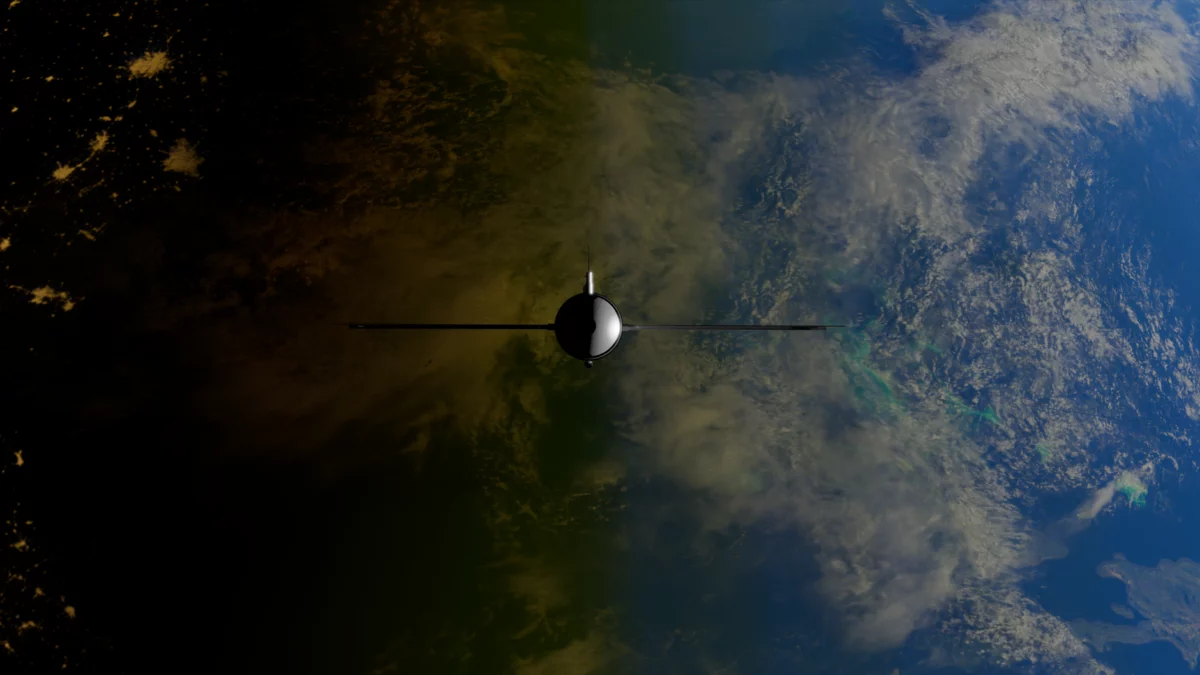
Japan’s MMX mission is designed to accomplish something no spacecraft has done before: collect material from a moon of Mars and return it to Earth. Led by the Japan Aerospace Exploration Agency, the ambitious probe will travel to Phobos, observe both Martian moons, land briefly to gather samples, and send those samples home for laboratory analysis. Beyond setting a technical milestone, the mission could resolve a long-running debate about how Phobos and Deimos formed—and reveal how material has moved through the Martian system over billions of years.
Formally known as Martian Moons eXploration, MMX represents Japan’s return to Mars exploration after the Nozomi spacecraft, launched in 1998, was unable to enter Martian orbit. The new mission combines Japan’s proven asteroid-sampling expertise with international instruments, a small rover, remote sensing, and unusually demanding navigation near a low-gravity moon. This analysis explains how the mission will work, what researchers hope to learn, and why a handful of Phobos material may transform the scientific understanding of Mars.
What Is Japan’s MMX Mission?
Martian Moons eXploration, commonly abbreviated as MMX, is a sample-return mission developed by the Japan Aerospace Exploration Agency. According to the official MMX project, its central objectives are to determine the origin of the Martian moons, study the processes affecting the Mars system, and improve the technology required for round-trip exploration.
Under JAXA’s published schedule, MMX is expected to launch during Japan’s fiscal year 2026, enter the Martian system in fiscal year 2027, and return its sample capsule to Earth in fiscal year 2031. Mission dates remain subject to launch readiness, spacecraft testing, and orbital constraints. The probe is intended to travel aboard Japan’s H3 launch vehicle.
Once near Mars, MMX will enter specialized orbits that allow repeated observations of Phobos. It will map the moon’s surface, measure its composition and internal characteristics, evaluate candidate landing areas, and attempt to collect more than 10 grams of material. The spacecraft will also conduct multiple observations of Deimos, Mars’s smaller and more distant moon, before beginning the return journey.
Why Phobos Is a High-Value Scientific Target
Phobos is an irregularly shaped body measuring roughly 27 kilometres along its longest dimension. It orbits exceptionally close to Mars—closer to its planet than any other moon in the Solar System—and completes an orbit in less than eight hours. Its surface is dark, heavily cratered, and dominated visually by the large Stickney crater.
Phobos is also moving gradually inward. Tidal interactions with Mars are reducing its orbital altitude, so it will not remain in its present state indefinitely. Estimates of its eventual fate vary, but it may break apart to form a temporary ring or collide with Mars tens of millions of years from now. That distant outcome is not an operational concern for MMX, yet it illustrates how dynamic the Martian satellite system is.
The unresolved question of origin
The mission’s primary scientific problem is deceptively simple: where did Phobos and Deimos come from? Their dark surfaces and irregular shapes resemble primitive asteroids, supporting the hypothesis that Mars captured them early in Solar System history. However, capturing one object into a stable, nearly circular equatorial orbit is dynamically difficult; capturing two objects into such configurations is more difficult still.
A competing model proposes that a major impact on early Mars ejected material into orbit. Debris could then have formed a disk around the planet and accumulated into one or more moons. In that scenario, Phobos might contain Martian material mixed with impactor debris rather than the primitive matter expected from a captured asteroid.
Remote observations have not settled the argument because different materials can produce broadly similar dark spectra after billions of years of radiation exposure, micrometeorite impacts, and space weathering. Laboratory measurements of returned grains can identify minerals, isotopes, organic compounds, and elemental ratios at a precision that orbiting instruments generally cannot match.
The decisive value of a Phobos sample is not simply that it comes from a new world. Its chemistry could distinguish between fundamentally different accounts of how planets acquire moons.
How the Phobos Sample Return Will Work
A sample-return mission must perform every major stage successfully: interplanetary navigation, orbital insertion, surface reconnaissance, descent, sampling, ascent, Earth return, and capsule recovery. Unlike a conventional orbiter, it cannot compensate for a failed collection by relying only on remote observations.
Operating near an irregular moon
Phobos has extremely weak gravity and an uneven gravitational field. A spacecraft cannot orbit it in the same straightforward manner that satellites circle Earth. MMX will instead use trajectories shaped by the combined gravitational influence of Mars and Phobos, enabling repeated close observations while remaining dynamically stable enough for mission operations.
Detailed mapping is essential because the landing area must balance scientific value with engineering safety. Large rocks, steep slopes, deep regolith, and uncertain surface strength could threaten the spacecraft. Engineers must also account for the fact that even a gentle contact can produce substantial motion in such low gravity.
Touchdown and sample acquisition
MMX is designed to use complementary sampling methods, including a coring mechanism that can obtain material from beneath the immediate surface. Collecting subsurface grains matters because the uppermost layer has endured prolonged solar radiation and space weathering. Material from greater depth may better preserve the moon’s original composition.
The spacecraft is expected to make brief surface contacts rather than remain as a conventional long-lived lander. After securing the samples in a return container, it will leave the vicinity of Mars and release an Earth-entry capsule near the end of its journey.
Japan has relevant experience from Hayabusa2, which returned samples from asteroid Ryugu in 2020. Nevertheless, Phobos presents a different navigation environment, a more distant destination, and the added complexity of operating deep inside Mars’s gravitational domain.
An international rover and instrument suite
The mission includes a small rover developed through cooperation between Germany’s DLR and France’s CNES. It is intended to descend to Phobos before the main spacecraft’s sampling attempt, study the regolith at close range, and provide practical information about how the surface behaves in weak gravity. Its mobility experiment may also inform future exploration of small bodies.
Additional instruments will examine surface composition, topography, dust, radiation, and the environment around Mars. NASA is contributing the MEGANE gamma-ray and neutron spectrometer; its name is derived from
Frequently Asked Questions
How can Phobos samples reveal whether the moon was captured or formed after a Martian impact?
Laboratory measurements can identify minerals, elemental abundances, isotopes, and ages far more precisely than remote instruments. Primitive, carbon-rich material resembling certain asteroids would support capture. Samples dominated by heat-altered Martian minerals or mixtures of Mars and impactor material would instead favor formation from an impact-generated debris disk.
Why does MMX need to return more than 10 grams when spacecraft can analyze material remotely?
Returning material allows scientists to use large, evolving laboratory instruments that cannot fit aboard a spacecraft. More than 10 grams can support multiple tests, preserve material for future research, and help researchers distinguish native Phobos grains from possible Martian ejecta deposited on its surface.
Why is landing on Phobos especially difficult despite its weak gravity?
Weak gravity makes conventional landing techniques unreliable because the spacecraft can rebound or drift away after contact. Phobos also has an irregular shape and a complex gravitational environment influenced by nearby Mars. MMX must navigate precisely, select a safe surface, touch down briefly, collect material, and depart without losing control.
Could the sample contain material originally ejected from Mars?
Yes. Large impacts on Mars can launch rocks into space, and some debris may eventually settle on Phobos. Such grains could complicate interpretation of the moon's origin, but they are also scientifically valuable because they may preserve records from multiple Martian locations and ancient periods without requiring landings across Mars.
Why will MMX observe Deimos if it is collecting samples only from Phobos?
Comparing both moons may show whether they share a common origin or experienced different evolutionary histories. Measurements of Deimos's shape, surface composition, craters, and orbital environment can test models involving asteroid capture or an impact-generated disk, strengthening the interpretation of the returned Phobos samples.