
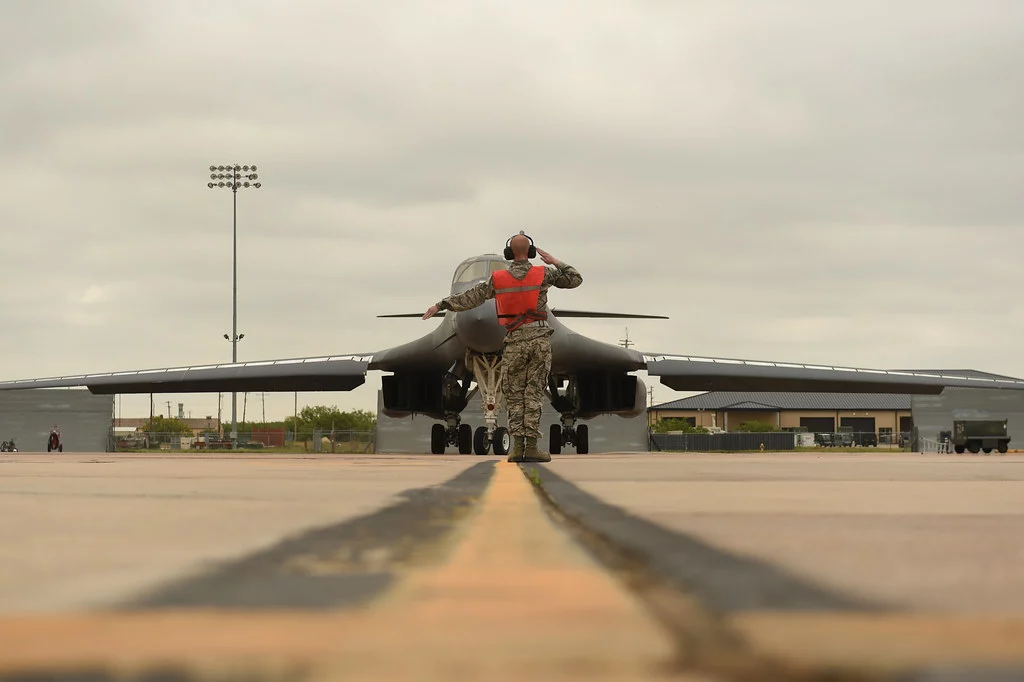
The sudden withdrawal of B-1 bombers at RAF Fairford is more than a routine redeployment. When the Pentagon confirmed that all U.S. aircraft had returned home after a security incident near the base, it turned a local alarm into an international signal. The episode sits at the intersection of United States Air Force operations, allied deterrence, and the fragile reality behind every modern strategic bomber mission.
For anyone watching transatlantic defense, the story is not just about a runway in England. It is about how quickly aircraft can be moved, how carefully a base must be protected, and how a single suspicious report can interrupt the rhythm of a multinational deployment.
What Happened at RAF Fairford?
According to the reported sequence, suspicious activity near RAF Fairford prompted nearby evacuations, police moved in, and the area was searched. Officials later said no explosives were found, yet the response had already done its job: it reduced risk quickly. Five London-based British men were arrested and later released on bail, leaving investigators to sort out what triggered the alert. In security terms, the speed of the response mattered as much as the final finding.
That kind of response is familiar to people who study modern defense. The goal is not to wait for certainty when the stakes are high; it is to act fast enough that uncertainty does not become catastrophe. In this case, the base did what a well-run military site is supposed to do: protect people first, then restore normal operations.
Why the Base Matters Beyond Gloucestershire
RAF Fairford, a Royal Air Force station in Gloucestershire, has long mattered because it is not an ordinary parking spot for military hardware. Its long runway and support layout make it suitable for heavy jets, and its role as an allied military base gives it strategic weight well beyond county lines. The incident therefore matters not only to Britain, but to NATO planners watching the balance between visibility and vulnerability.
Fairford’s importance is also historical. During the Cold War, airfields like this carried enormous symbolic value because they showed that the alliance could move fast, project force, and keep pressure on an adversary without permanent escalation. That logic has not disappeared. It has simply become quieter, more technical, and more dependent on precise coordination between governments, logistics teams, and local authorities.
How the B-1 Lancer Fits the Bigger Picture
The B-1 Lancer is a long-range bomber that remains central to American airpower because it combines speed, payload, and flexibility. But its value depends on more than its airframe. It depends on fuel, maintenance, crew safety, and secure basing. It also depends on public confidence. If a deployed bomber force cannot stay secure on the ground, then the mission’s deterrent value is weakened before a single plane takes off.
That is why the United States Department of Defense treats these deployments as both an operational event and a political message. In a place like Fairford, the presence of heavy bombers says that the U.S. can move power across the Atlantic and sustain it near Europe. The withdrawal, by contrast, says that commanders will not risk personnel or aircraft simply to preserve appearances.
For allies, this matters because bomber presence in Britain is one way the U.S. shows commitment inside NATO. For local residents, however, the same activity can feel much closer to home: louder engines, temporary restrictions, and an alert that changes daily life in minutes. That tension between alliance strategy and community disruption is the hidden price of hosting high-value military assets on a busy base.
Security, Readiness, and the Price of a False Alarm
In modern defense planning, a false alarm is never really false if it reveals a vulnerability. A disciplined response can look abrupt from the outside, but it protects people, aircraft, and the credibility of the installation itself. The incident at RAF Fairford showed how quickly a temporary scare can ripple through diplomacy, local policing, and operational scheduling. It also showed why commanders prefer decisive withdrawal to quiet uncertainty.
In military terms, caution is not weakness; it is a form of discipline.
That sentence captures the deeper lesson of the episode. The story is not simply that bombers left Britain. It is that a modern allied airbase must be ready for both the visible mission and the invisible risk. The stronger the aircraft and the larger the strategic role, the more important it becomes to keep the ground situation calm, verified, and under control.
Questions Readers Are Asking
Why did the B-1 bombers leave so quickly?
The Pentagon said the aircraft returned home after the security incident. With no explosives found, the withdrawal appears to have been a precautionary move designed to protect personnel and preserve operational control.
Does this mean RAF Fairford is losing its role?
Not necessarily. One incident does not erase the base’s strategic value. If anything, it highlights how important secure access is to future rotations and allied exercises. A base that can respond cleanly to a scare is still a base that can host high-end missions.
What to Watch Next
The most important question now is not whether the U.S. can continue to use RAF Fairford. It is how future deployments will balance deterrence with tighter access control, better verification, and quicker communication. Watch for whether bomber rotations resume at the same tempo, whether security procedures become more layered, and whether allied planners spread assets more widely to reduce exposure.
The real insight is that modern airpower is no longer judged only by what flies overhead. It is judged by how quickly a command network can react when something feels wrong on the ground. That makes the next chapter less about one withdrawal and more about the evolving standard for trust, readiness, and resilience around the bases that host the West’s most visible military power.
Frequently Asked Questions
¿La retirada de los B-1 significa que la misión fue cancelada por completo?
No necesariamente. La retirada indica que el mando priorizó la seguridad tras el incidente, pero no implica el fin de la cooperación militar ni de futuras rotaciones. En despliegues como este, los aviones pueden regresar rápidamente a su base de origen y volver más adelante si las condiciones de protección y operación se consideran adecuadas.
¿Por qué RAF Fairford es tan importante para los bombarderos estadounidenses?
RAF Fairford no es solo una pista conveniente: su longitud, infraestructura y ubicación la hacen apta para recibir aeronaves pesadas como el B-1. Además, su valor es estratégico porque permite a Estados Unidos proyectar poder en Europa sin mantener una gran base permanente allí, lo que refuerza la disuasión aliada.
Si no se encontraron explosivos, ¿por qué hubo tanta reacción policial y militar?
Porque en seguridad de instalaciones críticas la prioridad es reducir el riesgo de inmediato, no esperar a una confirmación absoluta. Evacuar, acordonar y registrar el área permite proteger a personas y activos de alto valor mientras se investiga. En este tipo de incidentes, una respuesta rápida se considera una medida de éxito, no de exageración.
¿Qué mensaje envía esta retirada a los aliados y a posibles adversarios?
Envía un mensaje doble: por un lado, que la presencia de bombarderos en Europa sigue siendo real y móvil; por otro, que esa presencia depende de condiciones de seguridad estrictas. Para los aliados, demuestra que EE. UU. valora la protección de su personal. Para un adversario, recuerda que la disuasión también exige bases seguras y resilientes.
¿Cómo afecta un incidente así a los residentes locales de Gloucestershire?
Para la población local, el impacto puede sentirse de forma muy inmediata: evacuaciones, presencia policial, restricciones de acceso y ruido asociado a operaciones militares. Aunque el evento sea breve, altera la rutina y puede generar preocupación. Aun así, las autoridades suelen considerar que esa interrupción temporal es preferible a un riesgo mayor para la comunidad.