
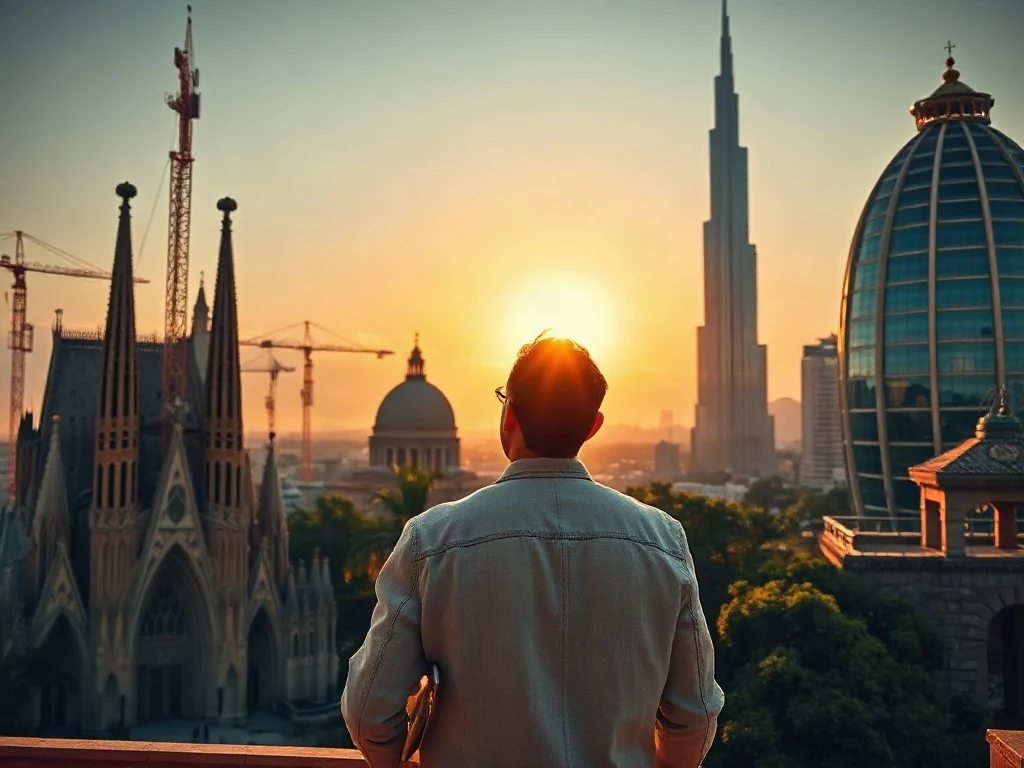
The seven contemporary wonders of the world sound like a simple parlour game until you try to play it with someone who loves you and disagrees with everything you say. The World Travel & Tourism Council (WTTC) is asking the world to choose seven landmarks that changed how we travel. A weekend spent arguing over that question with my father produced a building site in Barcelona, an opera house in the Amazon, a stalemate over Dubai and a surprisingly serious problem with the number seven. This article explains why the question is harder than it looks, which criteria matter, and what a credible list of modern wonders should actually reward.
What Are the Seven Contemporary Wonders of the World?
There is no single official answer, and that is the first thing to accept. The phrase refers to a proposed list of recent or still-relevant landmarks, not a fixed canon. Searchers who ask what are the modern wonders of the world usually find several competing lists. The WTTC initiative, as framed, adds a filter that earlier lists mostly ignored: influence on travel itself. The test is not only whether a place is beautiful or old, but whether it changed where people go, how they get there and why they bother.
I should be clear about what I can and cannot say. The core premise, that WTTC wants the public to choose seven landmarks that changed how we travel, comes from the campaign’s public framing. I have not seen a full methodology, so treat any details about shortlists, voting windows or verification as unconfirmed until you check the WTTC website.
A Short History of Wonder Lists
The Ancient Original
The first list of wonders was a travel guide. Hellenistic writers, including the poet Antipater of Sidon, catalogued the Seven Wonders of the Ancient World for Greek-speaking visitors touring the Mediterranean. Only the Great Pyramid of Giza still stands. The lesson for any modern list is humbling: most wonders disappear, and the list outlives them.
The 2007 Popular Vote
In 2007 the New7Wonders of the World campaign, founded by Bernard Weber, named the Great Wall of China, Petra, Christ the Redeemer, Machu Picchu, Chichén Itzá, the Colosseum and the Taj Mahal. Organisers claimed participation in the many millions, but the exercise was a global popularity contest, and UNESCO publicly distanced itself from it. Crucially, every winner was old. The 2007 list looked backward.
| List | Main question | Weakness |
|---|---|---|
| Ancient wonders | What should a traveller see? | Almost entirely lost |
| New7Wonders (2007) | What do people love most? | Popularity contest, no modern landmarks |
| WTTC contemporary wonders | What changed how we travel? | Criteria are subjective and the cap is seven |
The Barcelona Building Site That Refuses to Finish
My first nomination was a construction zone. The Sagrada Família, begun in 1882 and shaped for decades by Antoni Gaudí, is still unfinished more than a century after his death in 1926. Reports have pointed to 2026, the centenary of his death, as the target for its tallest tower, though schedules for a project this complex have slipped before and may again.
Why does it belong on a list about travel? Because it proves that a work in progress can be a destination. Cranes sit beside carved stone, and visitors pay for the privilege of watching a cathedral grow. Parts of the site belong to a UNESCO World Heritage Site listing for the Works of Antoni Gaudí. Yet the building is also a case study in the tension travel creates. Barcelona has become a symbol of overtourism debates, with local protests and city plans to curb tourist apartments. A true contemporary wonder cannot ignore the people who live beside it.
An Opera House in the Amazon
My father’s counter-nomination was more romantic. The Amazon Theatre in Manaus, opened in 1896, is a gilded European fantasy rising from the edge of the rainforest. It was financed by the wealth of the rubber boom, when the Amazon basin supplied a world hungry for tyres and cables.
It is not contemporary by date, but it is contemporary by argument. It asks what travellers actually crave: authenticity, or the astonishment of something impossible in an impossible place. Few buildings do that more vividly, and that is exactly the kind of landmark the 2007 list overlooked.
Dubai, Burj Khalifa and the Argument That Never Ends
Then came Dubai. The Burj Khalifa, opened in 2010 at 828 metres, is the tallest building ever completed, and the city around it was deliberately engineered into a global crossroads for air travel and tourism. My father calls it a triumph of ambition. I call it a theme park for skyscrapers. We both have a point, and the disagreement shows what the WTTC criterion really tests.
Spectacle Versus Substance
If the question is whether a place changed travel behaviour, Dubai’s case is strong. It turned a stopover into a destination and shifted the geography of long-haul routes. If the question is cultural depth, the argument weakens. Neither answer is wrong. The criteria decide the winner, which is why any list should publish them before the voting starts.
Why the Number Seven Is Such a Problem
The number seven carries enormous cultural weight, but it is a poor fit for a world this large. Consider the categories competing for slots:
- Icons of architecture, such as the Eiffel Tower and the Sydney Opera House.
- Infrastructure that quietly rewired movement, such as the Panama Canal and the Channel Tunnel.
- Cultural catalysts, like the Guggenheim Museum Bilbao, credited by many commentators with sparking the so-called Bilbao effect of culture-led urban regeneration.
- Living works in progress, such as the Sagrada Família.
These are my own illustrative examples, not WTTC shortlist entries. They show that a list of seven forces an impossible choice between a monument you photograph and a tunnel you simply pass through. Under a travel-impact test, infrastructure may deserve more credit than any facade, yet no one votes for a tunnel with the same passion as for a cathedral.
How to Judge Modern Wonders That Changed How We Travel
If you want to take part credibly, apply a consistent framework rather than a gut reaction. Here is the one my father and I eventually agreed on, after a truce involving coffee:
- Travel impact: Did it create new routes, habits or whole destinations?
- Cultural significance: Does it mean something beyond its tourism value?
- Durability: Will it matter in fifty years, or only this decade?
- Accessibility: Can ordinary people experience it, not only the wealthy?
- Responsibility: Does it manage the pressure that mass tourism places on communities and the environment?
Common Mistakes When Voting
- Voting for the place you visited most recently, which is recency bias.
- Confusing fame with influence. Many famous sites changed nothing about how we move.
- Ignoring the host community, whose cost of hosting visitors is rarely counted.
- Treating the final list as a ranking rather than a conversation.
Frequently Asked Questions
What are the new seven wonders of the world?
The most widely cited list is the 2007 New7Wonders selection: the Great Wall of China, Petra, Christ the Redeemer, Machu Picchu, Chichén Itzá, the Colosseum and the Taj Mahal, with the Great Pyramid of Giza as an honorary candidate. It is a popularity-based list, not an official heritage designation.
Who is choosing the contemporary wonders?
WTTC is inviting the public to nominate and choose seven landmarks that changed how we travel. Check the council’s official channels for current rules, since I cannot confirm the voting mechanism.
Is Dubai a contender?
It is arguable. The Burj Khalifa and Dubai’s role as an aviation and tourism hub make a strong travel-impact case, but critics question its cultural depth. Much depends on how the criteria are weighted.
Can an unfinished building count?
Nothing in the premise rules it out, and the Sagrada Família shows how an ongoing project can shape visitor behaviour for generations.
The Number Seven Is the Point, Not the Problem
The most important insight from a weekend of arguing is that the limit is the feature. Seven forces a society to say out loud what it values in travel: beauty, ambition, access, memory or movement. A list of seventy would let everyone avoid that choice. Whatever WTTC ends up publishing, the revealing part will not be the seven names but the criteria behind them.
Watch three things next. First, whether the campaign publishes a clear methodology and how it treats infrastructure alongside monuments. Second, whether sustainability and local consent become part of the test, given the pressure on cities like Barcelona. Third, whether a result is announced that people accept rather than merely share and mock. My own prediction, which is only a prediction, is that the list will please no one entirely, and that is how you will know it worked. The unanswered question is whether the next wonder will be something we visit, or something that carries us there.
Frequently Asked Questions
Is there an official list of the seven contemporary wonders of the world?
No. The phrase refers to a proposed, evolving list rather than a fixed canon, and several competing lists exist. The WTTC initiative asks the public to choose seven landmarks that changed how we travel. Details such as shortlists or voting rules remain unconfirmed until you check the WTTC website.
How does the WTTC approach differ from the 2007 New7Wonders vote?
The 2007 campaign was a popularity contest that rewarded beloved landmarks, and every winner was ancient, so it looked backward. The WTTC framing adds a filter earlier lists mostly ignored: whether a place changed where people go, how they get there and why they travel.
Why is the Sagrada Família considered a candidate if it is still unfinished?
Because it shows that a work in progress can be a destination. Visitors pay to watch the cathedral grow beside cranes and carved stone. Reports point to 2026 for its tallest tower, but schedules have slipped before. It also highlights overtourism tensions in Barcelona.
Can a landmark built in 1896, like the Amazon Theatre in Manaus, count as contemporary?
Not by date, but the article argues it qualifies by argument. Built with rubber boom wealth at the edge of the rainforest, the Amazon Theatre prompts debate about what modern wonders should include, showing that relevance to travel and global trade can matter more than construction year.
Why does the number seven make choosing so difficult?
The cap forces trade-offs among subjective criteria such as beauty, age, cultural influence and impact on travel. Seven is a legacy of the ancient list, not a measure of merit, so strong candidates like Dubai or the Sagrada Família must be left out or fiercely defended.
What lesson do the ancient Seven Wonders offer for a modern list?
They began as a travel guide for Greek-speaking visitors around the Mediterranean, and only the Great Pyramid of Giza still stands. The lesson is humbling: most wonders disappear while the list endures, so any modern selection should consider preservation and the communities living beside the sites.