
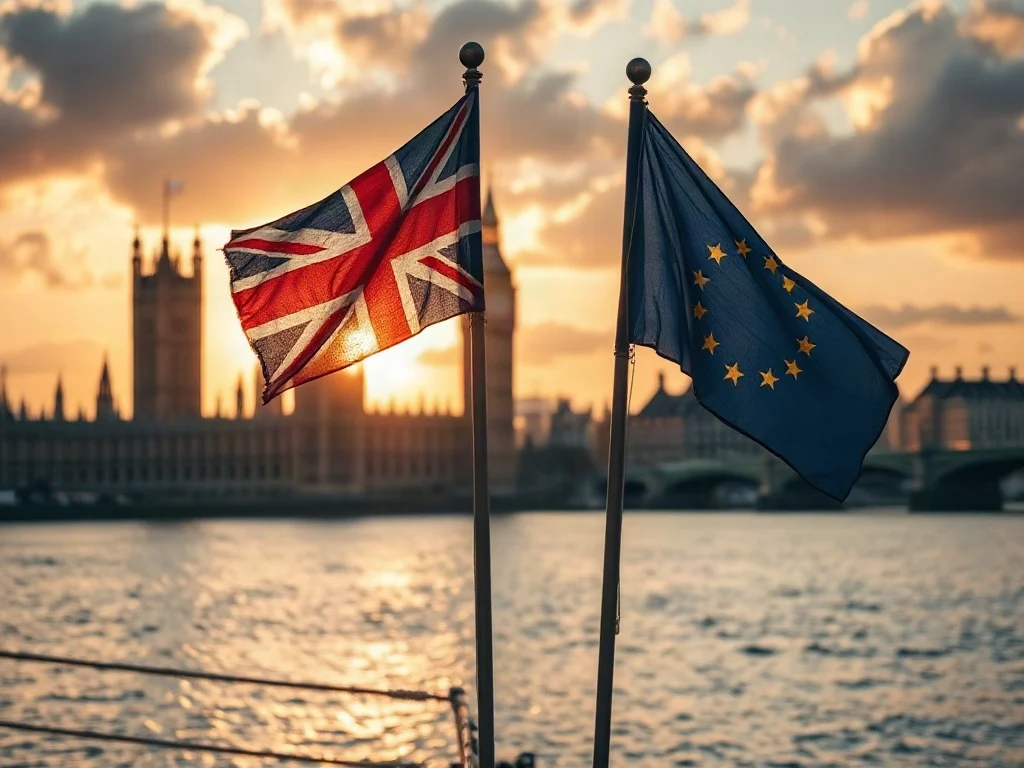
David Lammy has urged Andy Burnham to take the UK back into the EU, after Burnham reopened a debate about the country’s long-term future. Reports describe Lammy as the former deputy prime minister. The intervention matters because the question of UK rejoining the EU has moved from the margins of British politics toward the Labour mainstream. The reports available so far say little about the detail of either man’s position, so this article does not guess at private arguments. It sets out the process any government would have to follow to return, step by step, and the political conditions that would shape each stage.
What the Lammy and Burnham intervention does and does not tell us
The facts are limited. David Lammy has publicly urged Andy Burnham to take the UK back into the EU. Burnham, the Mayor of Greater Manchester, had reopened the debate about the UK’s long-term place in Europe. Lammy previously served as Deputy Prime Minister, and the report describes him as a former holder of that office.
Three things remain open. The first is whether Burnham has committed to any policy, or has only widened the range of acceptable discussion. The second is how far the call departs from the stated position of Keir Starmer‘s government. That position has been to improve relations with the EU while ruling out rejoining the single market or the customs union. The third is whether the intervention is about a timeline or about a principle. These gaps matter because rejoining is a sequence of decisions, each with its own gatekeeper.
How the process of rejoining the EU would work
A state that has left the EU does not get a fast-track route back. Article 50 of the Treaty on European Union says a former member that asks to rejoin is subject to the ordinary accession procedure in Article 49. The consolidated treaty text is available on EUR-Lex.
Step 1: Build a domestic mandate
Before any application, a UK government needs political authority. The 2016 referendum produced a 51.9% to 48.1% vote to leave, and many politicians argue that reversing it needs a fresh public vote. Whether a referendum is legally required is a separate question from whether it is politically unavoidable. In practice, an application without clear electoral backing would invite attack at home and doubt in Brussels.
Step 2: Submit a formal application
Under Article 49, a European state that respects the EU’s founding values and is committed to promoting them may apply. The application goes to the Council of the European Union, and national parliaments are notified.
Step 3: Council decision and Commission opinion
The European Commission assesses the applicant, and the Council must agree unanimously to open negotiations. Unanimity is the decisive hurdle. Any single member government can delay or attach conditions, as past enlargement rounds have shown. The Copenhagen criteria set the benchmark: stable democratic institutions, a functioning market economy, and the capacity to take on the obligations of membership. The UK would meet the first two easily. The third is where the real work lies.
Step 4: Negotiate the accession terms
Negotiations cover the acquis communautaire, the accumulated body of EU law, and are organised into policy chapters. A candidate does not bargain over whether to adopt EU rules. It bargains over transition periods and implementation. The UK’s starting position is unusual, because it applied EU law for decades. It has also diverged since 2021, so it would not be a clean restoration.
Step 5: Ratification
The finished accession treaty needs the consent of the European Parliament, then approval by the Council. It must then be ratified by every member state under its own constitutional rules, and in some countries that means a national referendum. Each ratification is a separate veto point.
No timeline is guaranteed. Historically, the 1995 accession of Austria, Finland and Sweden moved quickly because those states were already closely integrated. Croatia took roughly a decade from application to membership. A well-aligned UK could be faster than Croatia, but the speed would depend on political will in the capitals of the 27, not only on technical readiness.
Can the UK rejoin the EU? The legal answer and the political one
Legally, yes. The treaties provide a route and make no exception for a state that has previously left. Politically, the answer depends on three conditions: UK domestic consent, EU member-state unanimity, and a settlement on the terms that previously made British membership distinctive.
Opinion is divided on the third point. Some analysts think the EU would want the UK back and would show flexibility. Others argue that the EU has little reason to reopen special arrangements for a state that chose to leave, and that it needs to deter other withdrawals. Neither view is established fact. Both are interpretations of incentives that would only become visible once a formal application was on the table.
The terms the UK would likely face on rejoining
The most contested part of any return is the loss of the opt-outs and rebates that Britain once held. Several are worth tracking.
- The budget rebate. The UK rebate, negotiated in the 1980s, ended with withdrawal. Many observers expect the EU to resist reviving it, and the UK would have to accept a full contribution unless it negotiated otherwise.
- The euro. New members are in principle obliged to join the eurozone once they meet the convergence conditions. Sweden has avoided doing so in practice, but it has not secured a formal opt-out like Denmark’s. Any UK government would need to say what it would negotiate here.
- Border arrangements. Britain held an opt-out from the Schengen Area. Whether a returning UK could keep that opt-out is an open negotiating question.
- Trade. Rejoining would put the UK back inside the single market and the customs union. That would end its independent trade policy and replace the current Trade and Cooperation Agreement.
Each of these terms is a trade-off. Reduced trade friction is the main economic argument for rejoining. The loss of rebates and a separate trade policy is the main argument against it. The size of the net effect is contested among economists, and no single figure should be treated as settled.
Why Labour’s position makes this debate harder than it looks
The Labour Party holds a delicate position. Its leadership has rejected rejoining the single market, the customs union or free movement, and has emphasised a reset with the EU over reopening the 2016 question. In 2025 the UK and EU announced a closer relationship covering security and defence and negotiations on food and agricultural standards. They also discussed a youth mobility scheme, with the future of the Erasmus Programme as one possible element. Those steps fall well short of membership.
A call from a senior figure such as Lammy therefore functions as political positioning as much as policy. It tests how much appetite exists in the party and the electorate for a long-term goal, even if the near-term programme stays cautious. It also raises a tension. Dwelling on rejoining can unsettle voters who backed Leave. Ruling it out permanently can alienate those who want a clear direction.
Northern Ireland as an edge case
Northern Ireland already operates under special arrangements through the Windsor Framework. Rejoining would, in principle, simplify some of those arrangements by removing the regulatory border in the Irish Sea. It would also reopen sensitivities in unionist politics, so it is not a purely technical gain.
How to evaluate claims about UK rejoining the EU
Readers who want to follow this debate critically can apply a few practical tests.
- Check which stage is being discussed. A statement about a referendum, an application, negotiations and ratification each describe a different step with different decision-makers.
- Separate closer alignment from membership. Veterinary agreements, defence cooperation and youth schemes are not accession, even when they reverse parts of the post-2020 settlement.
- Ask who holds the veto. The UK government and parliament control the application. Every EU member state controls the outcome.
- Look for the terms, not the slogan. A credible plan says what the UK would do about the euro, Schengen and its budget contribution.
- Distinguish projection from evidence. Economic forecasts depend on assumptions and are not measurements.
A common mistake is to treat rejoining as a reversal of Brexit that restores the earlier relationship. The EU has also changed since 2016, and its enlargement policy has become more demanding and more geopolitical. Another mistake is to assume that domestic enthusiasm alone settles the matter.
FAQ
Has the UK government decided to rejoin the EU?
No. The government has said it wants closer relations with the EU but has ruled out rejoining the single market or the customs union. The Lammy and Burnham exchange is a political intervention, not a government policy change.
Can the UK rejoin the EU after Brexit?
Yes, in legal terms. Article 50 treats a former member’s request to return as an ordinary application under Article 49. It would need unanimous approval from member states and ratification by all of them.
How long would rejoining take?
There is no fixed answer. Past enlargements ranged from a few years to roughly a decade. The UK’s regulatory familiarity might help, but political agreement among the member states would be the deciding factor.
Would the UK need to adopt the euro?
In principle, new members commit to adopting the euro once the convergence conditions are met. Whether the UK could negotiate a formal opt-out, as Denmark has, would be a matter for negotiation.
The question behind the question: who owns the mandate?
The most important insight from this episode is that the rejoin debate is not primarily a legal or technical one. The treaties already supply a route. What is missing is a settled domestic mandate and an agreed view of the terms. Lammy’s call to Burnham shows that the argument is shifting from whether the topic can be discussed to who in Labour should lead it, and on what timetable.
Several things are worth watching. Does Burnham state a position beyond reopening the debate? Does the government’s cautious line hold as the EU relationship deepens? And do any member states signal what they would demand of a returning UK? The biggest unanswered question is whether Britain’s current gradual reset becomes a stepping stone to membership or a lasting alternative to it. That question cannot be answered until a party is willing to put the full terms of return before voters.
Frequently Asked Questions
Could the UK rejoin the EU quickly because it was already a member?
No. Article 50 says a former member asking to return must follow the ordinary accession procedure in Article 49. There is no fast-track route. Prior membership helps because the UK applied EU law for decades, but the Council still has to agree unanimously before negotiations can open.
Is a new referendum legally required before the UK could apply?
The article treats this as separate from the political reality. A referendum may not be strictly required by law, but the 2016 vote was 51.9% to 48.1% to leave. Many politicians argue reversing it needs a fresh vote, and an application without clear electoral backing would face doubt in Brussels.
Why is unanimity in the Council such a big obstacle?
Every member government must agree to open negotiations, so any single state can delay the process or attach conditions, as earlier enlargement rounds have shown. Ratification of the final treaty then needs approval from every member state, and some countries may hold their own referendums.
Would the UK have to adopt EU rules again, or could it negotiate exemptions?
A candidate does not bargain over whether to adopt EU law, only over transition periods and implementation. The UK's long membership is an advantage, but its regulatory divergence since 2021 means the return would not be a clean restoration of the earlier position.
Does Lammy's call mean Labour or Burnham has committed to rejoining?
Not necessarily. The reports say little about the detail of either man's position. It is unclear whether Burnham has committed to a policy or only widened the debate. Keir Starmer's government has ruled out rejoining the single market or customs union, while seeking better relations with the EU.
Which Copenhagen criteria would be hardest for the UK to meet?
The UK would easily meet the first two criteria: stable democratic institutions and a functioning market economy. The difficult one is the third, the capacity to take on the obligations of membership, because the UK has diverged from EU law since 2021 and would need to align again.