
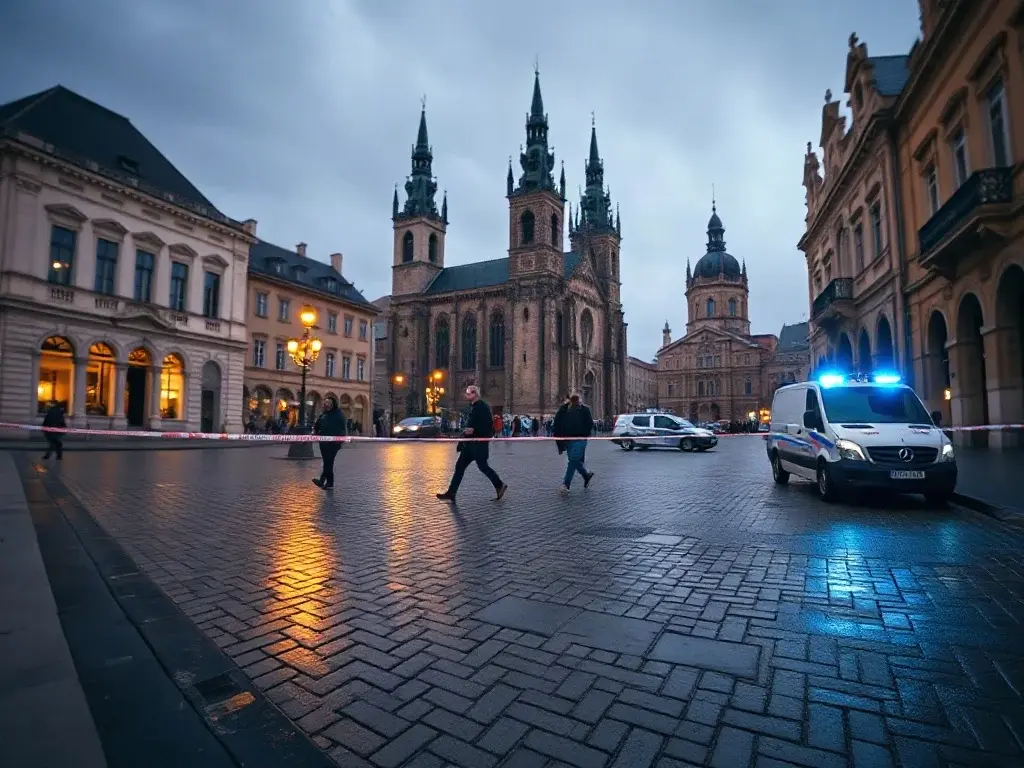
The Krakow shooting has drawn attention for an unusual reason: the moment gunshots rang out in the city’s main market square was captured on video that BBC Verify has since authenticated. In the first hours after any violent incident, authenticated footage is the most valuable evidence the public has. It is also easy to misread. This analysis sets out what the verified video establishes, how that verification works, and which questions no clip can answer. It deliberately avoids filling gaps in the public record with speculation.
What Is Actually Established About the Krakow Shooting
The source material for this article is narrow. The BBC reports that video authenticated by its verification unit shows the moment gunshots were fired in Krakow’s main market square, and it describes the incident as deadly. The details people usually want first are not covered by that statement: the number of casualties, the identity or motive of any suspect, and the precise sequence of police response. Those details should come from Polish authorities and from continuing reporting, and readers should treat any figures that circulate without attribution as provisional.
That limit is the useful starting point. Verification answers a specific, bounded question: is this footage genuine, and does it show what it is claimed to show? It does not, by itself, explain why an event happened or who is responsible.
Why the Main Market Square Matters
The Main Square in Kraków is the centre of the city’s tourist and civic life. It sits within the Historic Centre of Kraków, a UNESCO-listed area, and is among the largest medieval town squares in Europe. It is anchored by the Cloth Hall and St. Mary’s Basilica, landmarks that appear in countless tourist photographs and videos.
This has two consequences for the analysis. First, the setting is one of the most densely photographed public spaces in Poland, so footage of any incident there is likely to exist in volume and from several angles. Second, because the square is so recognisable, its landmarks give verification analysts reliable anchor points for confirming where a video was filmed.
How BBC Verify Video Analysis Works
Authentication is a structured process, not a single test. BBC Verify draws on open-source intelligence methods, the same family of techniques popularised by investigative groups such as Bellingcat. The BBC describes its own work on its BBC Verify page. The core steps are well documented across the field.
Geolocation
Geolocation means matching what is visible in the footage, such as building facades, paving patterns, street furniture and rooflines, against satellite imagery, street-level photography and maps. In a place as distinctive as Krakow’s market square, this step is comparatively straightforward. The harder question is the camera’s position and angle, because that determines what the footage can and cannot show.
Chronolocation and Timing
Analysts also try to establish when a clip was recorded. Shadows, weather, lighting, visible clocks, and the earliest known upload of the file all help. An old video recirculated as new is among the most common forms of misinformation after a breaking event, and a date check is often the fastest way to catch it.
Source and Metadata Checks
Verification teams try to trace footage back to its original uploader or filmer rather than relying on reposts. File metadata, including Exif data where it survives, can corroborate time and device, though social platforms often strip it on upload. Contacting the original filmer, where possible, adds context that pixels cannot provide.
Audio Analysis
Because this footage is described as capturing the moment gunshots rang out, audio is significant. Analysts can assess the number and spacing of the sounds and whether they are consistent with gunfire. Echoes in a walled square complicate such readings. Audio can support an account of events, but it rarely settles one on its own.
What Verified Footage Can and Cannot Tell Us
The central analytical error after a shooting is treating authentication as explanation. A verified clip is a fact about an event. It is not an interpretation of that event.
- It can confirm that gunfire occurred at a particular place and approximately when.
- It can show immediate crowd behaviour, such as people running, taking cover or gathering.
- It can help fix a timeline when combined with emergency calls and official statements.
- It cannot establish motive, the full number of people affected, or events outside the camera’s frame.
- It cannot, alone, confirm identity. Faces and clothing in low-resolution, moving footage are unreliable identifiers.
There is also a selection problem. Video that gets shared and verified is video that someone happened to capture and chose to publish. A single vantage point can mislead about the scale or sequence of an incident, and the footage that reaches the public is a biased sample of what occurred.
Authenticated video tells you that something happened. It does not tell you why, or how much more happened beyond the edge of the frame.
The Information Vacuum After a Deadly Incident
In the hours after a shooting in a public place, official information is usually sparse and fast-moving. Social platforms fill the gap. The result is a mix of genuine eyewitness clips, recycled footage from unrelated events, and deliberate disinformation. Unintentional misinformation is at least as damaging, because well-meaning users share unconfirmed claims about suspects and motives quickly.
Synthetic media adds a newer layer. A deepfake is not the main risk in most breaking-news cases, since misattributed real footage is far more common. But the existence of convincing fakes lets bad-faith actors dismiss genuine evidence as fabricated. Provenance standards such as those developed by the Coalition for Content Provenance and Authenticity aim to address this, but adoption among everyday smartphone users and social platforms remains incomplete.
This is why a public verification statement from a major newsroom carries weight. It narrows the range of plausible claims early, while the story is still forming.
Public-Space Security and Policy Questions
A deadly shooting in a heavily visited historic square will raise policy questions, but they should be asked carefully and only after the facts are established. Several are likely to come up.
Firearms Regulation
Debates after such incidents typically turn to licensing and access. Gun politics in Poland operate within a licensing framework, and how a weapon was obtained, whether legally or not, is a basic question that investigators and officials must answer before any regulatory conclusion is drawn. Drawing policy lessons without that information is guesswork.
Surveillance and Response
Municipal CCTV coverage and the speed of police response will likely be examined. Cameras help reconstruction after the fact. Evidence that they prevent violence in open public spaces is weaker, and this is a genuine point of disagreement among researchers and civil liberties advocates.
Crowd Management
Open squares are hard to secure by design. Their value as civic space depends on being accessible, which limits the use of fixed barriers and screening. Crowd control planning in such places tends to focus on rapid evacuation routes and communication rather than perimeter control.
Human and Economic Consequences
The immediate human cost is the priority, and it is also the area where the verified record is thinnest at this stage. Beyond casualties, incidents like this can leave lasting psychological trauma among witnesses, residents and workers in the surrounding area. Economically, a city that depends on visitors may see short-term effects on tourism and local trade. There is no reliable data yet on whether that will happen, and past patterns elsewhere vary widely depending on the nature of the incident and how it is perceived afterwards.
How to Evaluate Footage of the Krakow Shooting
Readers, editors and content publishers can apply a few disciplined habits.
- Prefer attributed sources. Look for footage that a reputable newsroom has said it authenticated, and note what exactly it says was verified.
- Check the date and location claims separately. A clip can be real but misdated or misplaced.
- Do not infer identity or motive from short clips or from captions added by third parties.
- Treat casualty figures as provisional until confirmed by official sources.
- Consider the graphic content. Sharing footage of violence can harm victims’ families and may interfere with identification and notification.
- Update when facts change. Publishers should correct and revise early reports as the official record develops.
A common mistake is amplifying the most dramatic version of events because it travels fastest. Slower, qualified reporting tends to age better.
Frequently Asked Questions
How did the Krakow shooting unfold?
Based on the source material, the only confirmed element is that authenticated video shows the moment gunshots rang out in the main market square. A full sequence of events depends on official statements and further reporting, and readers should be cautious of detailed timelines that lack attribution.
What does it mean that BBC Verify authenticated the video?
It means the BBC’s verification team assessed the footage, typically checking its location, timing and origin, and concluded it is genuine and shows what is claimed. It is a statement about the video, not about the wider causes or circumstances of the incident.
Can a video prove who was responsible?
Rarely on its own. Identification generally requires corroboration from investigators, physical evidence and legal process. Footage is one input among several.
Why is Krakow’s Main Market Square significant?
It is the historic and tourist heart of the city, a UNESCO-listed area visited by large numbers of people. Its prominence means incidents there attract wide attention and are often recorded from multiple angles.
The Question the Footage Cannot Answer
The most important lesson from the early record of the Krakow shooting is a methodological one. Authentication has become the first line of defence against false narratives, and it works well for the narrow question it addresses. But the public tends to hear “verified” and assume “explained.” Those are different things, and the gap between them is where speculation thrives.
Watch for three developments. First, official confirmation of casualty numbers, a suspect’s identity, and the circumstances of the weapon, which will determine whether the policy debate is about firearms access, security design or something else entirely. Second, whether additional authenticated footage from other angles emerges, since a single vantage point can distort scale and sequence. Third, how platforms handle graphic content and recycled clips as the story develops.
A reasonable prediction is that provenance tools will become part of routine newsroom practice, but they will not replace human judgement. The unanswered question is whether audiences will learn to hold back until the full picture emerges, or whether the speed of the first clip will keep outrunning the slower work of establishing what actually happened.
Frequently Asked Questions
Does BBC Verify authenticating the video mean we know who the shooter is or why it happened?
No. Authentication only confirms that the footage is genuine and shows what it claims to show: gunshots in Krakow's main market square. It does not identify a suspect, explain a motive, or establish casualty numbers. Those details must come from Polish authorities and continuing reporting.
Why is it easier to verify a video filmed in Krakow's Main Square than in many other places?
The square is one of Europe's largest medieval town squares and is heavily photographed. Landmarks such as the Cloth Hall and St. Mary's Basilica give analysts reliable anchor points, so they can match buildings, paving and rooflines against satellite imagery and street-level photos to confirm the location.
Can a verified video be old footage that is being passed off as new?
Authentication is meant to catch exactly that. Analysts check shadows, weather, lighting, visible clocks and the earliest known upload to date a clip. Recirculated old video is a common form of misinformation after breaking events, so a date check is often the fastest way to expose it.
Why can't audio of gunshots in the square simply prove what happened?
Analysts can assess the number and spacing of sounds and whether they match gunfire, but the walled square creates echoes that complicate such readings. Audio can support an account of events, yet it rarely settles one alone, so it must be combined with other evidence.
If metadata is missing from a clip, does that mean the video is fake?
Not necessarily. Social platforms often strip Exif data when files are uploaded, so its absence is common. Verification teams instead try to trace the footage to its original filmer, compare it with other angles, and use geolocation and timing checks to corroborate it.
How should readers treat casualty figures that circulate without a source after an incident like this?
Treat them as provisional. The verified material described here does not cover casualty numbers, suspect identity or the police response timeline. Wait for attributed statements from Polish authorities or established news organisations rather than relying on unsourced figures spreading on social media.