
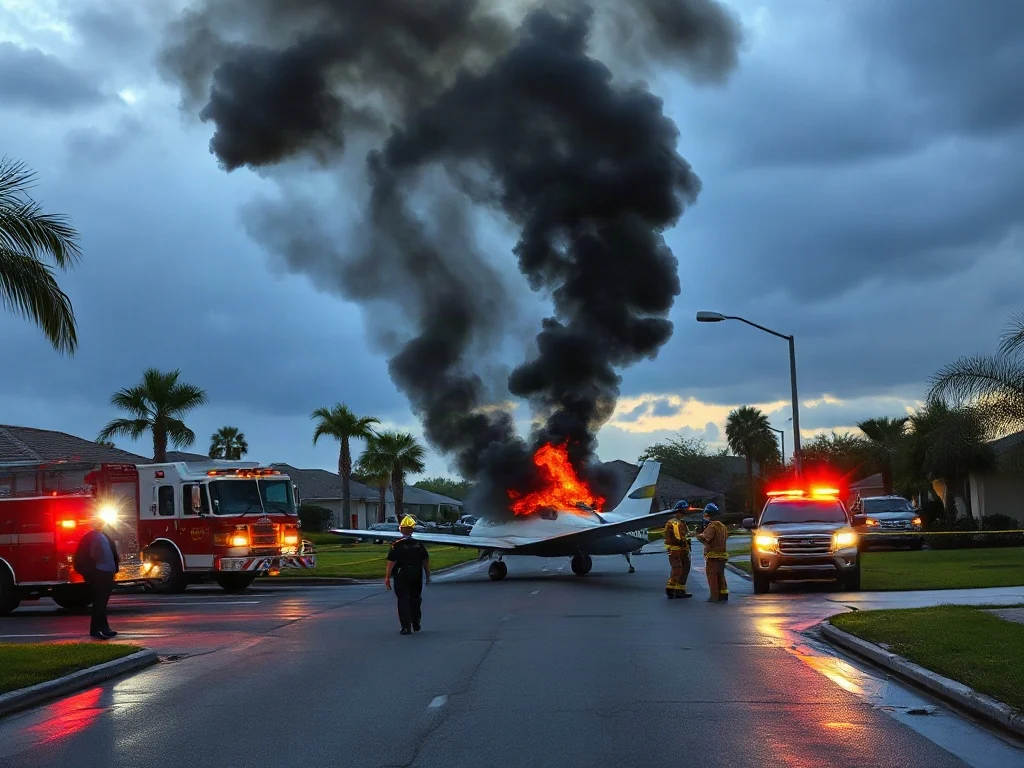
A business jet crash in South Florida has left nine people dead and a residential community in shock. On Sunday, a Learjet plunged into a neighbourhood and exploded into a fireball close to homes and a busy road. Air traffic control recordings indicate that the pilot had reported icing, precipitation and severe turbulence before the aircraft entered a steep dive. Everyone on board was killed. This article separates what is confirmed from what remains unknown, and explains the aviation science that investigators will be weighing.
What Happened When the Learjet Fell From the Sky
The confirmed facts are stark. A business jet came down in a populated part of South Florida. Nine people aboard died, and the wreckage burned fiercely beside residences and a heavily travelled road. The recordings suggest the final minutes of the flight were marked by a pilot confronting several hazards at once.
Here the reporting stops and speculation must not begin. A pilot’s weather report is a crucial clue, but it is not a verdict. The cause of the crash has not been established, and any firm conclusion at this stage would be premature.
Why Icing, Precipitation and Severe Turbulence Are a Dangerous Combination
Each of the three conditions the pilot reported is serious on its own. Together, they can overwhelm even an experienced crew.
Aircraft Icing
Aircraft icing occurs when supercooled water droplets freeze onto an aircraft’s surfaces. Ice changes the shape of the wing, adds weight and increases drag. It can also degrade the airflow that generates lift, raising the speed at which a wing will stall. Ice can also block a pitot tube, which feeds airspeed data to the cockpit, and unreliable airspeed readings have contributed to other accidents.
Severe Turbulence
Turbulence at the severe level can throw an aircraft violently, make instruments hard to read and momentarily push control beyond a pilot’s grasp. It often accompanies a thunderstorm, and especially a towering cumulonimbus cloud, where updrafts, downdrafts, heavy precipitation and icing can coexist within a few miles.
The Compounding Effect
Aviation accidents rarely have a single cause. Investigators often find a chain of events, and weather may be only one link. Turbulence can disrupt an aircraft’s attitude while ice degrades its performance, and the crew must manage both while talking to controllers. That workload is exactly why this accident will draw intense scrutiny.
Can a Steep Dive Be Explained?
The phrase “steep dive” invites many possible explanations, and readers should be wary of any claiming certainty. Investigators are likely to examine several established categories of events:
- Aerodynamic stall: a loss of lift that can lead to a rapid loss of altitude if not corrected.
- Spatial disorientation: in cloud and turbulence, the pilot’s inner ear can mislead them. Spatial disorientation has been linked to events such as the graveyard spiral.
- Instrument or system failure: including blocked sensors or flight control problems.
- Structural or mechanical issues: which can only be assessed through wreckage examination.
Which of these, if any, applies is for investigators to determine. The dive is a symptom, not yet a diagnosis.
How the Investigation Will Unfold
In the United States, civil aviation accidents are investigated by the National Transportation Safety Board, with participation from the Federal Aviation Administration. Updates are published through the NTSB, and the FAA provides regulatory information at faa.gov.
Investigators typically rely on several evidence streams:
- The air traffic control recordings already reported, which capture the pilot’s own account of conditions.
- Any available flight recorder data, if recorders are recovered and readable.
- Radar and ADS-B tracking data showing the aircraft’s path and speed.
- Weather records, including weather radar imagery, and forecasts available to the crew from sources such as the Aviation Weather Center.
- Wreckage, maintenance records and crew history.
Preliminary findings often emerge within weeks, but a final probable-cause determination can take a year or longer.
What This Tragedy Reveals About Risk and Responsibility
Private aviation is a world of professional skill and, at times, narrow margins. Flights operated under instrument flight rules allow crews to fly in cloud, but they do not remove the physics of ice and storms. Good crew resource management, conservative weather decisions and disciplined deviation around hazardous cells are the main defences, and investigators will ask whether they held.
The crash also raises an uncomfortable community question. Aircraft in trouble near airports can end up above neighbourhoods, and the fireball beside homes and a busy road shows how close such disasters can come to people on the ground.
Frequently Asked Questions
What caused the South Florida business jet crash?
The cause has not been determined. The pilot reported icing, precipitation and severe turbulence before the Learjet entered a steep dive, but investigators have not confirmed whether weather was the cause.
How many people died in the crash?
All nine people aboard the aircraft were killed.
Can icing and turbulence bring down a jet?
They can contribute to serious accidents by degrading lift, disrupting instruments and increasing crew workload. Modern jets are built to handle many such conditions, but severe cases can still exceed an aircraft’s or crew’s limits.
Who investigates crashes like this?
In the United States, the National Transportation Safety Board leads civil aviation accident investigations, supported by the Federal Aviation Administration and other parties.
The Question the Recordings Cannot Yet Answer
The most important insight so far is that the pilot told controllers about the danger before the dive began. Those recordings capture a professional describing a deteriorating situation, and the investigation must establish what happened in the interval between that report and the impact.
Watch for the NTSB preliminary report, which should set out the verified timeline. Also watch for any findings about the weather the crew was given, any recovered flight data, and any recommendations on routing around severe weather. If investigators find that icing and turbulence were the decisive factors, the lesson will concern how crews and operators weigh weather risk. If the cause lies elsewhere, the weather reports may prove to be a tragic backdrop rather than the story. Either way, nine lives and a stunned neighbourhood deserve an answer based on evidence rather than assumption.