
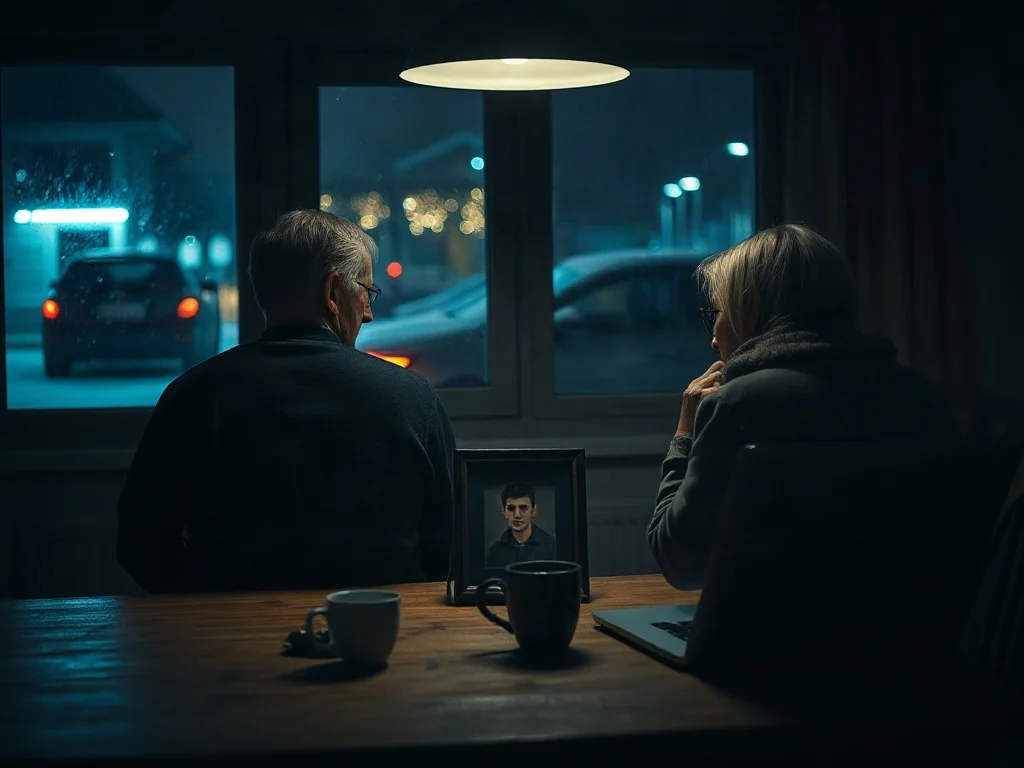
The Nowak family police footage account is difficult to read, and it should be. A family has described the night officers told them their son had died, and the ‘unbelievable pain’ of later watching recorded images of him handcuffed as he was dying. This article does not retell the case beyond what the published summary establishes. It asks a harder question: what do institutions owe a family when a death after police contact is documented on video, and how often do they meet that obligation?
The analysis rests on a limited public description of the family’s testimony. Specific facts, such as the circumstances of the restraint, the cause of death and any legal findings, should be checked against the full report and any official determination. Where this article moves beyond the case into general principles, it says so.
What the Nowak Family Have Said, and What It Reveals
The family describe two separate injuries. The first is the death notification, the night police told them their son had died. The second is the footage, in which they watched him being handcuffed while he was dying. These are different failures of care, and they should be analysed separately.
A death notification is a moment of institutional contact the family will remember for life. Its tone, timing, clarity and honesty shape how they later judge everything else the authorities say. Viewing footage is a different kind of event. It is evidence, but it is also a private catastrophe, because the family is asked to look at the last minutes of a person they loved, through the lens of the organisation that was present.
The footage is evidence for the investigator. For the family, it is the last record of their son’s life, and they should not have to meet it unprepared.
The family’s phrase, ‘unbelievable pain’, should not be read as rhetoric. It describes an effect that bereavement researchers recognise: sudden, violent and potentially preventable deaths tend to produce more complicated grief and sometimes symptoms resembling post-traumatic stress disorder. Being shown images of the death adds to that burden.
Why Handcuffing a Dying Person Draws Such Scrutiny
The image that stays with the family is a person in handcuffs while his life was ending. To a lay viewer, restraint of someone who may be unwell or unresponsive looks like a contradiction in priorities: control first, care second. Whether that was what happened here is a matter for the investigators and the courts. The criticism the image provokes, however, is one that policing has faced for decades.
The Policy Tension Between Control and Care
Officers are trained to secure a scene and prevent harm. They are also trained to recognise medical emergencies. These duties collide when a person is collapsing, intoxicated, in mental distress or physically struggling. Police guidance in England and Wales, including material from the College of Policing, stresses monitoring a restrained person’s breathing and responsiveness. It also stresses that a person who is quiet or has stopped resisting may be in medical danger rather than complying.
The risks of restraint are well documented. Positional asphyxia is a recognised danger when someone is restrained in a position that limits breathing, especially face down with hands behind the back. The broader use of force continuum is meant to ensure that force is proportionate and ends once the justification ends. Critics argue that in practice, restraint can persist after the threat has gone.
Competing Interpretations
There are two defensible readings of footage like this, and an honest analysis holds both open until the evidence is tested:
- The operational reading: officers acted amid uncertainty and risk, and applied restraint before it was clear the person was in medical crisis.
- The accountability reading: signs of medical distress were missed or under-prioritised, and restraint continued when resuscitation or medical assessment should have taken precedence.
Each reading carries different consequences for training, discipline and, where relevant, criminal or civil liability. A family’s pain does not decide between them, but it is a legitimate reason to demand that the question is answered thoroughly.
Body-Worn Video: Transparency With a Human Cost
Body-worn video was introduced in large part to increase public trust and give investigators an objective record. In many cases it does exactly that. It can corroborate an officer’s account, expose a false one, or show that an apparently clear-cut incident was more complicated.
The Nowak family’s experience exposes a second-order problem. Footage has a clear evidential purpose, but its use in bereaved families’ lives is far less settled. Few, if any, standard protocols exist to ensure that families are:
- Told in advance what the footage contains and whether it is graphic.
- Offered the choice of viewing it, and of having a trusted adviser, lawyer or support worker present.
- Given time between disclosure and any public hearing or interview.
- Offered psychological support, not only a legal briefing.
It would be inaccurate to claim that no such practice exists anywhere. Practice varies between forces, investigations and inquests, and some families report sensitive handling. The concern is inconsistency: a family’s experience should not depend on the individual officer or investigator they meet.
The Night of Notification
The family’s description of the night they were told of their son’s death highlights a quieter policy gap. Notifying next of kin is a duty that falls to officers who may have limited information and little training in delivering it. Where the death followed police contact, there is an additional conflict of interest: the notifying organisation may be the one whose actions are under scrutiny.
What Good Practice Looks Like
- Clarity: state plainly that the person has died, and avoid euphemism.
- Candour: say what is known and what is not, and do not offer premature explanations that may later be contradicted.
- Independence: explain promptly that an independent body will investigate, and how to contact it.
- Continuity: assign a single family liaison point so relatives do not have to retell the story repeatedly.
The principle of candour has been debated for years in public inquiries, and campaigners argue it should be a legal obligation on public bodies. Whether or not that is adopted, the first night is where candour either begins or is lost.
How Deaths After Police Contact Are Investigated
In England and Wales, serious incidents involving police are referred to the Independent Office for Police Conduct (IOPC), whose current guidance and case information are published on the IOPC website. A coroner then holds an inquest, which determines who died, and how, when and where. Where the state may bear responsibility, the inquest engages obligations under the European Convention on Human Rights and the right to life, including a duty to conduct an effective investigation in which the family can participate.
Critics, including many families and campaign groups, have long argued that the process is slow, that families often struggle to obtain legal representation of equal strength to that of police forces, and that outcomes seldom lead to sanctions. These are contested claims, and the IOPC and policing bodies dispute parts of them, but the perception of imbalance is itself a trust problem that policy has to address.
Lessons From Other High-Profile Cases
Public attention to restraint deaths has been shaped by high-profile cases elsewhere, most notably the murder of George Floyd in the United States and, in Scotland, the death of Sheku Bayoh. These cases are legally and factually different from one another and from the Nowak case, so direct comparison is inappropriate. What they share is the effect of video and prolonged inquiry on public confidence, and the pressure they place on institutions to explain how restraint is justified, monitored and ended.
The contested concept of excited delirium illustrates another risk. Explanations that cannot be independently verified can obscure the question of whether restraint itself contributed to a death. Analysts should treat any such label with caution, and note that major medical bodies have moved away from it.
Practical Steps for Families, Advisers and Institutions
For Bereaved Families
- Seek specialist legal and advocacy support early, ideally from organisations experienced in deaths after state contact.
- Ask in writing what footage exists and how and when it will be shown.
- Request that a support person be present for any viewing, and decide in advance whether to watch alone or with others.
- Keep a record of every communication with police and investigators.
For Police Forces and Investigators
- Adopt a written protocol for disclosing graphic footage to families, including advance warning and support.
- Train officers delivering death notifications in plain-language, trauma-aware communication.
- Review whether restraint-monitoring procedures are working in live incidents, not only on paper.
- Publish learning from cases promptly, so reform does not wait years for a final hearing.
Common Mistakes
The most frequent failures are predictable: offering explanations before facts are known, treating family liaison as a communications exercise rather than a duty, and assuming that disclosure of footage equals transparency. Showing a family the worst moments of a relative’s life, without preparation, can be a form of institutional harm even when the legal obligation to disclose is met.
Where This Is Heading
Several developments are plausible, though none is certain. Pressure is likely to continue for a statutory duty of candour. Body-worn video will probably become more widely used and more heavily analysed, including by independent experts and, potentially, automated tools. Families will increasingly expect access to footage, which makes disclosure protocols more important. Policing bodies may also face stronger demand to show that restraint training reflects current medical evidence.
These are reasonable expectations rather than confirmed reforms. The direction of travel depends on political will and on whether individual cases like this one are treated as isolated tragedies or as evidence about the system.
Frequently Asked Questions
What did the Nowak family say about the footage?
According to the published summary, they described the ‘unbelievable pain’ of watching footage of their dying son in handcuffs, and recounted the night police told them he had died.
Do families have a right to see police body-camera footage after a death?
There is no single universal right. Access usually depends on the investigation, the inquest process and disclosure decisions. Families generally participate through the coroner’s process and, where relevant, the IOPC. A solicitor can advise on the specific situation.
Is it normal for police to handcuff someone who is seriously ill?
Restraint can be used when officers believe there is risk, but guidance emphasises monitoring a restrained person’s condition and providing medical help. Whether those standards were met in a particular case is for the investigation to determine.
Who investigates deaths after police contact in England and Wales?
Typically the Independent Office for Police Conduct investigates serious cases, and a coroner holds an inquest.
What the Footage Cannot Answer
The most important insight in the Nowak family’s account is that accountability and care are not the same thing, and institutions often deliver only the first. A system can capture every second of a death on video and still fail the people left behind: by notifying them poorly, by disclosing evidence without support, and by leaving them to wait years for explanations.
Watch three things next. First, whether the investigation addresses the specific question the image raises: why restraint was applied or maintained as the man’s condition deteriorated. Second, whether the forces involved introduce clear standards for showing graphic footage to families. Third, whether the debate over a statutory duty of candour gains new momentum. The question that remains unanswered is whether the next family will face the same screen with any more preparation than this one did.
Frequently Asked Questions
Why is the death notification treated as a separate harm from seeing the footage?
They are different moments of institutional contact. The notification shapes how a family judges everything authorities later say, through its tone, timing and honesty. Viewing footage is a distinct trauma, because relatives must watch the final minutes of someone they loved, filmed by the organisation that was present.
Does the article say the officers did something wrong?
No. It stresses that the circumstances of the restraint, the cause of death and any legal findings must be checked against the full report and any official determination. It sets out two readings, operational and accountability, and holds both open until the evidence has been tested by investigators and courts.
Why does handcuffing someone who is dying draw such strong criticism?
To a lay viewer, restraining a person who may be unwell or unresponsive suggests control was put ahead of care. Policing has faced this criticism for decades. Whether it applies in this case is for investigators and courts to decide, not for viewers of the footage.
Why might a person who has gone quiet during restraint still be in danger?
Guidance in England and Wales, including College of Policing material, warns that someone who is quiet or has stopped resisting may be in medical danger rather than complying. Positional asphyxia is a recognised risk, especially when a person is held face down with their hands behind the back.
Is 'unbelievable pain' just emotional language, or is there evidence behind it?
The article says it should not be read as rhetoric. Bereavement research recognises that sudden, violent and potentially preventable deaths tend to cause more complicated grief, and sometimes symptoms resembling post-traumatic stress disorder. Being shown images of the death can add to that burden.
What should institutions do when a family is going to see footage of a death?
The article argues that families should not meet the footage unprepared. Although it is evidence for investigators, it is also the last record of a son's life. This implies advance warning, support and care in how and when it is shown, though it presents these as general principles.