
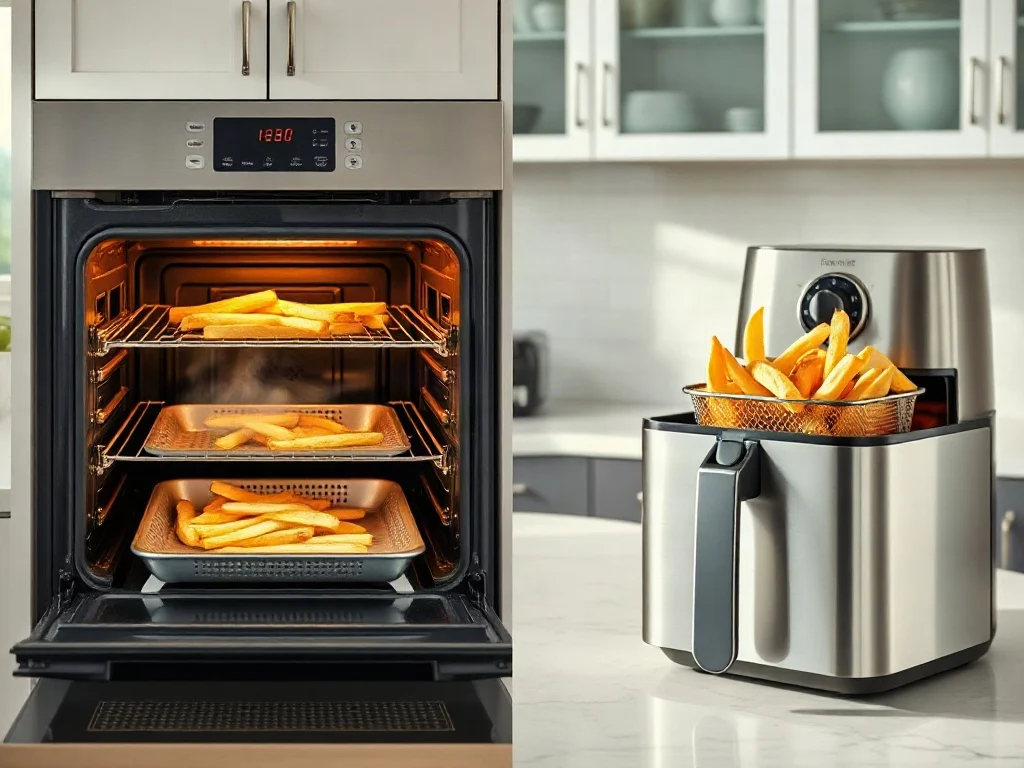
The oven air fryer setting promises crisp, golden food without buying another appliance. It delivers part of that promise, but the label hides real physical differences. Both machines are built on convection oven principles, yet a full-size oven cavity and a compact countertop unit behave very differently. This analysis explains where the gap comes from, when it matters, and how to narrow it.
What the Oven Air Fryer Setting Really Does
An air fryer is, mechanically, a small convection oven: a heating element and a fan circulate hot air around food. Philips popularized the appliance for home kitchens around 2010. The name is marketing, because the food is not fried in oil in any conventional sense.
An oven’s air fry mode usually combines high temperature, the convection fan, and often a perforated tray or mesh basket. I know of no widely adopted industry standard for what this mode must do, so implementations vary by manufacturer. Some ovens add a dedicated element or a stronger fan. Others simply relabel a standard convection bake. Check your manual before assuming your oven is the more capable variety.
Why a Countertop Air Fryer Usually Crisps Better
Airflow Density and Chamber Size
Crispness depends on how fast moisture leaves the food surface. Moving air disrupts the insulating layer of humid air around food, a process governed by convective heat transfer. In a small chamber, the fan moves a high volume of air across a short distance, and the air stays hot and turbulent around the food. A large oven cavity has far more volume to fill. Air velocity at the food surface is typically lower, and heat is diluted across the space.
Basket Design
Most countertop units hold food in a perforated basket, so air reaches the top and bottom at the same time. An oven rack with a solid sheet pan blocks airflow underneath. That is why oven fries often brown on top and stay soft below.
Browning Chemistry
The golden crust people want comes from the Maillard reaction and, with sugars, caramelization. Both need a dry surface and high heat. Because evaporation must finish before browning accelerates, anything that slows moisture removal delays the crust. Weaker airflow does exactly that.
Oven vs Countertop Air Fryer: A Direct Comparison
| Factor | Oven air fry mode | Countertop air fryer |
|---|---|---|
| Capacity | Large, suited to batches | Small, often one to two servings |
| Airflow at food surface | Generally weaker | Generally stronger |
| Preheat time | Longer | Short |
| Cleanup | Trays are easy, but the cavity can spatter | Basket is removable, but its coating wears |
| Counter space | None needed | Required |
The oven wins on volume. If you cook for a family or roast a whole tray of wings, it may beat several rounds in a small basket. A countertop unit wins on speed and texture for small portions. This is a trade-off, not a clear hierarchy.
How to Get Better Results From Oven Air Fry Mode
- Use a perforated tray or wire rack so air reaches the underside of the food.
- Preheat fully, including the tray if it is metal.
- Dry the food with paper towels before cooking.
- Arrange a single layer with gaps. Crowding traps steam.
- Use a high-smoke-point oil in a thin coating.
- Flip or rotate halfway, because ovens often have uneven hot spots.
Common Mistakes
Copying a countertop recipe’s time and temperature is the most frequent error. Recipes written for a small chamber often need adjustment in an oven, and an oven thermometer reveals whether the display matches reality. Lining the tray with solid foil or parchment paper can also block airflow. Finally, browning starchy foods heavily produces acrylamide in any hot-air method, so deep browning is not free of trade-offs.
Frequently Asked Questions
Can you air fry in a regular oven?
Yes, partly. A conventional oven with a convection fan can approximate air frying on a perforated tray at high heat. Results are usually less uniform than in a dedicated countertop unit.
Does oven air fry work as well as an air fryer?
Rarely identically. Larger cavities generally mean lower air speed at the food’s surface, so browning takes longer and crispness can lag. Good technique narrows the gap.
Is a convection oven the same as an air fryer?
They share the same principle. The differences lie in size, fan strength, and basket design, which together make air fryers more intense.
Is an air fryer more energy efficient than an oven?
For small portions, a compact appliance heating a small volume plausibly uses less energy. Real figures depend on the specific models, so check manufacturer data.
The Real Question Is Airflow, Not the Label
The most important insight is that “air fry” describes a result, not a standardized technology. What decides crispness is how much hot, dry air moves across the food’s surface, and a small chamber has a structural advantage there. Ovens can close much of the gap with the right tray, preheating, and spacing, but they cannot change their own geometry.
Watch whether manufacturers start publishing airflow specifications or independent testing standards for air fry modes. Without them, buyers compare marketing rather than performance. As ovens add stronger fans and purpose-built trays, the gap may shrink. Whether the industry defines the term or leaves it to branding remains an open question.
Frequently Asked Questions
How can I tell if my oven's air fry mode is a real upgrade or just a relabeled convection bake?
Check the manual or the manufacturer's spec sheet. Some ovens add a dedicated element or a stronger fan for air fry mode, while others simply rename a standard convection bake. No widely adopted industry standard defines what the mode must do, so implementations vary by brand.