
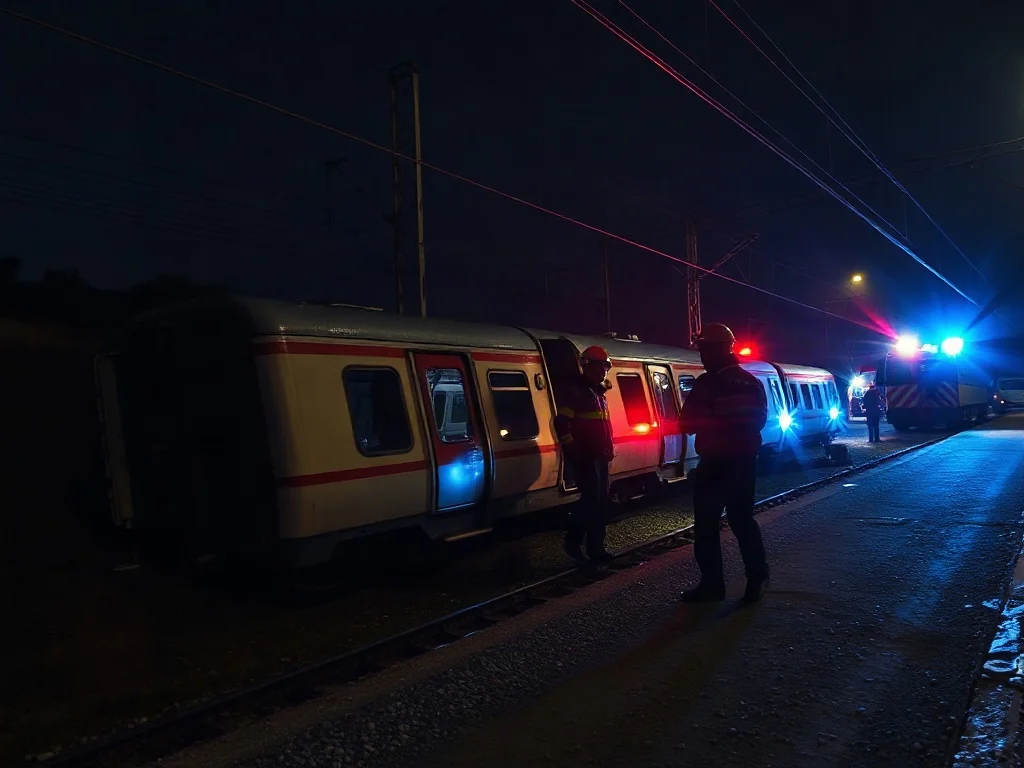
Spain has begun three days of national mourning after a train crash killed dozens of people, one of the deadliest rail accidents in the country’s recent history and among the worst railway disasters in Europe’s modern era. Emergency teams worked through the night to locate survivors and recover victims, while investigators turned their attention to the question that follows every major rail tragedy: how a mechanical or human failure, or a combination of both, could have produced such a catastrophic outcome. This article examines the crash in the context of Spain’s rail network, the established facts available at the time of reporting, the investigative process that will determine the cause, and the broader implications for railway safety across Europe. It separates confirmed information from speculation, which is essential in the immediate aftermath of an incident when early accounts frequently change.
Background: Spain’s High-Speed and Regional Rail Network
Spain operates one of the most extensive high-speed rail networks in the world, built largely over the past three decades under the state operator Renfe and the infrastructure manager ADIF. The country’s high-speed lines, which connect Madrid with cities such as Barcelona, Seville, and Valencia, have been widely praised for their reach and punctuality. Alongside them run older conventional lines, including regional commuter services, where infrastructure is often more varied in age and condition. This split matters for safety analysis, because accidents on legacy lines tend to involve different risk factors, such as signaling systems, track geometry, and rolling stock age, than those on modern high-speed corridors.
Spain’s rail safety regime is overseen by national regulators and, since the European Union’s fourth railway package, has been shaped by the European Union Agency for Railways, which sets common technical standards for interoperability and safety. Accident investigations in Spain are conducted by an independent body, the Comisión de Investigación de Accidentes Ferroviarios (CIAF), which publishes findings in accordance with EU directives. The existence of this independent investigative framework is significant: final reports typically take months rather than days, and early public statements from officials should be treated as provisional.
The Immediate Response and the Limits of Early Information
Emergency responses to rail disasters follow a well-established sequence: securing the site, triaging casualties, establishing a family assistance center, and beginning forensic identification of victims. The overnight search operation reflects these priorities. Rescue teams work in conditions that are hazardous and often confined, with twisted metal, damaged overhead electrical lines, and the risk of further collapse. Declaring a period of national mourning is a political and symbolic act, but it also signals the scale of the loss and the expectation that the state will provide transparent answers.
Readers should be cautious about early reports on causes. In most major rail accidents, initial theories regarding speed, signaling errors, or track defects are revised as data recorders are analyzed, wreckage is examined, and witness testimony is verified. Event data recorders, commonly called black boxes, along with signaling logs and control-center communications, are the primary sources that investigators use to reconstruct the sequence of events. Until these are reviewed, any claim about the precise cause should be regarded as unconfirmed.
Possible Causal Factors in Rail Accidents
Rail disasters generally arise from one or more of a limited set of causal categories. Understanding these categories helps readers evaluate reports as they emerge, without assuming any particular explanation for this specific crash.
Human Factors
Driver error, including overspeeding, missed signals, or fatigue, is a recurring finding in rail investigations. Modern systems are designed with automatic train protection to mitigate such errors, but the effectiveness of these systems depends on installation coverage, maintenance, and whether they are active on a given line. Human factors also extend to dispatching decisions and communication failures between control centers and crews.
Infrastructure and Maintenance
Track defects, including rail breaks, worn components, and problems with switches and points, can cause derailments. Maintenance budgets, inspection frequency, and the age of infrastructure are therefore central to safety analysis. In several European countries, underinvestment in conventional lines has been raised by unions and safety bodies as a structural concern, though such claims require verification against specific findings in each case.
Rolling Stock and Signaling
Derailments can result from wheel or bogie failures, while signaling malfunctions can permit conflicting train movements. The interaction between old signaling equipment and newer rolling stock is a documented challenge in some networks, a point often discussed in relation to the European Train Control System, which aims to standardize signaling across borders but is being deployed unevenly.
Expert Perspectives and Competing Interpretations
Commentators in the rail sector typically divide into two camps when discussing major accidents. One emphasizes the exceptional safety record of European rail, noting that fatal accidents are statistically rare relative to road travel, and that each disaster drives regulatory improvement. The other argues that the reassurance of aggregate statistics can obscure systemic weaknesses on particular lines, and that safety culture, staffing, and investment priorities deserve scrutiny beyond technical fixes. Both perspectives can be valid simultaneously. The key analytical question for this crash will be whether the failure was an isolated technical or human event or whether it reveals a pattern that other lines share.
Safety investigations are designed to find causes, not to assign blame, and their value depends on the willingness of the system to act on what they reveal.
Economic and political dimensions also shape the debate. Rail is promoted across the EU as a low-carbon alternative to aviation and road freight, and high-profile accidents can affect public confidence in that transition. Regulators must balance the expansion of services with the cost of upgrading safety systems, a tension that becomes sharper when budgets are constrained.
Practical Implications for Passengers and Operators
For passengers, the practical takeaway from any rail accident is limited, since the statistical risk of rail travel remains low. Nonetheless, travelers can benefit from knowing how to access official information through national railway operators and emergency services, and from following verified updates rather than social media speculation. For operators and regulators, the lessons are more concrete: verifying the coverage and functioning of automatic train protection, auditing maintenance records, and ensuring that safety recommendations from earlier investigations have been implemented. Common mistakes include treating a single incident as either a complete vindication or a total failure of the system, and failing to follow up on recommendations after the news cycle has moved on.
Future Developments and Open Questions
In the coming months, the most consequential developments will likely be the publication of the formal investigation findings, any resulting regulatory directives, and parliamentary or public inquiries into maintenance and staffing. The European Union may also use the incident to press for faster deployment of interoperable signaling and stronger cross-border safety standards. Investment in rail infrastructure is expected to continue as a policy priority, although the specific measures that follow this crash cannot be predicted with confidence until the causes are established.
Frequently Asked Questions
What caused the Spanish train crash?
The official cause has not been confirmed in the information available at the time of reporting. Investigations by the independent accident investigation body will examine recorder data, signaling logs, infrastructure condition, and witness accounts before determining the cause.
Why is Spain observing three days of mourning?
National mourning is a formal expression of grief and respect for the victims. It is typically declared after events of exceptional scale and signals that the state recognizes the national impact of the loss.
Is train travel in Europe safe after this accident?
European rail remains statistically one of the safest forms of land transport. A single accident, however serious, does not change that baseline, though it does prompt scrutiny of specific lines, systems, and maintenance practices.
The Question That Will Decide Whether This Crash Changes Anything
The most important insight from this tragedy is that the immediate facts will matter far less than what the investigation reveals about the conditions that made the accident possible. If the cause proves to be an isolated fault, the response will be corrective. If it exposes gaps in maintenance, signaling coverage, or oversight that other lines share, the event will become a test of whether Spain and the wider European rail sector are willing to act on systemic findings rather than treating them as exceptions. Readers should watch for the formal investigation report, the recommendations it contains, and whether those recommendations are funded and implemented on a timeline that the public can verify. The unanswered question is not only why this train crashed, but whether the next warning in the system will be heeded before another disaster occurs.
Frequently Asked Questions
Why are early official statements about the cause of the crash considered provisional?
Independent investigators must analyze event data recorders, signaling logs, control-center communications and the wreckage itself before establishing a cause. Early accounts often change as this evidence is reviewed, and in Spain the CIAF publishes final findings, which typically take months rather than days.
What role does the CIAF play after a rail accident in Spain?
The Comisión de Investigación de Accidentes Ferroviarios is an independent body that investigates rail accidents in accordance with EU directives. It is separate from the operators and infrastructure managers, which helps ensure its conclusions about causes and safety recommendations are impartial.
Why does the crash's location on a conventional line matter for the investigation?
Accidents on older conventional lines often involve different risk factors than on modern high-speed corridors, such as older signaling systems, track geometry and rolling stock age. Investigators will therefore examine these legacy-specific elements alongside human factors.
What are the main causal categories investigators consider in rail disasters?
Rail accidents generally stem from human factors such as overspeeding, missed signals or fatigue, along with technical causes like signaling failures, track defects or equipment faults. Many serious incidents result from a combination of both, which is why investigators assess them together.
Does declaring national mourning indicate who is responsible for the crash?
No. A national mourning period is a political and symbolic act that recognizes the scale of the loss and signals that the state will provide transparent answers. It does not establish responsibility, which can only be determined once the formal investigation concludes.