
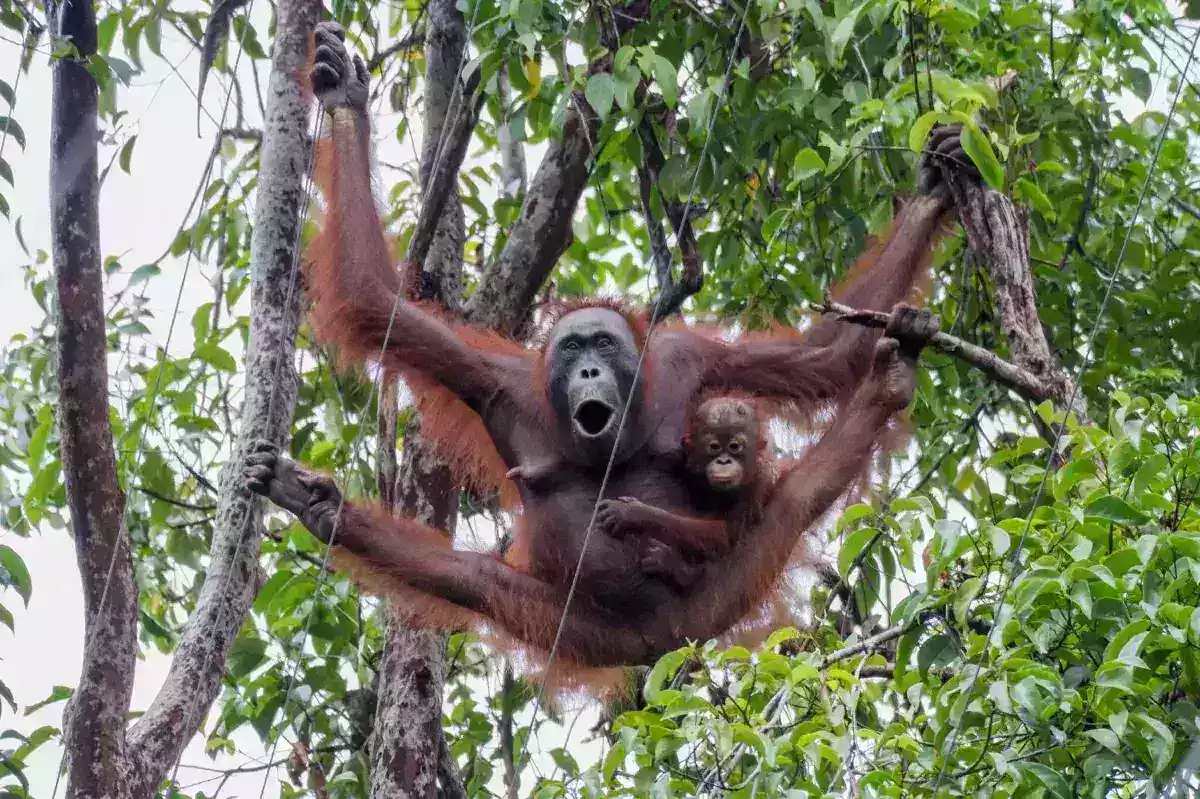
Orangutan breeding programs linking accredited zoos across the United States are producing a closely watched rise in successful births, often described as a baby boom. The newborns attract enormous attention online, but their significance extends beyond appealing photographs. Each birth reflects years of genetic planning, reproductive assessment, behavioral management and cooperation among institutions responsible for one of the slowest-breeding mammals on Earth.
The central question is not simply how zoos produce more orangutan babies. It is whether coordinated breeding can maintain healthy, behaviorally capable populations while helping the public understand the far greater challenge facing orangutans in Southeast Asia. Examining how these programs work reveals both the value and the limits of conservation conducted under human care.
Why Orangutan Births Are Unusually Significant
Orangutans are great apes native to the rainforests of Borneo and Sumatra. They mature slowly, typically give birth to a single infant and have exceptionally long intervals between births. Young orangutans remain dependent on their mothers for years while learning what to eat, how to move through the canopy and how to construct sleeping nests.
This life history evolved in relatively stable forest environments, but it makes wild populations poorly equipped to recover quickly from habitat loss, hunting or other sudden pressures. A female cannot rapidly replace lost offspring. Consequently, every viable birth in a professionally managed population carries substantial demographic importance.
Three living species are recognized: the Bornean orangutan, Sumatran orangutan and Tapanuli orangutan. They are distinct conservation units, not interchangeable versions of the same animal. Responsible zoo management therefore avoids hybridizing species and considers ancestry when recommending potential pairs.
How the Coordinated Breeding Network Works
Modern zoo breeding is rarely a matter of placing two animals together and hoping for an infant. Participating institutions cooperate through population-management frameworks associated with the Association of Zoos and Aquariums. Its Species Survival Plan model coordinates decisions for designated species across multiple facilities.
Genetics and demographic planning
Specialists maintain pedigrees and examine how closely animals are related. They also consider age structure, sex ratios, reproductive history and the number of descendants already associated with a particular genetic line. A genetically underrepresented animal may receive a breeding recommendation, while an individual whose ancestry is already common may not.
The objective is not the largest possible number of births. It is a sustainable population that retains as much genetic diversity as practicable over time. Uncontrolled reproduction could produce overcrowding, amplify inherited problems and leave zoos without suitable long-term placements.
Matching behavior as well as biology
A recommendation does not guarantee compatibility. Orangutans are highly intelligent members of the great ape family, and each individual has a distinct temperament and social history. Care teams commonly introduce animals gradually, beginning with visual, auditory or olfactory contact before allowing closer interaction.
Keepers and veterinary staff monitor appetite, stress indicators, aggression, affiliative behavior and the animals’ willingness to share space. An introduction may be paused or reversed when welfare concerns arise. This ability to adapt is essential because a genetically desirable pairing is not automatically a behaviorally appropriate one.
Transfers between institutions
Because no single zoo contains every suitable partner, animals may move between accredited institutions. Transfers require veterinary examinations, transport planning, regulatory compliance and careful preparation. Orangutans may be trained through positive reinforcement to enter transport spaces voluntarily or participate in routine health procedures, reducing the need for restraint.
Moving a socially and cognitively complex animal is never trivial. Familiar objects, established cues and communication between outgoing and receiving care teams can help preserve continuity. The receiving zoo must also provide suitable climbing structures, privacy, enrichment and skilled personnel.
What Makes Successful Orangutan Breeding Possible?
The answer to how zoo orangutan breeding works lies in the interaction of population science, animal choice and long-term care. Reproduction is not treated as an isolated event. It is one phase within a lifetime welfare plan for the mother, infant, potential father and other animals sharing nearby environments.
Reproductive and veterinary expertise
Veterinary teams track general health and may use hormonal monitoring, ultrasound or other diagnostic tools when appropriate. However, intervention has limits. A healthy pregnancy does not ensure an uncomplicated birth, and excessive handling can cause avoidable stress. Decisions must balance the value of information against the animal’s welfare and the clinical need.
Age also matters. Delayed breeding may narrow reproductive opportunities, yet breeding before an animal is behaviorally or physically prepared creates different risks. Population managers must therefore coordinate demographic goals with individual medical assessments rather than following a universal timetable.
Maternal learning and social experience
Orangutan infants learn intensively from their mothers. Females that observed competent maternal care while young may have useful behavioral experience, although individual outcomes still vary. Zoos can support mothers through secluded nesting areas, stable routines and the ability to choose whether to remain visible.
If a mother does not provide adequate care, staff face a difficult decision. Hand-rearing may be necessary to protect the infant, but prolonged human dependency can complicate later social development. Whenever safely possible, teams may seek strategies that preserve contact with the mother or other orangutans rather than treating human care as an equivalent substitute.
Habitats designed for agency
Effective habitats provide more than minimum space. They include vertical complexity, flexible climbing routes, nesting material, opportunities to forage and areas where animals can withdraw from public view. Rotating enrichment challenges problem-solving abilities without making food access unpredictable to a harmful degree.
A successful birth is not the endpoint of managed conservation. Success must also be measured through maternal welfare, infant development, genetic value and the quality of lifelong care.
From Social Media Attention to Conservation Action
Infant orangutans frequently become social media stars because their facial expressions, grasping behavior and dependence appear familiar to human observers. This visibility can increase attendance, donations and interest in wildlife. It also creates a risk: audiences may remember the baby’s name while overlooking the destruction of the ecosystems on which wild orangutans depend.
Zoos can turn attention into conservation value by connecting every birth announcement with specific educational messages. These should explain species identity, maternal development, threats in the wild and credible ways to support habitat protection. Content should avoid costumes, forced interactions or captions that present a great ape as a human child or prospective pet.
The strongest communication frames an infant as an ambassador for its wild counterparts without implying that zoo births compensate numerically for wild losses. That distinction is crucial to public understanding of ex situ conservation, which protects populations outside their natural habitat but cannot replace functioning forests.
Can Zoo Breeding Save Orangutans?
Can zoo breeding save endangered orangutans? Not by itself. Coordinated populations can preserve genetic lineages, advance veterinary knowledge and provide sustained public engagement. They may also offer research opportunities that would be impractical or intrusive in the wild. Nevertheless, the survival of orangutans as wild species ultimately depends on protecting connected forest habitats and preventing avoidable deaths.
Deforestation, agricultural expansion, infrastructure development, fire, illegal killing and wildlife trafficking create overlapping pressures. The role of palm oil requires particular nuance. Blanket boycotts can shift demand toward other oil crops that may require more land, while poorly governed production can cause serious ecological damage. More effective approaches emphasize traceable supply chains, deforestation-free production and stronger enforcement.
All three orangutan species are classified as Critically Endangered on the IUCN Red List. International trade is also governed through the Convention on International Trade in Endangered Species of Wild Fauna and Flora. These protections matter, but laws and classifications succeed only when they are supported by habitat governance, monitoring, enforcement and local participation.
Benefits, Limitations and Ethical Tensions
| Area | Potential contribution | Important limitation |
|---|---|---|
| Population security | Maintains genetically managed animals across institutions | Capacity is limited and care must continue for life |
| Research | Supports longitudinal behavioral and veterinary observation | Zoo conditions do not fully reproduce wild ecology |
| Education | Creates emotional engagement with conservation | Entertainment-focused messaging can distort the issue |
| Fundraising | Can direct money and attention toward field projects | Financial impact should be documented transparently |
| Reintroduction | Preserves knowledge and genetic material | Zoo-born releases are complex and are not the routine objective |
Critics of captivity argue that highly intelligent, wide-ranging apes cannot exercise a natural range of behavior in zoos. Supporters contend that accredited institutions can provide high welfare while sustaining insurance populations and funding conservation. Both positions raise valid questions. The appropriate evaluation should focus on measurable welfare, institutional transparency, conservation outcomes and whether breeding serves a justified population plan.
Reintroduction is especially easy to misunderstand. Orangutans born in zoos may lack the ecological knowledge, disease history and survival skills needed for release. Suitable secure habitat must also exist. Rehabilitation and release programs in range countries generally work with displaced or confiscated orangutans under specialized protocols; they should not be conflated with routine zoo breeding.
Best Practices for Conservation-Focused Zoos
Institutions seeking to turn breeding success into credible orangutan conservation efforts should adopt practical standards that can be evaluated publicly:
- Follow evidence-based breeding recommendations rather than pursuing births primarily for attendance or publicity.
- Publish welfare and population objectives, including how behavioral health and reproductive decisions are assessed.
- Fund field conservation consistently and identify the organizations, locations and intended outcomes supported.
- Use precise educational language that distinguishes zoo population management, rehabilitation and wild habitat protection.
- Design for animal choice, including privacy, vertical movement and control over social proximity.
- Measure campaign outcomes through donations, learning, purchasing commitments or policy engagement—not views alone.
- Collaborate with range-country expertise instead of presenting overseas institutions as the sole leaders of orangutan recovery.
Readers can evaluate a zoo by looking for accreditation, a clear conservation strategy, transparent financial reporting and evidence that animal care extends beyond attractive exhibits. Relevant internal resources could include a guide to ethical wildlife tourism, an explanation of zoo accreditation standards and practical advice on choosing deforestation-free products.
Frequently Asked Questions
Why are orangutan babies rare?
Orangutans reproduce slowly, usually have one infant at a time and provide prolonged maternal care. Their slow life cycle makes each birth important and prevents populations from rebounding rapidly after losses.
Are orangutan breeding programs the same as rescue centers?
No. Zoo breeding programs manage populations under human care, while rescue and rehabilitation centers typically receive displaced, injured or confiscated animals. Their methods, legal responsibilities and release objectives differ.
How do zoos choose orangutan breeding pairs?
Population managers examine species identity, ancestry, genetic representation, age, health, reproductive history and institutional capacity. Care teams must then determine whether the proposed animals are behaviorally compatible.
Will babies born in American zoos be released into the wild?
Release is generally not the routine goal. Reintroduction requires suitable protected habitat, disease-risk analysis, appropriate behavior, legal authorization and extensive post-release monitoring.
How can visitors help wild orangutans?
Visitors can support transparent field programs, avoid wildlife attractions offering direct contact, reduce waste, examine corporate deforestation policies and favor responsibly sourced products. They can also ask zoos for evidence connecting public campaigns to measurable conservation work.
What the Next Generation Will Test
The most important insight behind the current baby boom is that reproduction is both a biological achievement and a governance test. A newborn may demonstrate effective cooperation among zoos, but the program’s deeper value depends on what happens throughout that animal’s life—and whether public enthusiasm produces durable support for wild populations.
Future developments are likely to include more sophisticated genetic analysis, noninvasive health monitoring, improved reproductive science and stronger welfare measurement. Digital storytelling may bring millions of people closer to orangutans, yet institutions will face growing pressure to prove that visibility translates into habitat protection rather than fleeting engagement.
The decisive question is therefore not how many infants appear in online feeds. It is whether coordinated breeding, ethical care, field partnerships and responsible land-use policies can operate as parts of one conservation system. If they can, zoo-born orangutans may help protect more than an assurance population. They may build the political and social commitment needed to keep their wild relatives in the forest.
SEO Data
Primary Focus Keyphrase: orangutan breeding programs
Related Keyphrase 2: orangutan conservation efforts
Related Keyphrase 3: how zoo orangutan breeding works
Related Keyphrase 4: can zoo breeding save endangered orangutans
Related Keyphrase 5: Species Survival Plan for orangutans
Primary Keyphrase Synonyms: orangutan conservation breeding, managed orangutan breeding, zoo orangutan breeding, coordinated orangutan breeding, captive orangutan breeding
SEO Title: Orangutan Breeding Programs: How Zoos Support Conservation
Meta Description: Discover how orangutan breeding programs coordinate genetics, welfare and zoo partnerships while supporting awareness and conservation in the wild.
URL Slug: orangutan-breeding-programs
Image Filename: orangutan-breeding-program-mother-infant.jpg
Image ALT Text: Mother orangutan holding her infant in a naturalistic zoo habitat
Image Title: Mother and Infant in an Orangutan Breeding Program
Image Caption: A mother orangutan cares for her infant, illustrating the long-term commitment required by coordinated breeding programs.
Search Intent: Informational with conservation-focused commercial investigation
Frequently Asked Questions
Are orangutans born in zoo breeding programs eventually released into the wild?
Generally, no. Accredited zoo breeding programs primarily maintain healthy populations under human care rather than produce animals for release. Reintroduction requires suitable protected habitat, survival skills, disease safeguards and long-term monitoring. Zoo populations can still support wild conservation through research, education, funding and greater public awareness.
Why can’t zoos breed different orangutan species to increase the overall population?
Bornean, Sumatran and Tapanuli orangutans are distinct species and conservation units with separate evolutionary histories. Hybridizing them would blur those lineages and reduce the value of managed populations for conservation. Coordinators therefore study pedigrees and ancestry carefully before recommending breeding pairs.
What happens when a genetically recommended pair does not get along?
Animal welfare takes priority over a breeding recommendation. Care teams use gradual introductions and monitor stress, aggression, appetite and affiliative behavior. If the animals appear incompatible, the introduction may be slowed, paused or ended. Population managers can then consider another partner or a different long-term placement.
Could a surge in orangutan births create overcrowding in zoos?
It could if breeding were uncontrolled, which is why coordinators consider available space, age structure, sex ratios and long-term placement capacity before recommending births. The goal is not continuous population growth but a sustainable, genetically diverse population that accredited institutions can responsibly house and care for throughout each animal’s life.
How are orangutans protected from stress when transferred between zoos?
Transfers involve veterinary screening, regulatory planning, specialized transport arrangements and preparation by familiar care teams. Through positive reinforcement, an orangutan may learn to enter a transport enclosure voluntarily. After arrival, staff typically allow an adjustment period and introduce the animal gradually to new surroundings, keepers and potential companions.