
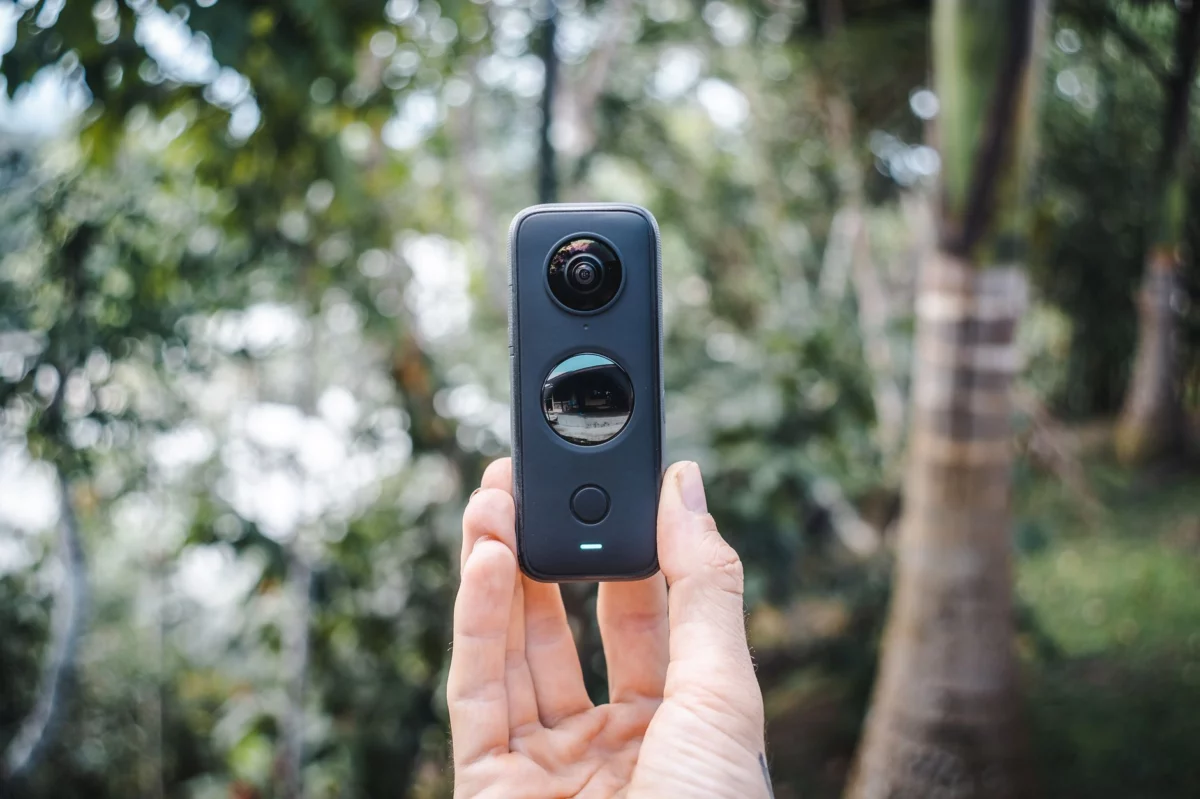
The Insta360 X6 review conversation starts with two consequential changes: larger image sensors intended to improve low-light performance and a smaller camera body. Those upgrades address a persistent compromise in consumer 360 cameras. Users want an immersive camera that captures every direction, yet they also expect the portability, durability and immediate usability of a conventional action camera. Based on the available 2026 report, the X6 is positioned as a stronger hybrid of those categories rather than merely an incremental resolution update.
Important details—including sensor dimensions, recording resolutions, frame rates, battery capacity, waterproofing, price and thermal limits—were not supplied in the source article. This analysis therefore separates confirmed claims from their likely technical implications. It explains why sensor size and body design matter, where software remains decisive and what buyers should verify before treating the X6 as a replacement for both a 360 camera and a traditional action camera.
Insta360 X6 review: the confirmed changes
The available information confirms that the Insta360 X6 is a compact 360-degree video camera with larger sensors than its predecessor and a physically smaller body. It is also described as a hybrid capable of serving both immersive-video and action-camera roles. No reliable numerical specifications accompanied those claims, so assumptions about exact sensor area, maximum resolution or recording duration would be premature.
The hybrid label matters because a 360 camera records overlapping views through opposing ultra-wide lenses. Software stitches those views into a spherical scene, allowing the editor to choose a conventional frame afterward. An action camera, by contrast, normally records a predetermined direction. The 360 approach offers creative freedom, while the conventional design generally delivers simpler framing, fewer stitching artifacts and more efficient processing.
The X6’s most important promise is not simply wider coverage. It is the possibility of obtaining useful action footage without deciding the final camera angle during capture.
Why larger sensors could improve image quality
Low-light performance and noise
A larger sensor can collect more light when other variables are comparable. That can improve the signal-to-noise ratio, preserve color and reduce the aggressive smoothing often seen in small-camera night footage. Sensor dimensions are therefore more informative than a headline pixel count alone. The relationship between physical size, pixel pitch and lens aperture is covered by the principles of image sensor format.
Modern compact cameras commonly use a CMOS active-pixel sensor, but hardware is only one part of the result. Exposure strategy, noise reduction, color processing and multi-frame combination can materially alter the final image. Larger sensors should give the X6’s processing pipeline better source data; they do not automatically guarantee natural detail or artifact-free night video.
Low-light improvement would be especially valuable for cyclists at dusk, indoor creators, concert attendees and travelers moving between bright streets and dark interiors. However, prospective buyers should examine full-resolution samples rather than compressed social-media clips. Fine textures, moving foliage, faces and shadow gradients reveal whether noise reduction preserves detail or turns it into a waxy surface.
Dynamic range and highlight control
Outdoor action scenes regularly combine deep shade with bright sky. Better dynamic range can retain information at both extremes, making reframed clips easier to grade. Larger sensors may help, but readout design, exposure bracketing and tone mapping remain critical. A camera can produce a bright image while still clipping clouds, lamps or reflective water.
Processing based on computational photography may combine exposures or apply localized tone adjustments. This can produce attractive footage, although moving subjects and mismatched frames can create ghosting. An expert evaluation should compare standard, HDR and low-light modes while subjects cross the stitch boundary.
Resolution is not the same as visible detail
In 360 video, the advertised resolution is distributed across the entire sphere. A reframed horizontal view uses only part of those pixels, so its effective detail can be substantially lower than that of a conventional camera recording the same final angle. Lens sharpness, stitching, compression and export settings also affect the result. Even if the X6 offers a high capture resolution, buyers should judge the exported flat video they intend to publish.
A smaller body brings benefits—and engineering risks
Reduced size makes a 360 action camera easier to mount on a helmet, handlebar, backpack strap or extension pole. Lower bulk can reduce leverage on mounts and make handheld use less conspicuous. It also helps the X6 compete with pocket cameras and phones for everyday travel footage.
Yet combining larger sensors with a smaller enclosure creates engineering tension. High-resolution capture and real-time stitching generate heat, while a compact body offers less internal space for cooling and battery cells. Without verified testing, it is not possible to state whether the X6 records longer or shorter sessions than earlier models. Buyers should look for continuous-recording tests conducted at multiple resolutions and realistic ambient temperatures.
Lens protection is another concern. Opposing fisheye lenses must protrude enough to see nearly the entire scene, leaving them more exposed than a recessed action-camera lens. A smaller chassis does not eliminate that vulnerability. Replaceable guards can reduce risk, but they may introduce flare, reflections or visible seams under difficult lighting.
How the X6 hybrid workflow should work in practice
Capture first, frame later
The defining benefit of 360 capture is reframing. A skier can concentrate on the route, a cyclist can record traffic approaching from several directions and a solo presenter can create multiple angles from one take. The editor later selects a field of view, adds keyframes and exports a conventional horizontal or vertical clip.
Reframing often relies on tracking and optical-flow techniques. These tools can smooth virtual camera movements, but they may lose subjects behind obstacles or misread similar objects. Automated edits should therefore be treated as a starting point rather than a substitute for reviewing the complete spherical recording.
Stabilization and horizon control
Electronic stabilization uses motion-sensor data and spare image area to counter camera movement. A spherical capture gives software unusual freedom to maintain a level horizon, which is valuable when the camera rotates during riding, running or water sports. The trade-off can include warping, reduced edge detail or abrupt corrections under extreme vibration.
Another issue is rolling shutter, which can bend vertical lines or create a wobbling appearance when a sensor is read sequentially. Larger sensors do not inherently solve this problem. Fast readout and effective processing matter more, making rapid panning and vibration tests essential.
Audio remains part of the action-camera test
A camera designed for immersive scenes also needs convincing spatial sound. Wind reduction, microphone placement and synchronization affect whether footage feels immediate or distracting. Some 360 workflows use concepts related to Ambisonics, although the source report does not confirm the X6’s audio format. Users should verify whether directional audio follows a reframed view and whether external microphones are supported.
Strengths, compromises and likely users
| Use case | Potential X6 advantage | What to verify |
|---|---|---|
| Travel and walking | Compact body and framing after capture | Battery life, low-light detail and export speed |
| Cycling and motorsports | Horizon leveling and all-direction coverage | Heat, vibration, wind audio and lens protection |
| Vlogging | One recording can produce several viewpoints | Skin tones, subject tracking and microphone options |
| Underwater activity | Immersive perspective | Official depth rating, housing needs and stitching quality |
| Professional production | Flexible establishing shots and virtual camera moves | Bit rate, color profiles, codec support and workflow compatibility |
The X6 appears most compelling for creators who routinely miss action outside a fixed frame. It may also benefit professionals who need compact secondary shots. A conventional action camera can remain preferable when maximum forward-facing detail, straightforward files, fast turnaround or easily replaced lens covers are priorities.
Durability claims require particular scrutiny. If an official specification cites water or dust protection, readers should understand the relevant IP rating, including its test conditions. Water resistance is not universal protection against salt water, high-pressure impacts, worn seals or operation with open port covers.
What to test before buying an Insta360 X6
- Inspect original files: Download unedited daylight, night and mixed-light footage rather than relying on platform compression.
- Check the stitch line: Look at nearby hands, handlebars, faces and moving objects as they pass between lenses.
- Compare reframed exports: Evaluate the actual 16:9 or 9:16 output against a conventional action camera.
- Measure practical endurance: Consider battery runtime, overheating, charging time and storage consumption in the desired mode.
- Audit the workflow: Confirm that the mobile and desktop applications support the required device, codec and export resolution.
- Price the complete kit: Include batteries, fast memory cards, mounts, lens guards, an extension pole and any underwater housing.
- Review repair options: Protruding 360 lenses are vulnerable, so warranty terms and lens-replacement policies can affect ownership cost.
Professionals should also test color matching with their primary cameras. A flexible 360 shot has limited value if sharpening, white balance or highlight rendering makes it visually incompatible with the rest of a production.
Frequently asked questions
Is the Insta360 X6 better in low light?
The reported larger sensors are intended to improve low-light performance, and the underlying physics makes that goal credible. The scale of the improvement cannot be established without sensor specifications and controlled comparisons of original footage.
Can the Insta360 X6 replace an action camera?
It may replace one for users who prioritize reframing, horizon control and all-direction coverage. A conventional action camera may still offer simpler operation and more concentrated detail in a fixed forward view.
Why does sensor size matter in a 360 camera?
Each lens must capture a very wide scene, often under short shutter times needed to control motion blur. More light-gathering capacity can improve noise, color and shadow detail, particularly indoors or around sunset.
Does a smaller camera always mean shorter battery life?
No. Battery capacity, processor efficiency, display use, recording mode and thermal management all influence runtime. The X6 requires independent endurance tests before any conclusion is justified.
The real test will be the complete imaging pipeline
The most important insight is that larger sensors alone will not determine whether the Insta360 X6 succeeds. Lens quality, sensor readout, stabilization, stitching, compression, mobile software and export performance form one connected imaging pipeline. A weakness at any stage can erase gains made by improved hardware.
Watch next for official specifications, original downloadable samples and repeatable thermal and battery testing. If the smaller design maintains sustained recording while the larger sensors deliver cleaner moving detail—not merely brighter processing—the X6 could narrow the practical gap between immersive cameras and premium action cameras. The unanswered question is whether it can achieve that balance without compromising durability, endurance or workflow speed.
SEO Data
Primary Focus Keyphrase: Insta360 X6 review
Related Keyphrase 2: Insta360 X6 low-light performance
Related Keyphrase 3: 360 action camera hybrid
Related Keyphrase 4: Can Insta360 X6 replace an action camera?
Related Keyphrase 5: best compact 360 camera
Primary Keyphrase Synonyms: Insta360 X6 camera review, X6 360 camera assessment, Insta360 X6 analysis, X6 action camera review, Insta360 X6 evaluation
SEO Title: Insta360 X6 Review: Larger Sensors, Smaller Body
Meta Description: This Insta360 X6 review examines its larger sensors, smaller body, low-light potential and value as a 360 action camera hybrid.
URL Slug: insta360-x6-review
Image Filename: insta360-x6-review-360-action-camera.jpg
Image ALT Text: Compact Insta360 X6-style 360 action camera with opposing lenses mounted outdoors at dusk
Image Title: Compact 360 Action Camera at Dusk
Image Caption: A compact dual-lens 360 camera designed for immersive action footage in challenging light.
Search Intent: Mixed informational and commercial investigation
Frequently Asked Questions
Can the Insta360 X6 realistically replace a conventional action camera?
Potentially, but only for users who value reframing flexibility over maximum simplicity. A 360 camera captures every direction and lets you choose the angle later, while a conventional action camera usually offers easier framing, lighter processing and fewer stitching artifacts. Buyers should verify single-lens performance, stabilization, export workflow and image quality before treating the X6 as a complete replacement.
Do larger sensors guarantee better night footage on the X6?
No. Larger sensors can collect more light and provide cleaner source data, but final quality also depends on lens aperture, pixel pitch, exposure strategy, stabilization and noise reduction. Full-resolution samples with moving subjects are especially important because aggressive processing may brighten footage while smearing faces, foliage and other fine textures.
Could the smaller X6 body negatively affect battery life or overheating?
A smaller enclosure can leave less room for the battery and heat dissipation, particularly during high-resolution recording or intensive stitching. However, efficiency improvements could offset those limitations. Because battery capacity, recording duration and thermal limits were not confirmed, buyers should look for continuous-recording tests rather than relying only on short promotional clips.
What footage should buyers inspect to judge stitching quality?
Useful tests should include subjects passing close to the camera, fast movement across the lens boundary, helmets or selfie sticks near the stitch line, and scenes with repeating patterns. Reviewers should also show uncompressed exports, since social platforms can hide seams, ghosting and detail loss. Lens spacing and software calibration matter as much as headline resolution.
Which specifications should be confirmed before pre-ordering the Insta360 X6?
Confirm the exact sensor dimensions, available resolutions and frame rates, battery capacity, waterproof rating, operating temperature limits and price. Also check maximum recording duration, single-lens modes, codec and bitrate options, replaceable-lens protection, stabilization performance and export requirements. These details determine whether the X6 is practical for extended action use rather than merely promising on paper.