
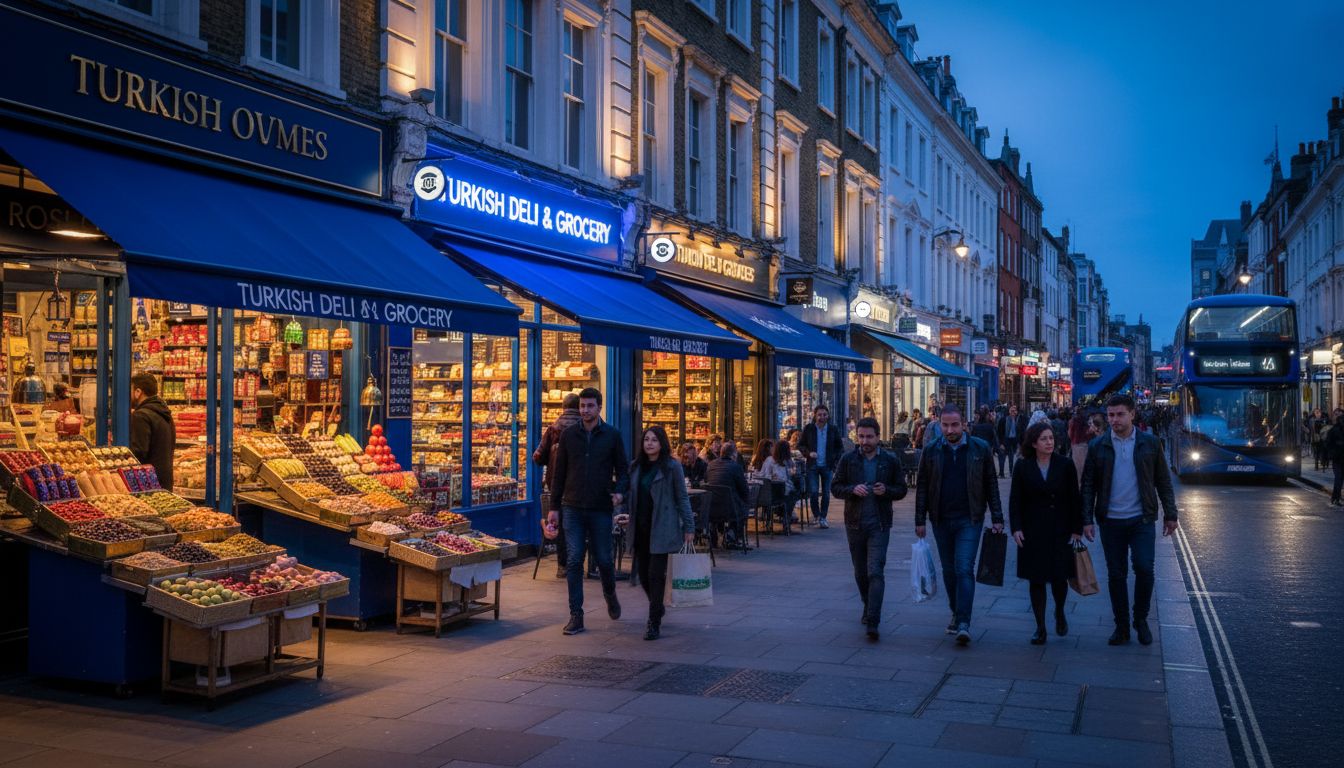
Across the UK, local high streets are changing fast. For many diaspora entrepreneurs, especially those serving close-knit communities with strong cultural ties, the question is no longer whether to sell online, but how to combine a visible local presence with digital reach. From market stalls and family-run shops to online listings, social commerce and direct-to-customer websites, this shift is helping independent businesses stay relevant in a tougher retail climate.
For the Turkish community in the UK, this story feels particularly familiar. A business may begin with a stall, a takeaway counter, a barber chair, a grocery shelf or a small office above a parade of shops. But today, future-proofing that business often means being findable online, taking digital orders, managing customer relationships better and using trusted community platforms to turn local reputation into long-term growth.
The high street is under pressure, but not in decline everywhere
Recent data shows why diversification matters. In its March 2026 bulletin on high streets and retail areas in Great Britain, the ONS said that retail employment fell more sharply in central high streets and shopping centres than in non-central high streets and retail parks over the period from 2015 to 2024. For independent traders, this is a clear signal that relying only on walk-in trade has become riskier, especially in town centres facing rising costs and changing footfall patterns.
That does not mean the high street has lost its value. The same ONS bulletin noted that retail addresses still accounted for around a third of addresses on central high streets in most countries and regions of Great Britain. Just as importantly, the high street mix is broadening. Cafes, restaurants, takeaways, pubs, banks and shops all contribute to the local economy, creating space for businesses that combine retail, services, hospitality and fulfilment.
For diaspora founders, this broader mix can be an advantage. Many already operate flexible business models by instinct: a grocery that also sends gifts, a bakery that takes WhatsApp orders, a travel service that sells online, or a fashion shop that also promotes products through marketplace listings. In other words, many community businesses are already built for the kind of hybrid retail future the data now supports.
Why diaspora entrepreneurs are central to the UK’s business future
Far from being a niche part of the economy, ethnic-minority and immigrant entrepreneurs are a major force in UK enterprise. The Global Entrepreneurship Monitor UK 2024/25 report found that the total early-stage entrepreneurial activity rate for the UK’s non-white ethnic population was 19.1% in 2024, compared with 10.4% for the white population. That is nearly double, and it highlights just how important minority founders are to business creation across the country.
The same report found that immigrant entrepreneurial activity stood at 13.0% in 2024, down from 16.3% in 2023, but still above the 9.8% rate for UK-born lifelong residents. Even in a more difficult trading environment, migrant and diaspora communities remain disproportionately active in starting businesses. This matters because the founders most willing to create new ventures are often the same people willing to rethink old high-street models.
There is also a wider surge in entrepreneurial intent. GEM reported that 36% of working-age people in the UK were either already engaged in entrepreneurial activity or intended to start a business within three years in 2024, the highest proportion since 1999. That means the pipeline of future founders is growing, and many of them will likely shape the next version of local retail corridors through hybrid, community-rooted business models.
From market stall to online listing: the new business ladder
For many small business owners, the traditional path was simple: start small, build regulars, then expand into a shop. That journey still exists, but it now often includes a second ladder running alongside it: online discovery, e-commerce, digital catalogues, social media selling and listing-based visibility. A trader can sell from a stall on Saturday, take orders through Instagram on Sunday and fulfil repeat business through a website during the week.
This shift is backed by the numbers. ONS retail data showed that online sales made up 26.8% of total retail sales in Great Britain in March 2025, up from 26.4% in February. A 2025 retail sector report citing ONS data also noted that online retail represented 27.6% of UK retail sales excluding automotive fuel in August 2025, up from 27.1% a year earlier. Online is no longer a side project. It is now a core sales channel.
For diaspora entrepreneurs, online listings are especially valuable because they reduce one of the biggest barriers to growth: discoverability. A business that is well known within one neighbourhood can become visible to a much wider audience when listed in trusted directories, marketplaces and local search platforms. This is especially useful for businesses serving community needs, including Turkish food, legal support, property services, education, travel and specialist retail.
Trust is local, but growth can be digital
One reason diaspora businesses perform strongly is that they often begin with trust. Customers come through family recommendations, word of mouth, shared language, cultural understanding and familiarity with products or services. On the high street, this creates loyalty that larger chains often struggle to match. In digital spaces, that same trust can become a competitive advantage when presented clearly through reviews, accurate listings, strong photography and responsive communication.
This is where community-focused platforms matter. A trusted listing can do more than display a business name and phone number. It can help communicate specialisms, opening hours, service areas, product categories and the cultural context that makes a business appealing. For example, a Turkish solicitor, accountant, caterer or home-improvement specialist may gain more confidence from customers when they are presented in a setting that understands their audience rather than treating them as just another anonymous listing.
The result is not a replacement of the high street but an extension of it. A storefront creates familiarity and credibility. An online presence creates convenience and reach. Together, they allow businesses to serve both the loyal local customer and the new customer searching online for a trusted provider. That balance is one of the clearest ways local high streets can be future-proofed rather than abandoned.
Technology is becoming basic infrastructure for independent retail
The UK government’s 2025 digital adoption agenda makes this point very clearly. The SME Digital Adoption Taskforce said the technologies SMEs need include CRM systems, e-commerce, accounting and AI products, and argued that stronger adoption is vital if the UK’s 5.5 million SMEs are to remain competitive. The language here is important: e-commerce is no longer discussed as an optional extra, but as part of core business infrastructure.
The taskforce also warned that UK SMEs lag behind G7 competitors in the uptake of digital tools and AI, and that many businesses overestimate their digital readiness. In practice, this means there is often a gap between what owners think they are doing digitally and what they need to do to stay competitive. A Facebook page alone is not a digital strategy. Neither is a website that cannot take enquiries properly or a listing with outdated contact details.
Private-sector commentary points in the same direction. KPMG’s 2025 private enterprise barometer said that technology, including AI, is instrumental to operating a customer-centred, seamless commerce model. Shopify’s UK State of Commerce Report 2024 likewise reflects how strongly retail platforms are focusing on omnichannel selling. For independent businesses, the takeaway is simple: future-proofing means combining human relationships with better systems.
Finance and support still shape who gets to scale
While entrepreneurial ambition is strong, access to finance remains uneven. The British Business Bank’s report on investing in ethnic minority entrepreneurs warned that without action, capital will concentrate in particular communities and the UK will miss vast latent potential. This is not a talent problem. It is a structural issue, and it affects whether promising businesses can invest in stock, staff, fit-outs, websites, delivery systems or marketing.
Yet the appetite to build remains strong. UK Finance, drawing on more than 25,000 SME Finance Monitor interviews, found that ethnic minority-owned businesses have a strong desire for growth. This aligns with what many community observers already see: the ambition is there, but businesses often need practical, affordable routes to turn momentum into scale.
There are also encouraging signs in lending data. Start Up Loans reported that demand for loans to start retail businesses rose 22% year-on-year in December 2024, with retail accounting for 6% of the total volume of loans in both 2023 and 2024. Richard Bearman of the British Business Bank captured the moment well when he said, “If we want to revive our high streets and create globally successful e-commerce companies then it is vital entrepreneurs have access to finance and mentoring support.”
Hybrid retail is already working in practice
One useful recent case study comes from Liverpool-based Robin Valley, highlighted by Start Up Loans. The business had operated as a wooden jewellery wholesaler before opening its first physical store in Manchester’s Arndale Centre. It now supplies more than 100 retailers, employs 20 people and had previously received a £15,000 Start Up Loan. The model is interesting because it shows movement in both directions: wholesale and broader distribution leading into physical retail, rather than only physical retail leading online.
This matters because it reflects a wider truth about modern commerce. Physical presence and online growth are no longer opposites. A shop can act as a showroom, collection point, community anchor or branding tool, while online channels handle repeat orders, out-of-area customers and seasonal sales. For diaspora founders, especially those with strong product niches or loyal cultural markets, that combination can be highly effective.
A Turkish confectioner, for example, might use a local shop to build sampling, trust and footfall, while using online listings and e-commerce to sell gift boxes nationwide. A local tailoring service may rely on in-person fittings but use digital booking, maps, reviews and messaging to attract customers from several boroughs. The future-proofed high street business is often the one that understands where physical interaction matters most and where digital convenience can do the rest.
Why trusted local networks matter more than ever
Digital adoption does not happen in a vacuum. The SME Digital Adoption Taskforce recommended partnering with trusted local and industry stakeholders, including trade bodies, accountants, bookkeepers and tech firms, to make digital transformation more accessible, credible and relevant. This is especially important for diaspora entrepreneurs, who may rely more heavily on community-based networks than on mainstream advisory channels.
That recommendation fits what support organisations are already seeing. Hatch Enterprise says 62% of the founders it supports are from minority ethnic backgrounds, suggesting that the demand for tailored business support is heavily concentrated among founders facing systemic barriers. Its recent impact materials also point to a deeper problem: many would-be founders still feel entrepreneurship is not something that resembles them, or believe white people have greater chances of success in business than people from ethnic minority backgrounds.
In that context, trusted directories, local business communities and culturally aware support platforms do more than generate leads. They reduce friction. They help founders feel visible, understood and credible. They also help customers find businesses with more confidence. For the Turkish community in the UK, this kind of trusted digital bridge can play a real role in strengthening both enterprise and local high streets.
Visibility, data and recognition are improving
Another important change is better official visibility. ONS published a dedicated 2024 release on business ownership by ethnicity group in London and the UK on 15 October 2025, based on the Annual Population Survey. While the data is still an approximation, the fact that it exists in a dedicated form is significant. It gives policymakers, researchers and business-support organisations a clearer picture of diaspora and ethnic-minority ownership.
That greater visibility is now filtering into the mainstream policy conversation. A House of Commons Library research briefing noted that in 2024 around 11% of UK business owners were from a minority ethnic group, drawing on ONS-related analysis and earlier work on the value of ethnic-minority firms. NatWest also described non-white ethnic groups as a cornerstone of UK entrepreneurial activity in its 2024 note on GEM findings. The language is changing: ethnic-minority founders are increasingly being recognised as central to the economy, not peripheral to it.
For local high streets, this matters because recognition shapes support. When data makes diaspora ownership more visible, it becomes easier to argue for better finance access, more relevant training, stronger digital support and more inclusive local economic policy. In practical terms, better recognition can help more businesses make the leap from informal visibility to structured, scalable presence both offline and online.
The strongest message from recent UK evidence is that the future of the high street is hybrid. Central high streets are under pressure, online retail now accounts for more than a quarter of sales, and entrepreneurial activity remains especially strong among non-white and immigrant populations. Put together, these trends suggest that diaspora entrepreneurs are not simply adapting to change. They are among the groups most likely to shape what a resilient local high street looks like next.
For Turkish and other diaspora business owners in the UK, future-proofing does not mean giving up the shopfront, the market pitch or the face-to-face service that built trust in the first place. It means adding the tools that make that trust more visible: online listings, digital systems, e-commerce, reviews and better customer communication. The businesses that thrive will often be those that stay rooted in community while becoming easier to find, easier to buy from and easier to recommend.