
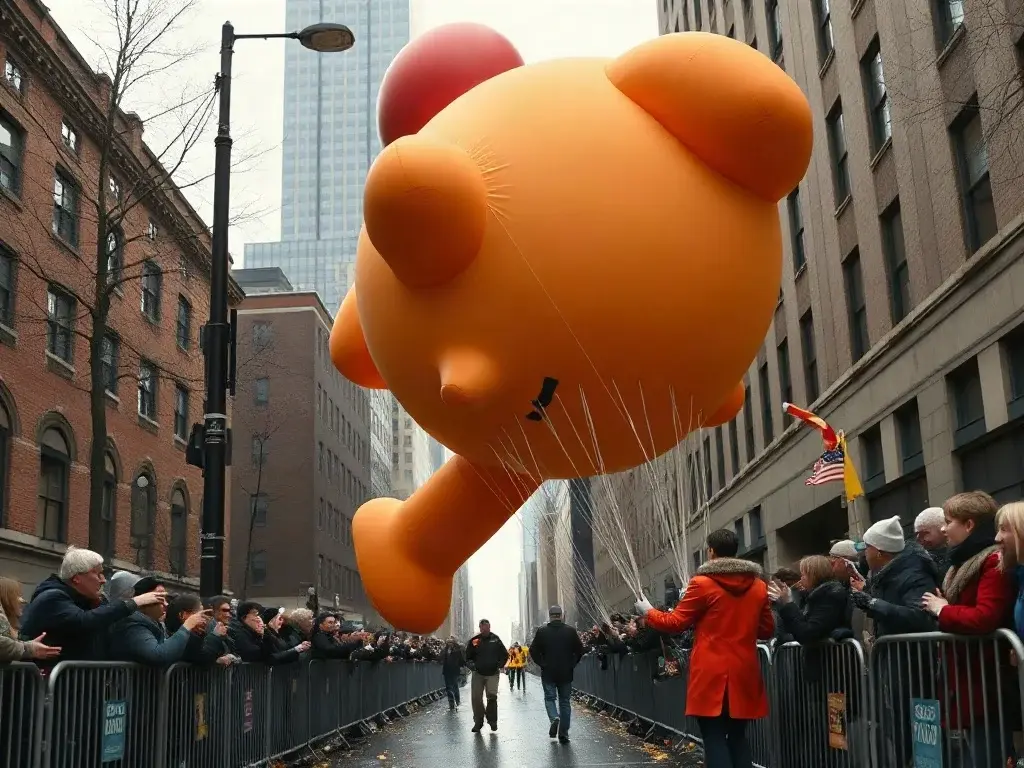
Macy’s Thanksgiving Day Parade mishaps have become a tradition of their own. Every November, viewers watch for a stumbling float, a sagging balloon or a gust that bends a giant cartoon character sideways. A recent listicle ranked the 12 worst incidents, from Barney’s “murder” to Sonic’s disastrous debut. That framing is entertaining, but it hides a more useful question: what do these failures say about how a Macy’s Thanksgiving Day Parade is engineered, regulated and remembered? This analysis treats the blunders as data about risk, design and public tolerance for spectacle, and it separates comic embarrassments from genuine safety failures.
Why Macy’s Thanksgiving Day Parade Mishaps Become Holiday Lore
The parade is a live, outdoor, televised event on a fixed date. It runs through the dense street grid of New York City, and the date cannot move when the weather turns. The main attractions are enormous, lightweight objects that behave like sails. Nearly every element of the design invites a visible failure, and the broadcast by NBC guarantees an audience for it.
The mishaps are also memorable because the parade is sentimental. It is part of the national ritual of Thanksgiving in the United States. A deflating mascot is funny because it punctures a polished corporate production. A balloon that injures a bystander is not funny, and a fair ranking has to keep that distinction in view.
A Short History of a Risky Design
The parade began in 1924, organized by employees of Macy’s and originally featuring live animals from the Central Park Zoo. The giant balloons arrived later, shaped by the designer Tony Sarg. Felix the Cat was among the earliest balloon characters. By the late 1920s the balloons were filled with helium, and in the early years they were released into the sky at the end of the parade. That practice was dropped in the early 1930s, a quiet admission that uncontrolled giant balloons were a poor idea.
The basic physics has not changed since. A helium balloon the size of a building has huge surface area and almost no mass relative to it. Handlers on ropes provide steering, but they do not provide stability. When wind arrives, the handlers become a thin and imperfect safety system.
The Four Failure Types Behind the List
Sorting the incidents by cause is more informative than ranking them by embarrassment. Most mishaps fall into one of four categories.
| Failure type | Typical cause | Seriousness |
|---|---|---|
| Wind and collision | Gusts push balloons into street furniture or buildings | Can be severe |
| Weather accumulation | Rain or snow collects on a balloon’s surface or folds | Usually minor, occasionally hazardous |
| Design or handling flaws | Poor inflation, awkward shape, or rope control problems | Mostly cosmetic |
| Performance and logistics | Technical glitches, timing errors, or crowd issues | Mostly embarrassing |
Wind and Collision: The Category That Changed the Rules
The most consequential incident widely documented occurred in 1997. The Cat in the Hat balloon, based on the Dr. Seuss character, struck a lamppost along Central Park West. The pole fell and seriously injured a spectator, who spent weeks in a coma. This is the incident that separates the parade’s history of comedy from its history of risk. Afterward, New York City tightened its wind restrictions. As widely reported, balloons are not supposed to fly when sustained winds exceed about 23 mph or gusts exceed about 34 mph. Readers can check the underlying weather terminology at the National Weather Service, and the concept of a wind gust matters here because gusts, not average wind, cause most balloon incidents.
The analytical point is that this threshold is a reactive rule. It was written after a serious injury, not before one. The parade’s safety history is largely a record of rules following harm.
Weather Accumulation: When Rain Becomes Slapstick
Rain is a quieter hazard. The best-known story, widely repeated, involves a Popeye balloon in the 1950s whose hat collected rainwater and then spilled it onto spectators. Few details beyond that anecdote are reliably documented, and lists tend to embellish. The lesson is practical: a balloon’s shape matters, because brims, ears and folds can trap water, and a design that looks charming in a studio can fail in a downpour.
Design and Handling: Where Barney and Sonic Fit
The headline of the listicle that prompted this article points to two of the best-known cases of character balloons going wrong. The Barney balloon’s “murder” and the debut of Sonic the Hedgehog, the mascot of Sega, are presented as comic disasters. The original piece supplies those details, and they should be read as entertainment rather than as engineering reports. What they share is instructive. Both involve licensed pop-culture characters whose popularity peaked at the moment of their balloon debut. That created pressure to feature them even when their forms were difficult to inflate and steer. A balloon is a licensing asset as much as a piece of equipment.
How the Parade Adapted
Over the decades, the organizers developed several mitigations. These include trained handlers, pre-event inspection, wind monitoring along the route, and the option to fly balloons lower or not at all. Lowering the balloons is the sensible compromise. It keeps the spectacle on screen while reducing the lever arm that wind can exploit.
The 2020 edition, held during the COVID-19 pandemic, was a useful natural experiment. With in-person spectators removed from the route and the balloons guided by specially designed vehicles rather than large crowds of handlers, the event showed that the spectacle can survive without the most crowded elements. Whether organizers apply that lesson permanently is a separate question, because the crowds are also part of the commercial point of the event.
The Problem With the 12 Worst Mishaps Format
Ranked lists reward the funniest anecdote, not the most important one. That produces three distortions.
- Flattening of severity. A balloon that sags and a balloon that injures a bystander appear side by side, as if they belonged to the same genre.
- Survivorship in memory. Incidents involving famous characters get remembered, while ones involving obscure balloons vanish, regardless of how serious they were.
- Folklore inflation. Details drift each time an anecdote is retold, and many popular stories lack primary documentation.
A more rigorous approach would rank incidents by injury, by property damage, and by operational consequence, and would separate those from pure comic value. The parade’s real mishap record is shorter and more sobering than the highlight reel suggests.
Practical Takeaways for Viewers and Event Organizers
What viewers can monitor
- Check the forecast for gusts rather than average wind speed.
- Watch whether balloons are flown lower than usual, which signals active risk management.
- Stay clear of street lamps and traffic signals along the route when winds are strong.
What event professionals can learn
- Plan for the gust, not the mean. Thresholds based on sustained wind alone miss the events that cause injuries.
- Audit the street, not just the balloon. The 1997 incident involved a lamppost, so route furniture is part of the risk model.
- Design for water. Avoid shapes that collect rain or snow.
- Separate licensing pressure from safety decisions. A balloon with a major sponsor should be grounded as readily as any other.
Frequently Asked Questions
What was the worst Macy’s parade accident?
The 1997 Cat in the Hat balloon incident is the most widely cited serious case. A lamppost struck by the balloon fell and seriously injured a spectator.
Are Macy’s parade balloons safe in high winds?
Not always. That is why wind limits exist. As widely reported, balloons are restricted when sustained winds exceed about 23 mph or gusts exceed about 34 mph, though the rules and their application can change.
Why do Macy’s balloons use helium?
Helium is non-flammable and lighter than air, which allows large balloons to float safely above the street. Early balloon practices have long since been abandoned in favor of controlled flights.
Has the parade ever been held without spectators?
Yes. In 2020, because of the pandemic, the parade was restructured with limited in-person attendance along the route.
The Real Lesson Is in the Wind Forecast, Not the Blooper Reel
The most important insight is that the parade’s mishaps are not random. They are the predictable output of a system that places enormous, wind-sensitive objects in a dense city on a fixed date, supervised by people on ropes. The comic incidents are the harmless tail of the same distribution that produced the serious 1997 injury. Viewers who enjoy the blooper reel should also appreciate that the quiet years are the result of conservative decisions.
What to watch next is whether organizers expand vehicle-assisted handling, redesign shapes to shed water, and publish clearer go or no-go criteria. The unanswered question is whether the public will accept a parade with fewer dramatic mishaps if the price is a lower-flying, less spectacular balloon. The history suggests that audiences say they want safety but remember the spectacle, and that tension will shape the next decade of the tradition.
Frequently Asked Questions
Why can't the parade simply be postponed when the weather is bad?
The parade is a live, televised event tied to a fixed Thanksgiving date, and it moves through dense city streets. Rescheduling is not a practical option. Organizers can only adjust, for example by flying balloons lower or keeping them grounded when winds exceed the safety limits.