
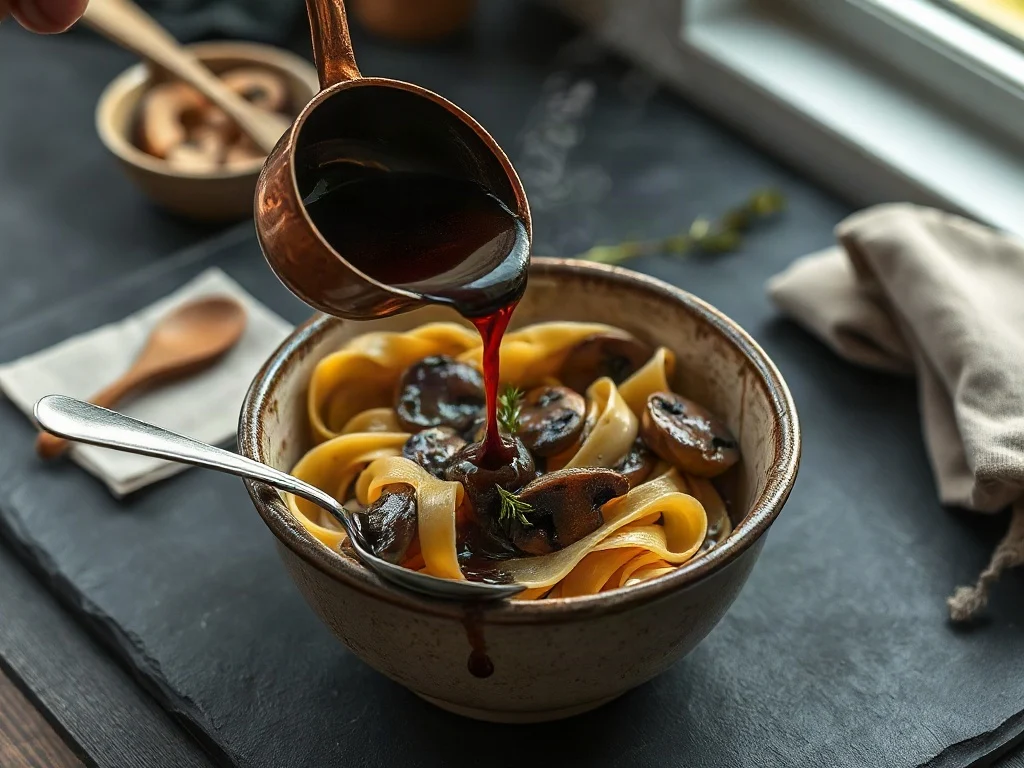
Classic demi-glace sauce has a reputation as a steakhouse luxury, and that reputation undersells it. Its concentrated, savory depth also suits mushroom pasta, quick pan sauces and slow-cooked stews. Because it is so concentrated, a small amount goes a long way, and that changes how the effort of making it should be judged. This analysis covers what demi-glace is, why it works, where it earns its place and where it does not.
What Is Demi-Glace Sauce?
Demi-glace is a French-style brown sauce. In the classical formulation, espagnole sauce is combined with brown stock and reduced by about half. The method is associated with Auguste Escoffier, who helped codify the mother sauce system that organizes much of French saucemaking. Espagnole is one of those five foundations. Demi-glace is generally treated as its refined derivative.
Many modern home and restaurant versions skip the espagnole step. They simply reduce a deeply browned veal or beef stock until it is glossy and lightly viscous. Purists object that this is a shortcut, but the result is close in function: a stock concentrated enough to coat a spoon.
Why the Flavor Works
Browning, collagen and reduction
Three mechanisms explain the depth. First, roasting bones and vegetables triggers the Maillard reaction, which creates the roasted, meaty flavor compounds. Second, long simmering extracts collagen, which converts to gelatin and gives the sauce body and a lip-coating texture. Third, reduction removes water and concentrates everything else, including umami.
Aromatics matter too. A classic base uses mirepoix and often a little tomato paste for acidity and color. Traditional versions use a roux for thickening, though a well-made reduction can thicken itself through gelatin alone.
Using Demi-Glace Beyond Steak
The strongest argument for making demi-glace is versatility. Used as a finishing element rather than a base, it lifts dishes that would otherwise rely on bouillon or salt.
| Application | Role of demi-glace | Practical note |
|---|---|---|
| Mushroom pasta | Adds savory depth that amplifies the earthy flavor of mushrooms | Stir in a spoonful with a splash of pasta water so the pasta is glazed, not drowned |
| Pan sauces | Gives body to a quick sauce built after deglazing | Add after the wine has reduced, then simmer briefly |
| Stews and braises | Reinforces the cooking liquid in a stew such as beef bourguignon | Add near the end to avoid over-reducing |
| Derivative sauces | Serves as the base for bordelaise and wine-based sauces | Pair with Madeira or red wine reductions |
Demi-glace versus gravy
Demi-glace is not simply fancy gravy. Standard gravy usually relies on pan drippings and flour or starch. Demi-glace relies on extracted gelatin and reduction, so it tastes more concentrated and less starchy. The tradeoff is time and cost.
Practical Considerations and Common Mistakes
- Under-browning the bones. Pale bones produce a pale, flat sauce. Browning is the flavor foundation.
- Salting early. Reduction concentrates salt. Season only at the end, and taste before adding demi-glace to a salted dish.
- Boiling hard. A vigorous boil clouds the sauce. A gentle simmer and regular skimming give a cleaner result.
- Using it as a base instead of an accent. Because it is concentrated, small additions work better than large pours.
The economics favor batch cooking. A large batch can be reduced, portioned and frozen, so one long cooking session supplies several meals. Commercial concentrates exist as convenience products. Their quality and sodium levels vary widely, so reading labels matters. Whether they match a homemade reduction is a matter of taste and budget, not a settled fact.
FAQ
What is demi-glace sauce used for?
It is a finishing and enriching sauce. Classic uses include steak and roasted meats, but it also works in mushroom pasta, pan sauces, braises and stews.
How is demi-glace different from espagnole?
Espagnole is the mother sauce, a brown stock-based sauce thickened with roux. Demi-glace is traditionally espagnole combined with more brown stock and reduced further, giving a more refined and concentrated result.
Can demi-glace be made ahead and stored?
Yes. Because it gels and concentrates well, it is commonly portioned and frozen. Store it in small amounts so you can use a spoonful at a time.
The Real Value of a Small Spoonful
The most useful insight is that demi-glace is better understood as an ingredient than as a sauce. Its value comes from concentration, which lets a single batch improve many dishes across weeks. That also explains why the dish deserves skepticism on one point: the labor only pays off if you actually use it widely. Cooks who reserve it for steak will probably find it excessive. Cooks who treat it as a pantry staple will find it economical.
Watch how the market for high-quality prepared stocks and concentrates develops. If those products continue to improve, the traditional long-simmered version may become a craft choice rather than a necessity. Whether commercial shortcuts can reproduce gelatin-rich body without heavy sodium remains the open question, and it is one that a side-by-side tasting will answer better than any label.
Frequently Asked Questions
Can I make demi-glace without espagnole sauce?
Yes. Many modern cooks skip espagnole and simply reduce a deeply browned veal or beef stock until it is glossy and lightly viscous. Purists call this a shortcut, but it works in a similar way: a concentrated stock that coats a spoon and adds body and depth.
Why does my demi-glace taste too salty or look cloudy?
Saltiness usually comes from seasoning early, because reduction concentrates salt. Season only at the end. Cloudiness comes from boiling too hard. Keep a gentle simmer and skim regularly, and the sauce will be cleaner and clearer.
Is demi-glace worth the time and cost for home cooks?
It can be, because it is so concentrated that a spoonful goes a long way. Making a large batch, reducing it, portioning it and freezing it lets one long cooking session supply several meals, which spreads out the effort and expense.
How is demi-glace different from regular gravy?
Gravy usually relies on pan drippings plus flour or starch. Demi-glace gets its body from gelatin extracted from bones and from reduction, so it tastes more concentrated and less starchy. The tradeoff is that it takes more time and costs more to make.
How much demi-glace should I add to a dish like mushroom pasta?
Use it as an accent, not a base. Stir in about a spoonful with a splash of pasta water so the pasta is glazed rather than drowned. Large pours overpower the dish, since the sauce is very concentrated.
Are store-bought demi-glace concentrates as good as homemade?
It depends on taste and budget, not on any settled rule. Commercial concentrates are convenient, but quality and sodium levels vary widely between brands. Read the labels carefully, and taste before adding one to a dish that is already salted.