
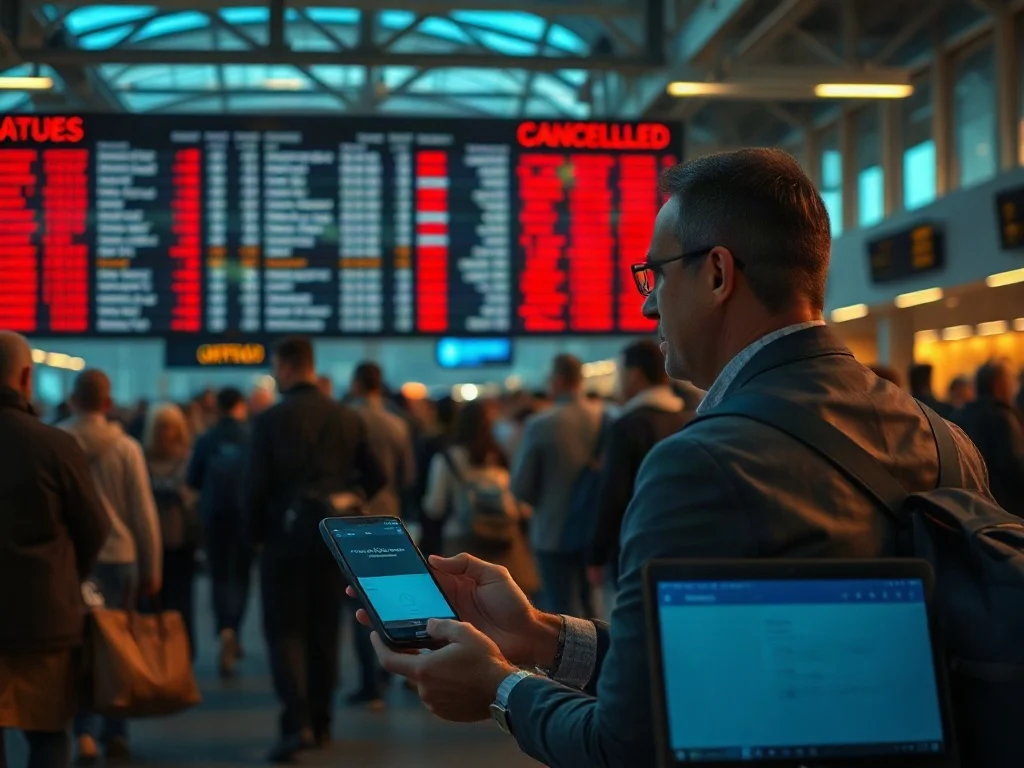
A cluster of major tech outages over roughly five days grounded flights, delayed bank transactions and knocked out workplace software, and the timing invited speculation about a coordinated attack. The public record so far does not support that theory. Every affected organization that commented, and the officials who weighed in, ruled out a cyberattack. This analysis separates what has been confirmed from what has been inferred, and asks whether the more useful story is a pattern of fragile infrastructure rather than a single villain.
The incidents involved Microsoft, the Federal Aviation Administration, JPMorgan Chase, United Airlines, Charles Schwab and Apple. Reporting by Business Insider found no indication that the failures were connected. That conclusion is narrower than it sounds. It means no one has shown a shared cause. It does not mean the failures share no conditions.
What Happened: The Incidents in Sequence
Each outage had a different technical profile, a different blast radius and a different official explanation. Treating them as one event obscures more than it reveals.
Microsoft 365: Productivity Software Goes Dark
Microsoft reported a significant disruption to its Microsoft 365 suite, affecting Outlook, Teams and Copilot. By late Friday morning the company said services were stabilizing. It described the cause as “technical” and “not related to cyber or AI / agents.” The explicit mention of AI agents is notable. Companies rarely rule out a cause unless they expect the question.
The FAA Ground Stop
The Federal Aviation Administration issued a nationwide FAA ground stop on Friday, citing problems with its air traffic control systems. Flights were held for more than four hours, producing thousands of delays and cancellations on Friday and Saturday. Transportation Secretary Sean Duffy and Homeland Security Secretary Markwayne Mullin blamed aging infrastructure. Mullin said they did not believe cybersecurity or an AI attack was involved.
JPMorgan Chase and the Ripple Through Banking
JPMorgan Chase said Monday that a “software bug in on-premise hardware systems” caused service problems. Customers reported trouble viewing account information and delayed transactions. Customers of Bank of America, Wells Fargo and US Bank also reported problems. US Bank said customers using Chase’s Zelle may have been affected. Chase stated, “There is no evidence this is cyber-related.”
The phrase on-premise hardware matters. It points to infrastructure the bank runs itself, not a cloud provider. That undercuts the easy assumption that cloud concentration explains every recent failure.
United, Schwab and Apple
United Airlines said Monday it had fixed a “technology issue” that delayed departing flights. In-progress flights and United Express flights were unaffected. FlightAware recorded 945 delayed United flights that day. The airline said there was no indication of a cybersecurity issue.
On Tuesday, Charles Schwab users saw an error message citing an “internal error or misconfiguration.” A spokesperson called it a brief webpage loading issue that had been resolved. Separately, Apple attributed outages affecting services such as Apple Pay and iCloud to an “internal update” and said it was not a cyberattack.
Why Are There So Many Tech Outages? Reading the Official Explanations
Set side by side, the stated causes are mundane: a technical fault, aging systems, a software bug, an internal update, a misconfiguration. None is exotic. That is precisely the point. The explanations describe self-inflicted failures, the kind that arise from changes, maintenance and decay in complex systems.
| Organization | Stated cause | Cyberattack ruled out? |
|---|---|---|
| Microsoft | “Technical” issue | Yes, also AI / agents |
| FAA | Aging air traffic control infrastructure (per officials) | Officials said they did not believe so |
| JPMorgan Chase | Software bug in on-premise hardware systems | Yes |
| United Airlines | “Technology issue” | Said no indication |
| Charles Schwab | Brief webpage loading issue; server error or misconfiguration message | Not addressed in the reporting |
| Apple | Internal update | Yes |
One caution is warranted. A company’s early statement is a first account, not a forensic finding. Organizations have legal and reputational incentives to rule out attacks quickly. Still, six independent denials, plus the absence of any contradicting government statement, make a coordinated attack an unsupported hypothesis.
The AI Pressure Argument
The most interesting claim came from Sen. Mark Warner, the top Democrat on the Senate Intelligence Committee. He said evidence suggested the outages reflected “legitimate efforts to secure our systems, not malicious activity.” He added that artificial intelligence is helping identify vulnerabilities faster, creating pressure to fix them immediately and “putting tremendous strain on systems that weren’t built to handle that pace of change.”
What the Claim Does and Does Not Establish
This is an interpretation, not a finding. Warner offered it as a reading of the evidence. The companies did not confirm it, and Microsoft explicitly denied an AI link to its own outage. The mechanism is plausible in principle, though. If vulnerability discovery accelerates, organizations must ship more patches and configuration changes on compressed timelines. Every change is a chance to introduce a fault, and a rushed change to a brittle system is the textbook recipe for an outage.
The argument has a weakness. The FAA problem was attributed to aging infrastructure, and Chase cited a bug in on-premise hardware systems. Neither obviously traces back to AI-driven patching. Warner’s thesis may explain some incidents and none of the others. Anyone claiming it explains all six is overreaching.
Legacy Systems: The Quiet Common Factor
Where the incidents do rhyme is in legacy dependency. A legacy system is not simply old. It is a system whose original design assumptions no longer match its operating environment. Air traffic control is the clearest case, since officials themselves pointed to aging infrastructure. The consequence is a single point of failure in which one fault halts a national system. Four hours of grounded flights is the visible cost of that design.
Why Fixes Lag
- Replacement risk: Swapping a core system can cause more disruption than tolerating its flaws.
- Funding cycles: Public agencies depend on appropriations, not operating budgets they control.
- Interdependence: Banks, payment networks and airlines depend on each other, so a fault at one node spreads, as the Chase and Zelle overlap showed.
Precedent: Outages Without Attackers
The pattern is not new. The 2024 CrowdStrike incident showed that a faulty update could disrupt airlines, banks and hospitals worldwide with no adversary involved. By contrast, the Colonial Pipeline ransomware attack was a deliberate cyberattack. Public confusion between the two is understandable because the user experience is identical: something stops working. The distinction matters because the remedies differ. Attacks call for intrusion response and attribution. Faults call for change management, testing and redundancy.
Practical Lessons for Businesses and Consumers
For Organizations
- Map dependencies. Know which of your processes rely on a single vendor, payment rail or internal system.
- Stage changes. Roll out updates to a small population first and keep a tested rollback path. Apple’s “internal update” and Schwab’s misconfiguration message are the kind of failures staged deployment is meant to contain.
- Plan degraded operation. Decide in advance how you work when email, payments or booking tools are down.
- Communicate early and specifically. The firms here were quick to say what the cause was not. Stating what is known about the cause builds more trust.
For Consumers
- Keep a second payment method when traveling, since a single wallet or bank can fail.
- Check airline status directly and through an independent tracker during disruptions.
- Be skeptical of social media claims of attacks. Official channels from the FAA and the Cybersecurity and Infrastructure Security Agency are more reliable than speculation.
Frequently Asked Questions
Were the recent tech outages caused by a cyberattack?
No evidence supports that. Microsoft, Chase, United and Apple each said the problem was not cyber-related, and officials including Sen. Warner and Secretary Mullin said they saw no sign of a coordinated attack.
Are the outages connected to each other?
Reporting found no indication that they are. The stated causes differ, and the systems involved are run by separate organizations.
What caused the FAA ground stop?
Officials cited problems with air traffic control systems and blamed aging infrastructure. The detailed technical cause has not been described in the reporting available.
Did AI cause these outages?
Not according to the companies that addressed it. Warner argued that AI-accelerated vulnerability discovery is straining systems, but that is his interpretation and not a confirmed cause of any specific incident.
The Real Question Behind the Outages
The most important insight is that the absence of an attacker is not reassuring. It is arguably worse. A hostile actor can be identified, sanctioned and defended against. Routine failures in aging, interdependent systems are structural, and they will recur unless someone funds and prioritizes resilience over speed.
Watch three things next. First, whether the FAA and Chase publish detailed post-incident analyses, because vague causes like “technology issue” prevent real learning. Second, whether Congress treats Warner’s warning as grounds for oversight of how quickly critical systems are patched. Third, whether the next failure of this scale arrives with a clearer culprit or the same ambiguity.
My reasoned prediction, flagged as such: outages of this kind will become more visible, not less, as interconnected systems grow and patch cadences quicken. The unanswered question is whether institutions will be willing to slow down changes to critical infrastructure when the pressure from every direction is to move faster.
Frequently Asked Questions
Were these tech outages caused by a coordinated cyberattack?
The public record does not support that theory. Every organization that commented, along with the officials who weighed in, ruled out a cyberattack. Business Insider also found no indication that the failures were connected. That means no shared cause has been shown, not that a hidden one is impossible.
If the outages were not connected, why did they happen so close together?
The article suggests the timing may reflect fragile, aging, complex infrastructure rather than one villain. Each incident had its own cause, such as a software bug, an internal update, a misconfiguration or aging systems. Several unrelated failures can cluster by chance, even without a common trigger.
Does 'no connection found' mean the outages share nothing at all?
No. The article calls that conclusion narrower than it sounds. It only means nobody has demonstrated a shared cause. The failures could still share underlying conditions, such as system complexity, frequent changes, maintenance gaps and decay in older technology.
Can cloud concentration explain all of these failures?
Not according to the evidence. JPMorgan Chase blamed a software bug in on-premise hardware systems, meaning infrastructure the bank runs itself rather than a cloud provider. That undercuts the easy assumption that reliance on a few cloud companies explains every recent outage.
Why did Microsoft explicitly rule out AI agents as a cause?
Microsoft described its Microsoft 365 problem as technical and not related to cyber or AI / agents. The article notes that companies rarely rule out a cause unless they expect the question, which suggests public speculation about AI and attacks was already circulating.
How severe were the disruptions for travelers and bank customers?
The FAA ground stop held flights for more than four hours, causing thousands of delays and cancellations on Friday and Saturday. FlightAware recorded 945 delayed United flights on Monday. Chase customers had trouble viewing accounts and faced delayed transactions, with Zelle users at US Bank possibly affected.