
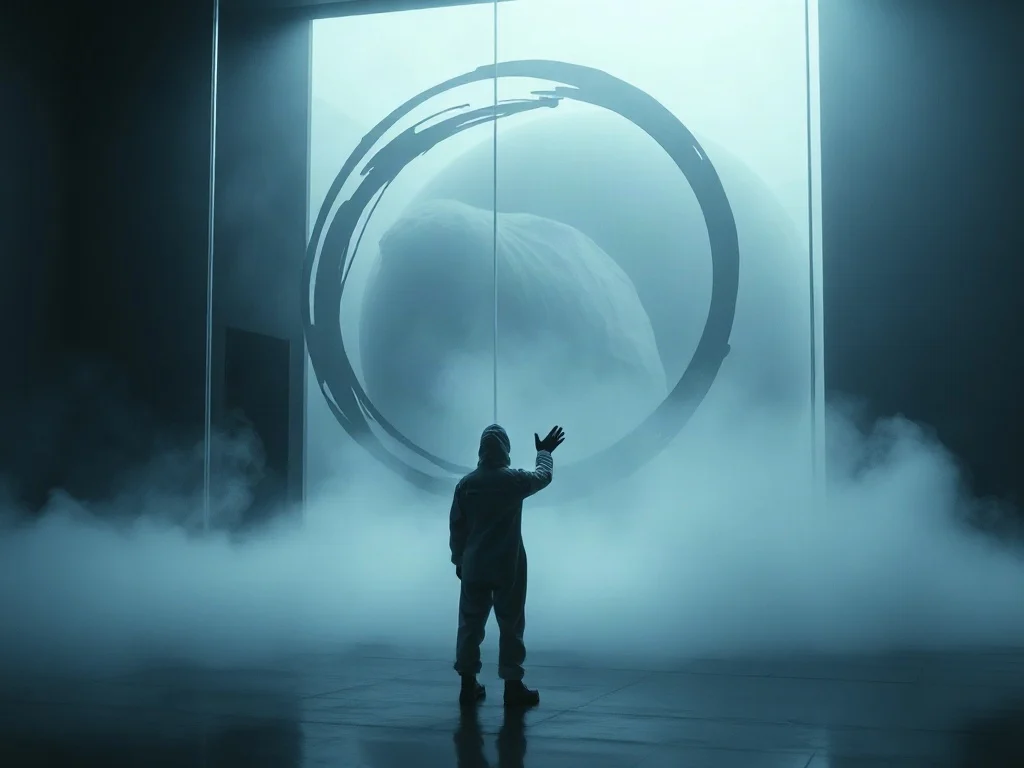
A decade after its release, the Arrival ending explained question still draws more search traffic than almost any other sci-fi puzzle of its era. The answer is not buried in a twist. It sits in the film’s structure, in a mistranslated word, and in a choice about time that Arrival asks the audience to judge. This analysis sets out what the film establishes, where it departs from its source, and where its science is weaker than its emotion.
The Short Answer: Why Did the Aliens Come to Earth?
The heptapods arrive to give humanity their language, and with it their way of perceiving time. In the film’s logic, they know that in roughly 3,000 years they will need human help. They cannot simply hand over a solution, so they distribute a cognitive tool. Twelve ships, twelve landing sites, and twelve fragments of a larger message force the nations of Earth to cooperate in order to understand it.
The film never fully spells out what the future crisis is. That omission is deliberate, and it is a limit of the film’s explanation rather than a flaw in the reading. The audience is given the mechanism of the gift, not the reason it will matter. Anyone claiming a precise motive beyond “we will need you later” is extrapolating.
The Mistranslation That Nearly Starts a War
The central conflict turns on one word. The aliens’ message, rendered as “offer weapon,” is read by several militaries as a demand or a threat. Louise Banks, the linguist played by Amy Adams, argues that the ambiguity lies in the word itself: “weapon” and “tool” are not distinguished clearly enough, and the aliens mean the language as the gift.
This is the film’s most effective critique of geopolitics. The danger is not alien hostility. It is human interpretation under pressure, and the film shows nations withholding information from each other in the name of security. The aliens’ strategy is therefore also a diagnostic: a species that cannot share a translation cannot be trusted with a future.
Why Colonel Weber and General Shang Matter
The military characters are not strawmen. Forest Whitaker’s Colonel Weber behaves rationally given the information he has, and the Chinese general Shang acts on the same logic from the other side. The resolution works because Louise bridges the gap, not because anyone abandons caution. That distinction keeps the film from collapsing into a simple parable of peace.
The Arrival Movie Daughter Twist, Reframed
The emotional core is the revelation that the scenes of Louise’s daughter, Hannah, are not memories. They are glimpses of the future. The film first presents them as a grief-stricken flashback sequence, which is a nonlinear narrative device the audience is trained to read in one direction. Once Louise begins to think in the aliens’ written language, the sequence is revealed to run the other way.
The reveal is reinforced by small details. Hannah’s name is a palindrome, which echoes the circular, direction-free logograms the heptapods use. The opening monologue, in which Louise says she used to believe in beginnings and endings, becomes the thesis of the film on second viewing.
What Louise Learns About the Future
In the film, Louise learns that Hannah will die young from a rare disease, and that her marriage to Ian Donnelly, played by Jeremy Renner, will end when she tells him. She also learns how to stop the war: in the future, General Shang tells her his wife’s dying words and his private number at a gala. She uses that information in the present to convince him to stand down.
This creates an apparent loop, since information from the future causes the present event that makes the future possible. The film treats this as a feature of the heptapods’ perspective rather than a paradox to resolve. A careful viewer can still object that the loop explains nothing about where the information originates, which is a standard problem in time-travel fiction.
Does Louise Have a Choice? Free Will and Determinism
The final scene is the most debated. Knowing everything, Louise says yes to Ian’s question about having a child anyway. Whether that is a free choice depends on how the film’s physics is read.
The heptapods’ time sense resembles eternalism, in which past, present, and future all exist equally. In that picture, the outcome is fixed. The film gestures at this through Ian’s mention of Fermat’s principle, which describes light as if it “knows” its destination before it begins. Yet the story insists on free will through Louise’s embrace of the outcome. The more honest reading is that the film proposes acceptance as agency: she cannot change the path, but she can choose how to live it.
Critics who find this unsatisfying have a fair point. If the future is fixed, her choice has no counterfactual, and the drama is a performance of a decision that was never open. The film’s response is emotional rather than logical, and that is both its strength and its limit.
How the Film Differs from Ted Chiang’s Story
The film adapts “Story of Your Life” by Ted Chiang, with a screenplay by Eric Heisserer. The adaptation adds a geopolitical thriller layer that the novella largely lacks, and it makes the aliens more purposeful. The source material is quieter, more abstract, and less interested in resolving a global crisis. The film’s decision to give the heptapods a purpose and the story a ticking clock is a commercial and dramatic choice, and it changes the meaning of the ending from contemplative to instrumental.
That shift is the most important critical question about the adaptation. The novella treats foreknowledge as a way of experiencing events. The film makes foreknowledge useful, which turns the premise into a plot engine and raises the loop problem discussed above.
Is the Language Science Real? The Sapir-Whorf Question
The film’s premise that learning an alien language rewires perception draws on the Sapir-Whorf hypothesis, or linguistic relativity. Here the distinction between versions matters.
- Strong version (linguistic determinism): language determines thought. Most linguists reject this form.
- Weak version (linguistic relativity): language influences certain habits of perception and memory. This has experimental support in areas such as color categorization and spatial reference, though effect sizes are debated.
Arrival takes the strong version and pushes it to the extreme, where a written language alters the experience of time itself. There is no evidence that human language can do this. The film is best understood as using the hypothesis as a metaphor, not a scientific claim, and its value lies in the question rather than in the physics.
The Craft Behind the Ending
The ending works partly because of craft. Director Denis Villeneuve pairs restrained visuals with a score by Jóhann Jóhannsson and the use of “On the Nature of Daylight” by Max Richter. The music frames the opening montage as loss, so the later reversal recontextualizes the same imagery without changing a single frame. The film earned multiple nominations at the 89th Academy Awards, including Best Picture and Best Director, and won for sound editing. Adams’s absence from the acting nominations is still cited as one of the ceremony’s notable omissions.
How Arrival Compares with Other First-Contact Films
Arrival sits in a lineage that includes Close Encounters of the Third Kind, Contact, and Interstellar. Its distinguishing move is to make communication, not spectacle or physics, the engine of the story. Contact preserves the question of belief, and Interstellar turns time into a tool for love. Arrival does both, but grounds them in a linguist’s craft, which makes the premise feel more personal and less technological.
The approach also explains why Villeneuve’s later epic, Dune, deals with prescience and fate in a related way. Both films ask what happens to agency when the future is visible.
Game Theory and the Gift Strategy
One underappreciated reading is economic. The heptapods’ distribution of the gift across twelve sites forces humanity into a cooperative game rather than a zero-sum contest. No nation can use its fragment alone. The design rewards information sharing and punishes unilateral action. That reading is an interpretation, not something the film states, but it fits the structure and explains why the aliens fragment the message at all.
Frequently Asked Questions About the Arrival Ending
Why did the aliens come to Earth in Arrival?
They came to give humanity their language so that humans could gain their nonlinear perception of time. The film implies they will need human help in about 3,000 years, but it never specifies how.
Who is the daughter in Arrival, and does she die?
Hannah is Louise’s future daughter. The scenes that appear to be memories are premonitions, and Hannah dies young from a rare illness. Louise knows this and chooses to have her anyway.
What does the heptapod language do?
Learning the circular written language, Heptapod B, gives Louise access to future events. It lets her experience time non-sequentially, which the film frames as a perceptual shift rather than conventional time travel.
Is the Arrival ending a time loop?
Partly. Information gained from the future, such as the general’s private number and his wife’s last words, is used in the present to cause the events that lead there. The film does not explain the origin of that information.
Is Arrival based on a book?
Yes. It adapts Ted Chiang’s novella “Story of Your Life,” though the film adds a more explicit geopolitical plot and clearer alien motives.
The Question the Ending Leaves Open
The most durable insight of Arrival is that its tragedy is not the death of a child but the knowledge of it, and the film asks whether love survives certainty. Ten years on, that question has become more relevant, not less. Predictive models, genetic screening, and algorithmic forecasts all push real people toward partial foreknowledge of their lives, and the ethical problem the film dramatizes is increasingly practical: what should someone do with a future they cannot change?
Watch for how the film is read as language technology advances. Large language models and machine translation make the film’s fear of mistranslation less hypothetical, and the line between “tool” and “weapon” is still decided by the interpreter. The unanswered question is whether Louise’s acceptance is wisdom or surrender. The film does not say, and that refusal is why people are still arguing about it.