
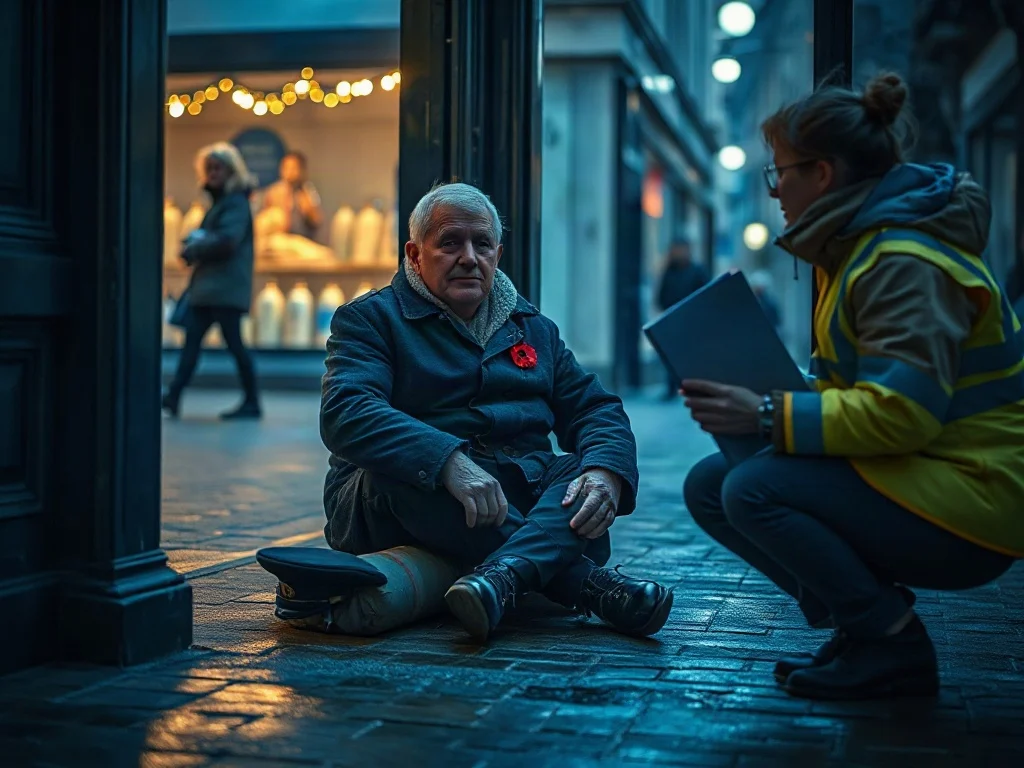
The pledge that veterans sleeping rough should not be a feature of this Christmas is politically easy to endorse and administratively hard to deliver. According to the report, Andy Burnham has said veterans should not sleep rough this Christmas. Downing Street says the prime minister will write personally to councils on Armistice Day to urge them to draw up plans. This analysis looks at what that commitment can realistically achieve, what the law already requires of councils, and where the weak points lie.
What the announcement says, and what it does not
The reported facts are narrow. There is an expressed ambition that no veteran sleeps rough at Christmas. There is a letter, timed for 11 November, urging local authorities to produce plans. The summary does not mention new funding, new legal duties, a target definition of a veteran or a method for measuring success.
That distinction matters. A letter urging councils to plan is an act of political signalling and coordination. It is not a policy instrument in the sense that a funded programme or a statutory duty is. Whether it becomes more than a gesture depends on what accompanies it, and that detail has not been reported.
Why Armistice Day is a shrewd date
Armistice Day falls roughly six weeks before Christmas, which is about the minimum lead time a council needs to identify, contact and accommodate individuals. It also sits within the season when the poppy and public gratitude toward service personnel are most visible. The timing exploits that moment of public attention, which creates real pressure on councils. It also frames a year-round structural problem as a seasonal one, which is a risk I return to below.
The legal framework councils already operate under
Councils are not starting from a blank page. The statutory baseline for homelessness in the United Kingdom is already substantial, and any new plan will sit on top of it.
- The Housing Act 1996 sets out the main homelessness duties in England, including the concept of priority need. Vulnerability arising from service in the armed forces is one of the recognised grounds for assessing priority need.
- The Homelessness Reduction Act 2017 added duties to prevent and relieve homelessness for eligible people, whether or not they are in priority need. The full text is available on legislation.gov.uk.
- The Armed Forces Covenant was put on a statutory footing by the Armed Forces Act 2021, which requires specified bodies, including local authorities, to have due regard to its principles in areas such as housing. Official material is published at armedforcescovenant.gov.uk.
This produces an uncomfortable question. If the legal architecture is already in place, why would a veteran still be on the street? A prime ministerial letter implicitly concedes that the gap lies in delivery, not in legislation. Duties to have “due regard” are also weaker than duties to secure outcomes, and councils retain wide discretion over how they weigh competing demands.
Why do veterans become homeless?
The causes are real but frequently overstated, so precision is needed. Most people leaving the armed forces make the transition into civilian housing and work without crisis. The risk is concentrated among a minority, and several overlapping factors are commonly cited by charities and researchers.
Transition and loss of structure
Service life typically provides accommodation, income and a social network in one package. Leaving removes all three at once, sometimes abruptly after a medical discharge or a disciplinary exit. People who joined young may never have managed a tenancy or a household budget.
Health and relationship breakdown
Mental ill health, including post-traumatic stress disorder, can contribute to housing instability, as can alcohol or drug dependence and the end of a relationship. Specialist providers such as Combat Stress exist because standard services do not always meet these needs. Research findings on how far veteran status itself raises homelessness risk are mixed, so claims of a uniform “veteran crisis” should be treated with caution.
The measurement problem
Any target of “no veteran sleeping rough” has to survive a basic test: can anyone count them? Reliable data on veteran rough sleeping is patchy. Veterans do not always identify themselves, and some distrust statutory services or do not think of themselves as veterans after a short period of service. A council that records zero veterans on a given night may simply be failing to ask the right question, or asking it in the wrong way.
This makes it easy for councils to appear compliant. A plan that claims success should be judged on how veteran status is recorded, who asks about it, at what point of contact and with what assurance about how the information will be used. Without consistent screening, the outcome will be reported through the lens of whatever each authority happens to measure.
What a credible council plan should contain
A plan that is more than a press-release exercise would include several specific elements:
- Systematic identification: a standard question about service history at first contact with housing, outreach and drop-in services.
- Named partnerships: agreed referral routes with veterans’ organisations such as the Royal British Legion and housing associations with armed forces housing experience.
- Accommodation capacity: a realistic assessment of available emergency and move-on units, rather than reliance on informal goodwill.
- Health pathways: links to mental health and substance misuse services that can see people quickly.
- Follow-through after Christmas: tenancy sustainment support so that a December bed does not become a January eviction.
- Public reporting: publication of the number identified, the number housed and the outcomes at three and six months.
Generalist charities such as Crisis have long argued that prevention and sustained support, not seasonal emergency provision, are what end rough sleeping. That argument applies equally to veterans.
The critic’s case: risks and unresolved tensions
Capacity and resources
Councils responsible for temporary accommodation are widely reported to be under heavy financial strain, and an unfunded request competes with statutory duties they already struggle to meet. If no extra money accompanies the letter, the likely outcome is reprioritisation within a fixed pool. That means a veteran placed in a bed may displace another vulnerable person, a trade-off the announcement does not address.
The ethics of prioritising by status
Special treatment for veterans rests on a moral argument about obligation to those who served. It is a legitimate position, and the Covenant embodies it. However, it raises a fairness question for non-veterans in equal need. A well-designed policy should address this by arguing that veteran-focused action builds capacity and practice that benefits wider homelessness services, rather than by creating a hierarchy of the deserving.
The seasonal framing
Christmas pledges generate attention, but rough sleeping is driven by evictions, relationship breakdown, welfare changes and housing supply throughout the year. A deadline of 25 December can produce a burst of activity followed by quiet. The test of this initiative is whether anyone is still housed, and still supported, in March.
Practical implications for professionals and readers
Housing officers should audit how veteran status is currently asked and recorded, and check that frontline staff know the priority-need position and Covenant duties. Charities should expect increased referral requests and should clarify which services they can offer and at what speed. For members of the public, the most useful action is usually to refer someone sleeping rough to a local outreach service or the national alert service rather than to give ad hoc help, because outreach teams can connect the person with entitlements, including those linked to service history.
Frequently asked questions
What has the government actually announced?
According to the report, Downing Street says the prime minister will write personally to councils on Armistice Day, urging them to draw up plans to prevent veterans sleeping rough over Christmas. Details of funding or enforcement have not been reported.
Are veterans entitled to priority housing?
Not automatically. Vulnerability resulting from service in the armed forces can be a basis for priority need under homelessness law, but each case is assessed individually. Councils must also have due regard to the Armed Forces Covenant in housing decisions.
Why do some veterans end up sleeping rough?
Typically through a combination of difficult transition from service, health problems, relationship breakdown and the loss of the structure that service life provided. Most veterans do not become homeless, so the risk is concentrated in a minority.
How can a veteran get help with housing?
They should contact their local council’s housing team, state their service history and ask for a homelessness assessment. Veterans’ charities and the Covenant website can provide additional guidance.
What to watch after the letter lands
The most important insight is that this is a coordination problem presented as a moral one. The law, the charities and the moral consensus already exist; what is missing is consistent identification, accommodation capacity and follow-through. A letter can only prompt councils to close that gap. It cannot close it on its own.
Three things will show whether the initiative has substance. First, whether the government attaches funding or a reporting requirement, because plans without either tend to vary widely in quality. Second, whether councils publish figures on how many veterans they identified and housed, and how they counted them. Third, whether support persists after the holiday period. My prediction, which is an assessment rather than a fact, is that some authorities will report success against narrowly defined measures in December while the underlying drivers continue unchanged. The unanswered question is whether this attention leads to a permanent veteran-identification and prevention standard, or whether it becomes one more annual pledge that fades with the poppies.