
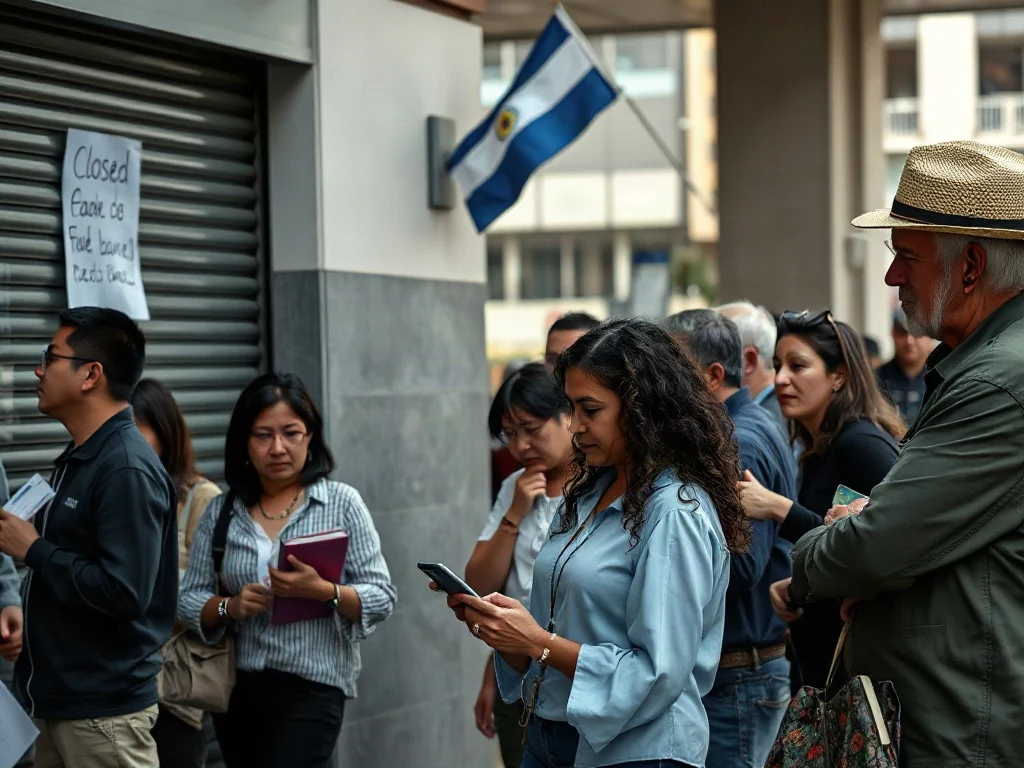
A report that the Paraguay president was impeached after a bank collapse, with millions of people unable to reach their savings, describes a rare event. A sitting head of state removed over a financial failure would be extraordinary, even in a country with a turbulent political history. According to the report, Santiago Peña was ousted because of a banking crisis that froze access to deposits. This analysis separates what is reported from what can be verified, explains how impeachment works under Paraguayan law, and sets out what the episode would mean for depositors, markets and the political order.
One caveat applies throughout. The available report is brief, and several details need confirmation from primary sources such as congressional records, the central bank and official statements. Where facts are unsettled, this article says so rather than filling the gap.
What Has Been Reported and What Remains Unverified
The core claim has three parts: a bank failed, a large number of customers lost access to their money, and the president was removed through impeachment as a result. Each part needs separate scrutiny.
The scale claim: “millions of people”
Paraguay is a small country. Its census-recorded population is roughly six to seven million, and a large share of its economic activity is informal. A crisis that locks “millions” out of their accounts would therefore affect a very large fraction of the banked population. That is possible, but it is a strong claim. Readers should ask whether the figure counts account holders, affected individuals, or people indirectly hit through payroll and card systems. The distinction matters because it determines whether this is a single-institution failure or a systemic event.
The causal claim: bank failure leading to removal
Reporting often compresses a sequence of events into one clean cause. Impeachments usually follow an accumulation of grievances: alleged regulatory failure, alleged favoritism, or a perceived slow response. The report points to the banking crisis as the trigger. The legal charge actually put before Congress may be narrower or different, such as “poor performance of duties”, a broad ground in Paraguayan law. Until the formal accusation is published, the causal story is an interpretation.
How Does Impeachment Work in Paraguay?
Paraguay’s Constitution provides for juicio político (political trial) in Article 225. The president, vice president and other senior officials can be tried for poor performance of duties, crimes committed in office, or common crimes. The procedure has two stages:
- The Chamber of Deputies must approve the accusation by a two-thirds majority.
- The Senate then sits as the trial body and must reach a two-thirds majority to remove the official.
Those thresholds are high, and they make a removal politically revealing. A two-thirds vote in both chambers means the president lost support well beyond the opposition. In Paraguay, where the Colorado Party has dominated for decades and Peña’s own movement won the 2023 election, such a vote would imply a rupture inside the governing coalition, not just an opposition victory. That is a reasoned inference, not a confirmed fact about the reported vote.
Precedents
Paraguayan impeachment has a record, and it is not reassuring about due process. In 2012, Fernando Lugo was removed within roughly a day of the Chamber’s accusation, a pace that regional governments and many legal scholars criticized as inadequate for a defense. In 2019, Mario Abdo Benítez survived an impeachment push linked to an energy agreement with Brazil over the Itaipú dam. The mechanism has therefore proven both fast and uncertain, depending on whether the president’s party holds together.
Why Bank Collapses Become Political Crises
A bank failure is political because deposits are the most direct contact ordinary citizens have with the financial system. When access is frozen, the damage is immediate: wages cannot be withdrawn, suppliers go unpaid, and rent and food become cash problems. This is the mechanism behind a bank run, where fear of losses prompts mass withdrawals that can bring down an otherwise recoverable institution.
The tools governments are expected to use
Citizens judge a government by whether the standard safeguards worked. Those safeguards include:
- Deposit insurance: A deposit guarantee scheme reimburses savers up to a cap. Paraguay operates a deposit guarantee fund linked to its central bank, but coverage limits and payout speed are decisive details that the report does not give.
- Lender of last resort: The Central Bank of Paraguay can provide emergency liquidity under the classic lender of last resort doctrine.
- Supervision and resolution: Bank regulators can intervene, restructure or wind down an institution in an orderly way, ideally before a run starts.
If any of these failed or were slow, voters and legislators would plausibly hold the executive responsible, even though bank supervision is formally the central bank’s responsibility. That gap between formal responsibility and political accountability is where impeachment risk grows.
Paraguay’s Banking History as Context
Paraguay has lived through serious financial turmoil before. The mid-1990s and early 2000s saw bank failures and depositor losses, which contributed to a lasting public wariness of financial institutions. Those episodes led to reforms in supervision and to the creation of deposit protection. Any new crisis would be read against this history, and the standard is demanding: institutions built after earlier collapses were meant to prevent exactly this outcome.
The monetary context also matters. The Paraguayan guaraní is the legal tender, but foreign-currency deposits, particularly dollars, remain part of the system, and currency mismatches can amplify stress during a run. How much of the reported crisis involved foreign-currency accounts is not stated.
Economic and Political Consequences
Immediate effects
If the report is accurate, the near-term picture would include succession and market reaction. Under the constitution, the vice president, Pedro Alliana, would take over. Continuity of the economic team would be the first signal watched by investors. Sovereign borrowing costs, the guaraní exchange rate and credit availability tend to react quickly when both the banking system and the executive are in doubt.
Medium-term risks
- Contagion: Depositors at other banks may withdraw funds as a precaution, spreading the crisis beyond the failed institution.
- Credit contraction: Surviving banks often tighten lending, which hurts small businesses and agriculture, central to Paraguay’s economy.
- Institutional precedent: Removing a president over a financial failure could encourage future impeachments as a routine political weapon.
Institutions such as the International Monetary Fund publish assessments of Paraguay’s financial sector, and these are the best baseline for judging whether the system was already fragile before the reported collapse.
Competing Interpretations
There are at least three readings of an event like this, and they are not mutually exclusive.
- Accountability reading: Lawmakers acted because the executive failed to prevent or contain a crisis harming millions. On this view, impeachment is working as a check on power.
- Scapegoat reading: Congress used a genuine crisis to remove a president for reasons rooted in factional rivalry, shifting blame away from regulators and legislators who oversaw the sector.
- Systemic reading: The collapse exposed weaknesses in supervision that preceded this government, and removing one person leaves those weaknesses untouched.
A critical reader should weigh which reading fits the documented sequence: who knew what, when supervisors flagged problems, and how fast authorities acted once the bank showed distress. These facts will come out through investigations and are not yet established.
What Depositors and Businesses Should Do
For people and firms exposed to a banking crisis, practical steps matter more than political commentary:
- Verify coverage: Check your institution’s status and the deposit guarantee limit on the Central Bank of Paraguay website, not social media.
- Diversify: Spread large balances across institutions so that each stays within insured limits.
- Document claims: Keep statements, transfer confirmations and account numbers to speed up reimbursement.
- Plan liquidity: Businesses should secure payroll and supplier payments through alternative channels and negotiate short-term terms where possible.
- Avoid panic withdrawals: Mass cash withdrawals from sound institutions can turn a contained failure into a systemic one.
Frequently Asked Questions
Was the president of Paraguay really impeached?
The report states that Santiago Peña was ousted after a banking crisis. Readers should confirm this through the official records of the Chamber of Deputies, the Senate and the Paraguayan government before treating the details as settled.
Who takes over if the president is removed?
Under the constitution, the vice president succeeds the president. Further steps depend on the timing and circumstances of the removal.
Can depositors recover their money after a bank collapse?
Recovery depends on deposit insurance limits, the bank’s remaining assets and the resolution process chosen by regulators. Insured deposits are typically repaid first, up to the cap.
Is a two-thirds vote hard to reach?
Yes. It requires support in both chambers well beyond a simple majority, which is why successful impeachments are uncommon and usually signal a fracture in the governing coalition.
The Question That Outlasts the Headline
The most important insight is structural. If a president can be removed for a bank failure, then either the system holds executives accountable for financial stability, or it treats a crisis as an opportunity to reshuffle power. The two outcomes look identical on the day of the vote and diverge afterwards. The test is what follows: whether regulators are investigated alongside the politicians, whether depositors are made whole quickly, and whether supervision is strengthened rather than merely personalized.
Readers should watch four things in the coming weeks: the exact charge approved by Congress, the stability of other banks, the pace of depositor reimbursement, and whether the new government keeps the central bank’s leadership. A credible financial recovery with an honest accounting of regulatory failures would suggest the impeachment worked as accountability. A crisis that fades from view while the underlying vulnerabilities persist would suggest it was only a change of faces. The evidence for which of these happened will arrive slowly, and it will matter more than the headline did.
Frequently Asked Questions
¿Está confirmado que Santiago Peña fue destituido por el colapso de un banco?
No. El artículo subraya que el informe disponible es breve y que faltan fuentes primarias, como actas del Congreso, comunicados del banco central y declaraciones oficiales. Hasta que se publique la acusación formal, la relación causal entre la crisis bancaria y la destitución sigue siendo una interpretación.
¿Por qué es dudoso que "millones de personas" hayan perdido el acceso a sus ahorros?
Paraguay tiene unos seis o siete millones de habitantes y una economía muy informal. Bloquear a millones de personas afectaría a gran parte de la población bancarizada. La cifra podría incluir titulares de cuentas, afectados indirectos por nóminas y tarjetas, o ambos, y eso cambia la dimensión del problema.
¿Qué mayorías exige el juicio político en Paraguay?
El artículo 225 de la Constitución exige dos etapas. La Cámara de Diputados debe aprobar la acusación por dos tercios, y después el Senado, que actúa como tribunal, debe alcanzar otros dos tercios para destituir. Son umbrales altos que requieren apoyo más allá de la oposición.
¿Qué indicaría una destitución de Peña sobre el Partido Colorado?
Como el Partido Colorado domina la política desde hace décadas y el movimiento de Peña ganó en 2023, reunir dos tercios en ambas cámaras sugeriría una ruptura dentro de la coalición gobernante. El artículo aclara que es una inferencia razonada, no un hecho confirmado sobre la votación.
¿Cómo se compara este caso con juicios políticos anteriores en Paraguay?
En 2012 Fernando Lugo fue destituido en aproximadamente un día tras la acusación, un ritmo criticado por no permitir una defensa adecuada. En 2019 Mario Abdo Benítez sobrevivió a un intento vinculado a un acuerdo energético sobre Itaipú. El mecanismo es rápido, pero su resultado depende de la cohesión del partido.
¿Por qué una quiebra bancaria puede provocar una crisis política?
Los depósitos son el contacto más directo de los ciudadanos con el sistema financiero. Si se congelan, no se pueden retirar salarios, se dejan de pagar proveedores y resulta difícil costear alquiler y comida. Ese daño inmediato lleva a exigir responsabilidades al gobierno y a los reguladores.