
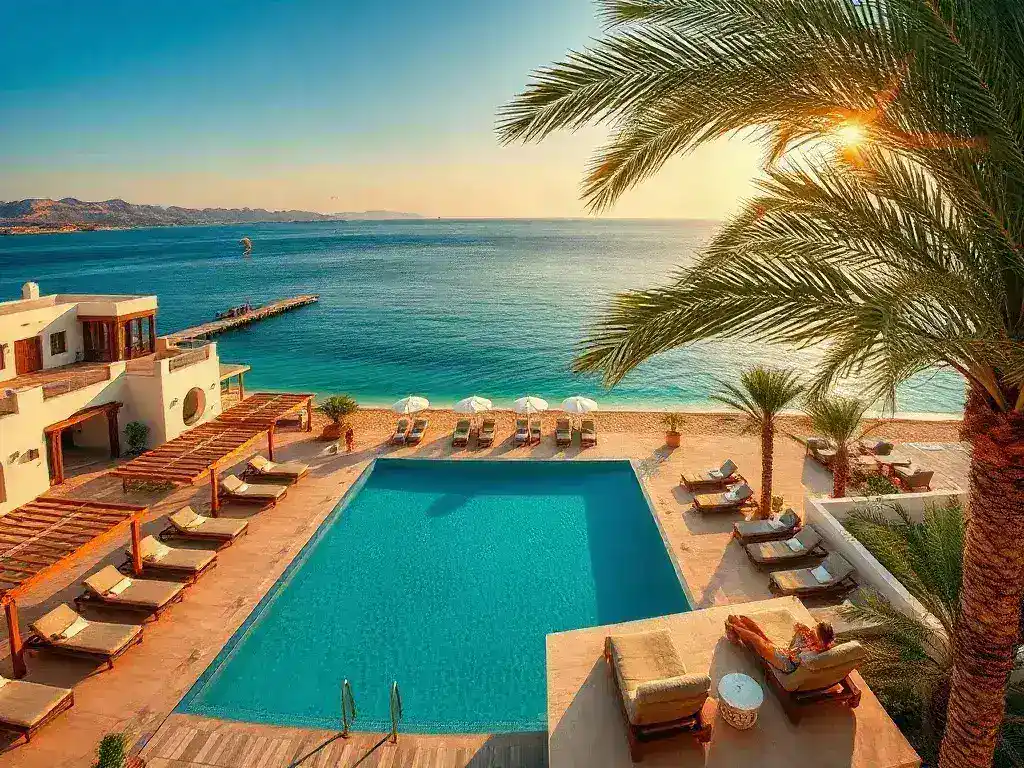
The ROBINSON Somabay story is about to get a second chapter. ROBINSON, the premium club brand of TUI Hotels & Resorts, has announced that it will operate two clubs on the Red Sea peninsula of Soma Bay. At the World Travel Market in London, ROBINSON and the Abu Soma Development Company extended the contract for the existing ROBINSON SOMA BAY until 2028. The partners are also planning a second club roughly one kilometre away. This article looks at what has been confirmed, why it matters for the Red Sea holiday market, and which questions remain open.
What the ROBINSON Somabay Announcement Actually Confirms
Announcements like this attract speculation, so it helps to separate the verified facts from interpretation. The facts are short and specific:
- The contract for the existing ROBINSON SOMA BAY has been extended until 2028.
- A second ROBINSON club is in development about one kilometre from the existing property.
- The new-build resort will have around 250 rooms.
- It will be designed as an adults-only resort.
- Opening is scheduled for 2029.
- The existing club is to undergo extensive modernisation.
Everything beyond that, including budgets, design language, room categories and the scope of the refurbishment, was not detailed in the announcement. Any analysis of those points is interpretation, and I label it that way below.
What Is a ROBINSON Club, and Why Does the Concept Matter?
Many travellers know ROBINSON by reputation rather than by definition. It is a club holiday brand within the TUI portfolio, positioned in the premium segment. The format sits closer to an activity-focused all-inclusive resort than to a conventional beach hotel. Sport, wellbeing and a strong programme of activities are part of the offer, and a consistent club identity runs across destinations. French operator Club Med is the best-known international example of a comparable idea.
The distinction matters commercially. A club brand sells a recognisable experience, not just a room. Guests who like one ROBINSON club tend to try another, which gives the operator a loyal repeat audience that a typical package tour hotel struggles to build. Two clubs in one destination suggest the company believes demand in Soma Bay is deep enough to support different guest profiles. You can find the brand’s official presentation on the ROBINSON website.
Why Soma Bay? The Destination Logic
Soma Bay is a peninsula on the Red Sea coast of Egypt, south of Hurghada and close to Safaga. It is a master-planned resort area, not a spontaneous cluster of hotels. That planning is exactly what a premium club operator needs: controlled density, shared infrastructure and room for large-footprint properties.
Wind, Water and Warm Winters
The Red Sea coast is known for steady winds and warm, dry weather through much of the year. That makes it a natural home for kitesurfing and windsurfing, and the surrounding reefs support scuba diving and snorkelling. The area is also associated with golf, including a course credited to Gary Player. For an activity-led brand like ROBINSON, this combination of water sports and sunshine fits the club promise closely.
Winter Sun for European Travellers
Egypt’s Red Sea resorts have long appealed to European travellers who want sunshine in the colder months. This is one reason tourism in Egypt remains a significant part of the country’s economy. A long-term commitment to Soma Bay suggests TUI sees the location as a durable pillar of its winter programme rather than a short-term opportunity.
Why an Adults-Only Resort in Egypt Makes Strategic Sense
The decision to design the new club as an adults-only property is arguably the most interesting part of the announcement. Here is my interpretation of why it is a smart move.
Clear Positioning Between Two Neighbours
With two clubs about a kilometre apart, differentiation is essential. If both properties targeted the same guests, they would compete for the same bookings. An adults-only concept gives the new resort a distinct identity, which would let each club target a different guest profile. The announcement does not say how the existing club will be positioned after its modernisation, so that remains an open question.
Operational Advantages
Adults-only resorts typically serve more focused guest needs. Restaurants, spa areas, evening programmes and quiet zones can be designed for adult tastes, without the compromises a mixed-age resort demands. At around 250 rooms, the new club is also comparatively intimate, which supports a boutique-like atmosphere and personal service.
The Trade-Off
The downside is a narrower market. Couples, friends and solo travellers are a strong segment, but excluding families removes a large booking pool, particularly during school holidays. That risk is partly offset by the existing club, which may continue to serve a wider audience. This is a reasonable expectation, not a confirmed plan.
The Existing Club and Its Extensive Modernisation
The announcement refers to an extensive modernisation of the existing property, but it does not list specific measures. In the resort industry, programmes of this kind usually cover rooms, public areas, dining concepts, wellness facilities and technical systems such as energy and water management. Whether ROBINSON will follow that pattern in Soma Bay has not been stated.
What can be said is that refurbishing a club while building a second one nearby signals confidence in the destination. Operators rarely invest in both at once unless occupancy and guest satisfaction justify it.
Two Clubs, One Kilometre: A Snapshot
| Aspect | Existing ROBINSON SOMA BAY | Planned second club |
|---|---|---|
| Status | Operating; contract extended until 2028 | In development |
| Expected opening | Already open | 2029 |
| Size | Not specified in the announcement | Around 250 rooms |
| Target audience | Not specified in the announcement | Adults only |
| Development focus | Extensive modernisation | New build |
Risks and Realities Behind the Optimism
Expansion plans always carry uncertainty, and a balanced reading should acknowledge it.
- Market concentration: Placing two clubs in one destination increases exposure to anything that affects Egyptian or regional travel demand, such as geopolitical developments, flight capacity or travel advisories.
- Currency and cost dynamics: Resort economics can be affected by fluctuations in the Egyptian pound and by construction and import costs. The announcement gives no financial figures, so any assessment here is general.
- Environmental responsibility: The Red Sea’s coral reefs are a core attraction and a fragile ecosystem. Principles of sustainable tourism are increasingly important to guests, partners and regulators, so how the new resort handles water, energy and coastal impact will be watched closely.
- Contract timing: The existing contract runs until 2028 while the new resort is scheduled for 2029. That one-year gap invites the question of what comes next for the original club. Further extensions seem plausible given the modernisation, but that is a prediction, not a fact.
What This Means for Travellers and Trade Partners
For Guests
Anyone considering a ROBINSON holiday in Egypt should expect more choice within a single destination. Travellers who prefer a quiet, grown-up atmosphere will have a dedicated option from 2029. Those who prefer the current club can expect a refreshed product after its modernisation. Check the official brand channels for dates and room information, since details may change.
For Travel Agents and Tour Operators
Two differentiated properties in the same location make it easier to match clients to the right club. The hospitality industry often rewards destinations that offer clear product tiers, and agents who understand the difference between the clubs will be better placed to advise clients.
For Investors and Developers
The announcement illustrates a partnership model in which a developer, Abu Soma Development Company, provides the property and a brand operator provides the concept and management. Long-term contract extensions are a positive sign of mutual confidence. The terms of the deal have not been disclosed, so no conclusions about returns can be drawn.
Frequently Asked Questions
What is the new ROBINSON resort in Somabay?
It is a planned second ROBINSON club in Soma Bay with around 250 rooms. It will be adults-only and is scheduled to open in 2029, roughly one kilometre from the existing club.
Is the existing ROBINSON SOMA BAY closing?
No. The contract has been extended until 2028, and the property is set for extensive modernisation.
Where is Soma Bay located?
Soma Bay is a peninsula on Egypt’s Red Sea coast, south of Hurghada.
Who is behind the project?
ROBINSON, part of TUI Hotels & Resorts, is working with the Abu Soma Development Company. The agreement was announced at the World Travel Market in London.
Will the new club welcome children?
No. The new resort is designed as adults-only.
The Question Hiding Behind 2029
The most important insight from this announcement is that ROBINSON is not simply adding rooms. It is building a mini-cluster in a single destination, with one refreshed club and one adults-only newcomer. That approach lets a brand deepen its hold on a location instead of spreading thinly across many.
The detail to watch is the 2028 and 2029 timeline. The existing contract ends a year before the new resort opens, so the next extension or renewal will reveal how long-term the partnership really is. Also watch how the modernised club is positioned against its adults-only neighbour, whether the refurbishment includes visible sustainability measures, and whether other club brands follow with similar multi-property strategies on the Red Sea.
My prediction, which is a reasoned expectation and not a confirmed fact, is that the two clubs will end up complementing each other, with one serving broader audiences and the other serving travellers who want a calmer, adult-focused stay. If that works, Soma Bay could become a template for how premium club brands grow in mature destinations: fewer new locations, deeper commitment to the right ones. The open question is whether the destination’s infrastructure, environment and demand can keep pace with that ambition.