
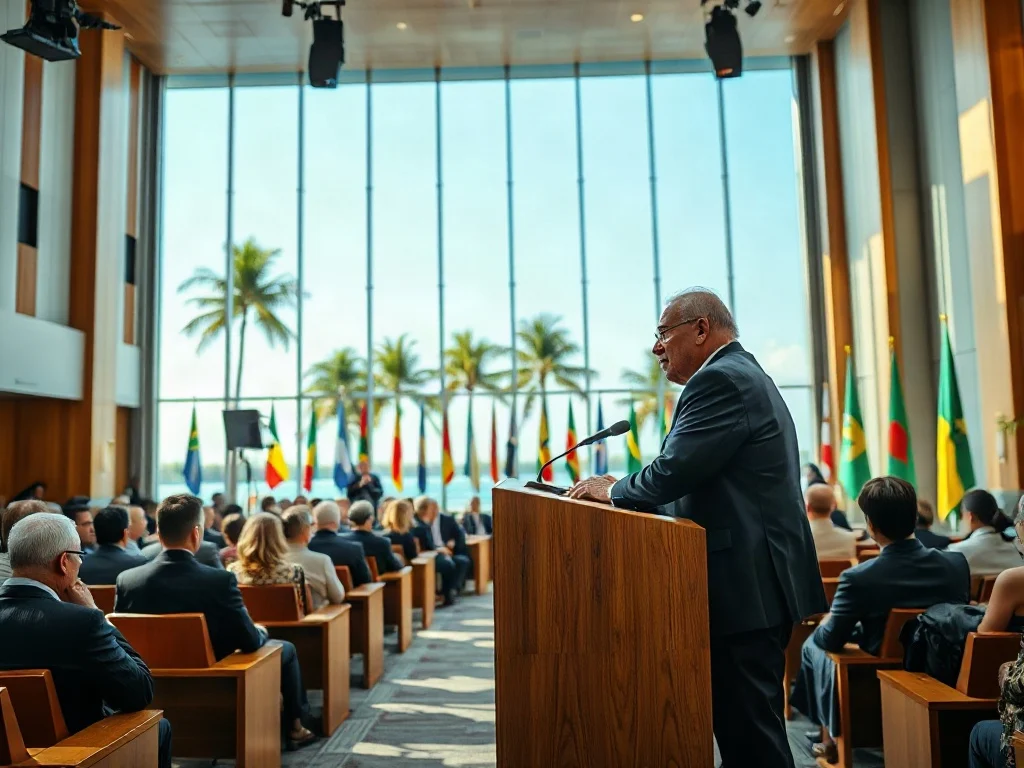
The King Charles slavery speech due in Antigua will close a nine-day Caribbean tour. It will also put the monarch in front of Commonwealth leaders at the moment when the region’s demand for reparatory justice is hardest to ignore. According to the reporting, the King will address slavery directly when he speaks to the Commonwealth Heads of Government Meeting. This analysis explains why the setting matters, what a constitutional monarch can and cannot say, and how to judge the address once it is delivered.
A caveat first: the text has not been published, so what follows is analysis of context and constraints, not a prediction of wording. The question that matters is not whether the King mentions slavery. He has done so before. The question is whether the speech moves beyond expressions of regret.
Why the King Charles Slavery Speech in Antigua Matters
The Commonwealth Heads of Government Meeting (CHOGM) is the main political gathering of the Commonwealth of Nations. It normally meets every two years, and the King attends as Head of the Commonwealth. A speech there is not a ceremonial aside. It is addressed to governments that include the descendants of enslaved people and the successors of the empire that enslaved them.
Staging that address in Antigua and Barbuda raises the stakes. The islands were built on a sugar economy that depended on enslaved African labour. The King is also their head of state, as the country is one of the Commonwealth realms. He will be speaking as the monarch of the host country, not as a visitor to a foreign one.
Background: The Crown, the Commonwealth and the Caribbean
The historical record
The Atlantic slave trade forcibly moved millions of Africans to the Americas, and British ships and merchants were deeply involved. Britain’s reckoning with that role followed the abolitionist movement and the Slavery Abolition Act 1833. That law is often described as moral progress, but it also compensated slave owners and not the enslaved. This asymmetry is central to modern reparations arguments.
The monarchy’s own links to the trade have drawn growing scrutiny. In 2023 Buckingham Palace said it supported academic research into the historical connections between the Crown and the slave trade. The findings of that work should be treated as the benchmark for any claims about royal responsibility, because the speech will be measured against documented history and not against rhetoric.
The King’s earlier statements
As Prince of Wales, Charles spoke in Bridgetown in 2021 at the ceremony marking Barbados becoming a republic. He called the “appalling atrocity of slavery” a stain on Britain’s history. That remains the most direct language he has used in the Caribbean. Any new address will be read against it, and a retreat from that wording would be noticed immediately.
What a Constitutional Monarch Can and Cannot Say
The central constraint is structural. Under a constitutional monarchy, the sovereign does not make policy. Speeches on politically sensitive subjects are shaped in consultation with ministers, which in practice means the British government as well as, in realm contexts, the governments of the countries concerned. The King can acknowledge history and express sorrow. He cannot announce compensation, commit public money or settle a legal question on his own authority.
This produces a predictable gap. Many in the Caribbean want concrete steps, while the Crown can legitimately offer only moral language. Critics read that gap as evasion. Defenders read it as the limit of the office. Both readings are partly correct, and the useful analytical question is how much moral language can do without institutional follow-through.
Reparatory Justice: The Core Dispute
The Caribbean Community, CARICOM, adopted a Ten-Point Plan for Reparatory Justice in 2014, which is published on the CARICOM website. It goes beyond cash. It covers a formal apology, debt cancellation, public health and education investment, cultural institutions, and technology transfer. Understanding reparations for slavery as a package matters, because debates that reduce it to a cheque miss the regional position.
| Form of response | What it involves | Within the King’s remit? |
|---|---|---|
| Acknowledgement | Recognising slavery as a historical wrong | Yes |
| Expression of sorrow or regret | Moral language short of legal liability | Yes, with ministerial advice |
| Formal apology | State-level admission of responsibility | Not alone; a government decision |
| Reparative measures | Funding, debt relief, institutional programmes | No; legislative and fiscal decisions |
The UK government has historically resisted formal reparations, partly on legal and fiscal grounds. Commonwealth leaders have also been cautious. At the previous CHOGM in Samoa, the final communique recognised calls for a conversation on reparatory justice, though it stopped short of any commitment. That is the diplomatic baseline the Antigua meeting inherits.
Antigua and Barbuda as a Setting
Few venues are as loaded. The history of Antigua and Barbuda includes sugar plantations, and Nelson’s Dockyard, a Royal Navy base now a heritage site, sits at the centre of the island’s tourism economy. Colonial infrastructure and its modern commercial afterlife coexist there.
Prime Minister Gaston Browne has been among the Caribbean leaders who have publicly supported reparations. A host government with an openly stated position gives the speech political weight it would lack elsewhere. It also removes the option of vagueness: the audience will include leaders ready to interpret every qualification.
How to Read the Speech: Practical Tests
Informed observers can assess the address using a few concrete criteria instead of reacting to headlines.
- Specificity. Does the King name the trade, the enslaved, and the Crown’s historical role, or does he use abstract language about a “shared past”?
- Verbs of responsibility. Words such as “regret”, “sorrow” and “apologise” carry very different legal and political meanings.
- Forward commitments. Does he reference education, historical research, cultural institutions or development partnerships, even in general terms?
- Relationship to the communique. Does the speech line up with, or run ahead of, what governments agree at the meeting?
- Response from host and CARICOM leaders. Their reaction is a better indicator of impact than commentary from London.
A common mistake in coverage is treating a single speech as a policy shift. Royal addresses rarely change government positions. They shift the range of what can be said afterwards, and that is the effect worth tracking.
Risks and Counterarguments
The risk of symbolism without substance
Critics argue that repeated royal acknowledgements work as a substitute for action, letting institutions show contrition while avoiding material commitments. This is a serious objection. It is strongest when acknowledgements are not followed by measurable steps.
The risk of going too far
The opposing risk is constitutional. If the King appeared to commit the UK government to a position it had not adopted, it would put the monarchy into party politics, which the institution is designed to avoid. Any language stronger than the government’s stance would therefore be significant, and probably deliberate.
Soft power
The Commonwealth’s cohesion is partly an exercise in soft power, and the monarchy is one of its few unifying symbols. Republican sentiment in several realms, together with the fallout from decolonisation, means the institution’s standing depends partly on how credibly it handles this history. The Commonwealth Secretariat, led by Secretary-General Shirley Botchwey, has its own interest in keeping the organisation relevant to younger, more sceptical populations.
Frequently Asked Questions
Will the King apologise for slavery in Antigua?
Nothing in the available reporting says so. A formal apology would normally require a government decision, so the more likely outcome is acknowledgement or an expression of sorrow. The wording will show how far the process of consultation allowed him to go.
Why does the Commonwealth debate slavery reparations?
Many Commonwealth members, especially in the Caribbean and Africa, are former British colonies whose economies and demographics were shaped by slavery and colonial rule. They see the Commonwealth as the natural forum to raise unresolved questions about compensation and redress.
What is the King’s role at CHOGM?
He is Head of the Commonwealth, a symbolic position that does not give him authority over member governments. Decisions at CHOGM are taken by elected leaders by consensus.
What is reparatory justice?
It is the principle that historical wrongs such as slavery warrant remedies beyond apology, including development funding, institutional reform and recognition. CARICOM’s Ten-Point Plan is the most developed regional statement of the idea.
The Test Is What Follows the Words
The most important insight is that this speech will be judged less on its content than on what it makes possible. The King can supply recognition, and recognition has real value. It also raises expectations that only governments can meet. The sharper the language in Antigua, the larger the gap between rhetoric and policy will look if nothing follows.
Watch three things in the weeks after the meeting. First, whether the CHOGM communique goes further than Samoa’s cautious wording on reparatory justice. Second, whether the UK government responds with any programme or commission, or simply restates its existing position. Third, whether the palace’s research into the monarchy’s historical links is published and acted on. My reasoned expectation, and it is only that, is that the language will be careful and the pressure will shift to London. The open question is whether Westminster will treat that pressure as a diplomatic nuisance or as the start of a negotiation it can no longer avoid.
SEO DATA
Primary Focus Keyphrase: King Charles slavery speech
Related Keyphrase 2: CHOGM Antigua and Barbuda
Related Keyphrase 3: King Charles Caribbean tour Commonwealth speech
Related Keyphrase 4: why does the Commonwealth debate slavery reparations
Related Keyphrase 5: reparatory justice Caribbean
Primary Keyphrase Synonyms: King’s address on slavery, royal speech on slavery, Charles III slavery remarks, monarch’s slavery statement, King’s Commonwealth slavery address
SEO Title: King Charles Slavery Speech in Antigua: What to Expect
Meta Description: The King Charles slavery speech in Antigua ends his Caribbean tour. Here is what he can say, what he cannot, and how to judge the address.
URL Slug: king-charles-slavery-speech-antigua
Image Filename: king-charles-slavery-speech-antigua-commonwealth.jpg
Image ALT Text: Elderly man in a dark suit speaking at a podium before Commonwealth flags in a Caribbean conference hall
Image Title: King Charles slavery speech at Commonwealth meeting in Antigua
Image Caption: The King is due to address Commonwealth leaders on slavery as his Caribbean tour ends in Antigua.
Search Intent: News/current event with informational intent
Suggested Internal Links: an article on the Commonwealth realms, an explainer on the CARICOM reparations plan, and coverage of previous CHOGM outcomes.
Frequently Asked Questions
Can King Charles announce reparations or compensation in his Antigua speech?
No. As a constitutional monarch he does not make policy and cannot commit public money or settle legal questions on his own authority. His speech is shaped in consultation with ministers, so he can acknowledge history and express sorrow, but any compensation would need government decisions.