
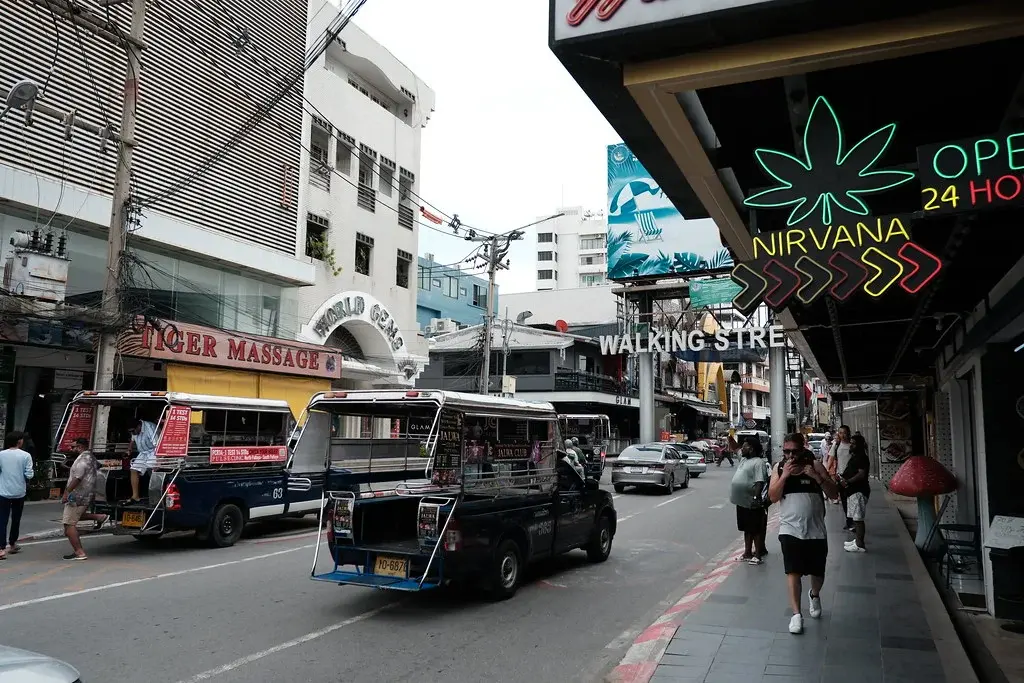
Pattaya sex trafficking is not a lurid side note to nightlife in Thailand; it is a predictable outcome when sex tourism, organized crime, and weak victim protection overlap. Reporting about women being drawn from a Thai party city into the UK sex trade, alongside the alleged role of a British intermediary described as a brothel queen, exposes a market that is structured, adaptive, and far harder to disrupt than a headline raid suggests.
The useful way to read this story is not as a morality tale about a single villain. It is a systems problem. Once a district normalizes cash-based nightlife, transient visitors, recruitment intermediaries, and a high tolerance for transactional sex, human trafficking and sex trafficking become easier to hide inside ordinary-looking travel, work, and housing arrangements. That is why the case matters far beyond one city or one arrest.
Why Pattaya matters in the trafficking map
Pattaya is a resort city in Thailand with an international reputation built on tourism, nightlife, and the blurred border between entertainment and exploitation. That does not mean the city itself is the crime. It means the local market provides the conditions traffickers prefer: high visitor turnover, low social visibility, a large cash economy, and constant interaction among tourists, venue staff, recruiters, and short-term workers.
That is why shorthand descriptions of a red-light economy can be misleading. A red-light district is not automatically a trafficking zone, and consensual adult sex work is not the same as coercion. But when a nightlife district is large, fragmented, and financially informal, it becomes much easier for exploiters to disguise control as choice. The line between voluntary movement and forced dependence is exactly where traffickers operate.
This is also why the story should be read alongside broader discussions of modern slavery. The term is not rhetorical. It describes a set of mechanisms: debt, threats, document retention, isolation, and psychological pressure. Once those mechanisms are in place, the venue is secondary. A bar, massage shop, apartment, or private residence can all become part of the same coercive chain.
How traffickers recruit and control victims
The most dangerous misconception is that trafficking always begins with open force. In practice, the first move is often social. Recruiters use friendliness, promises of income, or a supposed relationship to build trust. That makes grooming central to the crime, even when the final exploitation happens far from the original contact point.
False opportunity, debt, and dependency
Recruitment commonly begins with a job offer, a travel promise, or an introduction through someone the target already knows. The next stage is usually dependency. Once the victim travels, the balance changes: transport, housing, food, or paperwork may be controlled by the recruiter. At that point, coercion does not need to be theatrical. It can be administrative, financial, or emotional.
| Stage | Typical tactic | Why it works | What disrupts it |
|---|---|---|---|
| Approach | Social contact, online message, or nightlife introduction | Looks ordinary and lowers suspicion | Verified recruitment channels and third-party checks |
| Commitment | Promise of work, travel, or a relationship | Creates hope before control appears | Independent verification of job terms and contacts |
| Control | Debt, document retention, surveillance, threats | Reduces the ability to leave | Safe reporting, emergency shelter, and rapid referral |
| Extraction | Forced or pressured commercial sex | Uses fear and isolation to sustain profit | Victim-centered policing and financial tracing |
That pattern is not unique to Thailand. It is common across migration pathways where workers move across language, legal, and social barriers. But Pattaya is a useful case study because the city’s nightlife economy gives traffickers a ready-made environment for repetition: recruit, move, isolate, exploit, replace.
For readers trying to understand the mechanics without flattening the crime into a single stereotype, the key is this: traffickers do not need to imprison every victim physically. They need enough leverage to make escape feel more dangerous than compliance.
Why the UK link changes the case
The connection to the United Kingdom matters because it shows the trade is not local. It is transnational, and the profit is distributed. A recruiter in one country, a controller in another, a driver or landlord in a third, and a customer base in a fourth can all participate in the same exploitative chain without meeting one another.
That is where the reported British intermediary becomes analytically important. The alleged brothel queen is less interesting as a personality than as a function. Mid-level operators translate street-level exploitation into a business model. They arrange accommodation, advertise services, coordinate travel, and keep the most visible violence at arm’s length. In other words, they make trafficking scalable.
The core mistake is to treat trafficking as a single arrest problem. It is a market-design problem: demand, logistics, debt, and silence all have to be broken at once.
This is also why comparisons with ordinary prostitution matter. Lawful or consensual adult sex work exists in many legal systems and is not identical to trafficking. But exploiters depend on that ambiguity. They hide coercion inside a sector already accustomed to discretion, stigma, and police attention. That is why the line between sex work policy and trafficking enforcement is never clean in practice.
In the UK context, the work falls on institutions such as the police and the National Crime Agency, but the real challenge is evidential. A case built only on street-level arrests may miss the logistics layer that makes the business profitable. Without financial records, digital communications, travel data, and witness protection, the network adapts faster than the prosecution.
Why victims remain hidden even when the abuse is obvious
Victims often do not present as victims. That is not because the abuse is fictional; it is because trauma, fear, and practical dependence distort what outsiders see. Someone may appear calm, inconsistent, or unwilling to cooperate. They may deny exploitation in the first interview. They may even protect the trafficker. None of that is unusual in a trafficking case.
The barriers are predictable. Language problems, fear of deportation, shame, concern for family members, and prior negative experiences with authorities can suppress disclosure. This is where references to modern slavery are useful: the crime is designed to make victims self-censor. The victim’s silence is often part of the control mechanism, not evidence against the claim of coercion.
Internationally, organizations such as the United Nations Office on Drugs and Crime and the International Labour Organization have repeatedly emphasized that forced labor and sexual exploitation are easier to hide in informal economies and cross-border arrangements. Their work matters because it shifts the discussion away from sensational incidents and toward the structural conditions that make exploitation profitable.
Common warning signs are not proof on their own, but they are enough to justify scrutiny:
- Someone else speaks for the person or controls their documents.
- The person has no clear control over money, movement, or phone access.
- Answers sound scripted, overly rehearsed, or fearful.
- There is an obvious mismatch between the promised job and the actual conditions.
- Visible anxiety rises when a supervisor, driver, or companion is nearby.
Those indicators are familiar because trafficking is usually operationally simple. It relies on repetition, not sophistication. The sophistication comes from concealment.
What authorities and platforms should do differently
The most effective response is not just more raids. It is better targeting. That means following money, housing, transport, online advertisements, and phone records, not merely arresting the people closest to the victim. It also means distinguishing between consensual adult commerce and exploitative control, because sloppy enforcement pushes victims further underground.
In practice, this requires cross-border cooperation between Thai and UK agencies, better survivor support, and faster information sharing. It also requires a more disciplined approach to online platforms. If recruitment happens through messaging apps, classified ads, or social media, then the digital trail is not secondary evidence; it is often the main evidence. The same is true for bank transfers, rent payments, and repeated short-term bookings.
Best-practice priorities
- Use financial investigations early. Trafficking leaves payment patterns even when witnesses are frightened.
- Separate victims from suspects quickly. Delay increases the chance that coercion is mistaken for consent.
- Build cases against facilitators. Drivers, landlords, advertisers, and organizers often matter more than the most visible front-line controller.
- Fund survivor services. Safe housing and legal advice increase the odds of reliable testimony.
- Train frontline staff. Hotels, transport workers, and venue staff can spot indicators before police do.
There is also a political dimension. Public debate often swings between two unhelpful poles: crack everything down, or assume all intervention is harm. The better position is narrower and more demanding: target coercion, not mere stigma; target profit, not appearance. That is the line that keeps anti-trafficking policy defensible.
FAQs
How does sex trafficking in Thailand typically move victims abroad?
It usually starts with recruitment through personal contact, online messaging, or a job promise, then moves into travel, dependency, and control. Once the victim is isolated, the trafficker can shift from persuasion to coercion.
Why is Pattaya a trafficking hotspot?
Pattaya combines tourism, nightlife, anonymity, and a high volume of short-term visitors. Those conditions do not create trafficking by themselves, but they lower the cost of concealment and make recruitment easier.
What should someone do if they suspect modern slavery?
Do not confront the suspected controller directly. Document what is observable, contact local authorities or a dedicated anti-trafficking hotline, and prioritize the person’s immediate safety. In the UK, official guidance from the Home Office and related agencies is the right starting point.
What the next crackdown needs to prove
The important question is no longer whether exploitation exists in nightlife economies. It does. The real question is whether investigators can prove the chain of control from the first recruitment contact to the final payment. If they cannot, the network survives by replacing people and reusing the same channels. If they can, the market becomes harder to run.
That is the most useful lesson in the reporting on Pattaya and the UK sex trade: the next phase of enforcement should not be judged by the number of visible arrests alone. It should be judged by whether the hidden infrastructure is disrupted — the debt, the documents, the online ads, the transport links, the landlords, and the enablers who make exploitation look ordinary. If that work does not happen, the city will keep attracting tourists, and traffickers will keep treating the noise of nightlife as cover.
The unanswered question is whether policymakers are willing to treat trafficking as an infrastructure problem rather than a vice problem. That distinction will determine whether the next headline is a breakthrough or just the start of another cycle.
Frequently Asked Questions
Why does the article say Pattaya is a trafficking risk without claiming the whole city is criminal?
Because the issue is the environment, not every person in it. A high-turnover tourism economy, cash-based nightlife, and loose oversight can make exploitation easier to hide. That means trafficking can exist alongside ordinary commerce and consensual adult sex work, which is why blanket judgments about the city miss how the abuse actually operates.
How can traffickers control victims if they do not start with violence?
Many cases begin with trust rather than force. Recruiters may pose as friends, partners, or job contacts, then create dependency through travel, housing, debt, or document control. Once a person is isolated, coercion can become financial, emotional, or administrative, which is often harder to notice than physical violence but just as effective.
Why is the UK sex trade relevant to a Pattaya trafficking story?
The link shows that trafficking is not confined to one place. Victims can be moved across borders and exploited in different markets, where intermediaries, housing, and client demand all help sustain the system. The UK connection matters because it reveals how international demand and local recruitment can form one connected chain of abuse.
What makes a trafficking network harder to disrupt than a single brothel raid suggests?
Trafficking networks are adaptive and distributed. If one venue is closed, recruiters can shift to another location, another contact, or another method of control. The real infrastructure often includes transport, documents, debt, and accommodation, so a raid may remove a site but leave the larger mechanism intact unless investigators trace the money and movement too.
How can ordinary-looking travel or housing arrangements hide exploitation?
Because coercion does not always look like captivity. A victim may appear to be staying in rented housing, traveling voluntarily, or working in a legitimate venue. In reality, someone else may control their income, movement, communications, or legal status. That gap between appearance and control is exactly what makes trafficking difficult to detect.