
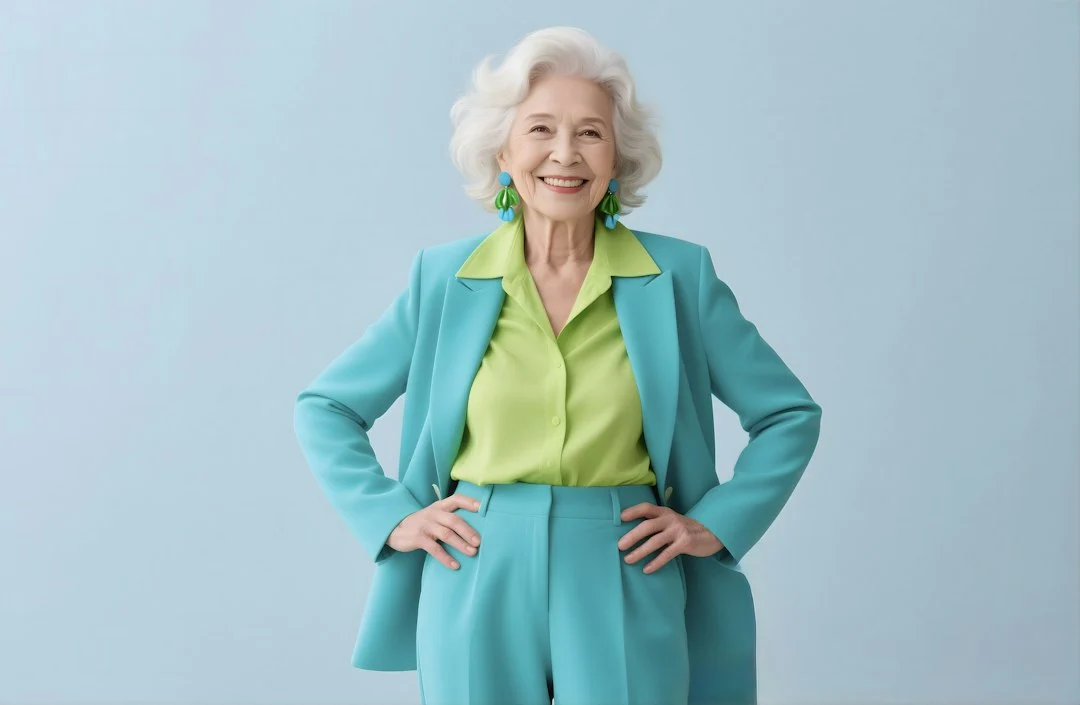
Ann Marie Harper’s run for the Miss Great Britain final is not just a local human-interest story. It is a stress test for a whole cultural category. At 71, the Scottish contestant from Prestwick, Ayrshire, is being discussed as the oldest ever finalist in the competition, and that detail matters because a beauty pageant has always been about more than appearance. It is about who gets to be seen, who gets to be judged, and which kinds of femininity are treated as credible in public.
That is why this story cuts through the usual pageant coverage. It sits at the intersection of ageism, performance, image-making, and the changing economics of attention. Harper, known online as Glamour Gran Ann, reportedly has a large following on social media, which only sharpens the point: in the modern pageant era, contestants are no longer assessed only as stage entrants. They are also personal brands, audience magnets, and symbolic arguments about what women can look like at different stages of life.
Why a 71-year-old finalist changes the frame
Pageants have always drawn criticism because they compress women into a public ranking system. Supporters describe them as platforms for confidence, advocacy, and talent; critics see them as polished rituals of comparison. Either way, age has traditionally been one of the clearest invisible borders. Youth has been treated as the default condition of desirability, relevance, and marketability. A 71-year-old finalist disrupts that assumption in a direct way.
The disruption is not simply numerical. It changes the symbolic contract of the competition. A younger finalist can be read as consistent with the genre. An older finalist forces the audience to ask whether the genre itself is more flexible than assumed. That question matters in a culture shaped by beauty norms, image filters, and the long shadow of gendered expectation. It also matters because public recognition at this level does not happen by accident. A finalist occupies a position of legitimacy. The system has, at least for one round, decided that this contestant belongs inside the frame.
That is a more serious development than a novelty headline suggests. In a society where women’s rights debates increasingly include control over image, work, and aging, the sight of an older contestant on a pageant stage is not trivial. It challenges the cultural habit of treating older women as either invisible or inspirational only in a narrowly sentimental sense. Harper is being watched because she is unusual, but the deeper issue is why her presence still feels unusual at all.
How pageants evolved without abandoning their core logic
The modern pageant world is more self-aware than it once was. Global contests such as Miss World and Miss Universe have spent years trying to present themselves as more than static beauty competitions. They emphasize advocacy, confidence, public speaking, and charity. Some audiences see that as progress. Others see branding language layered over the same old hierarchy.
The truth is less flattering to both camps. Pageants did not stop being appearance contests, but they also did not remain frozen in the past. They now reward camera fluency, narrative control, stage polish, and digital reach. Contestants are expected to embody a coherent identity. That identity may include activism, entrepreneurship, fitness, performance skill, or community work. In practice, this means the competition has expanded without fully shedding its original architecture.
Harper’s candidacy fits that evolution. Her age does not erase the pageant logic; it tests whether the logic can accommodate a different kind of contestant. If it can, then the competition is genuinely broadening. If it cannot, then the inclusion functions mainly as spectacle. The distinction matters. Symbolic inclusion can attract attention without redistributing power.
Traditional pageant logic versus newer expectations
| Traditional reading | What this case suggests |
|---|---|
| Youth signals value | Stage presence, confidence, and audience connection can matter more than age alone |
| Beauty is the main currency | Narrative, resilience, and personality now shape the public response |
| Followers are secondary | Visibility on social media can amplify relevance before a contestant ever steps on stage |
| Pageants are fixed cultural rituals | They are being pressured by feminism, digital culture, and changing ideas of representation |
The role of social media in making the contest matter
Harper’s reported following of 57,000 turns her into more than a local entrant. It makes her part of the attention economy. That is important because modern pageants increasingly overlap with influencer culture, where visibility is both proof and product. A contestant with an established audience carries built-in proof of public interest. She may also bring stronger sponsor value, broader reach, and a ready-made story.
This does not mean follower count decides the competition. It usually does not. But social media alters the environment in which the competition is judged. It encourages contestants to present a more complete persona: the polished image, the daily routine, the charity message, the backstage preparation, the personality that fills the gap between formal appearances. In that sense, a pageant entrant now resembles other public-facing figures shaped by digital self-presentation.
That shift has downsides. It can reward confidence in performance more than substance. It can favor people who already understand how to package themselves. It can also intensify comparison, which affects self-esteem on both sides of the screen. But it also opens a door for contestants who would once have been dismissed too early. Older women often have stronger personal narratives, more discipline, and a clearer public voice. Social media makes those qualities visible.
What the ‘unexpected talent’ really signals
The article’s reference to Harper’s unexpected talent is doing more than describing a performance category. It suggests a reversal of expectation. The audience may assume that a 71-year-old contestant will be impressive simply for showing up. Talent changes that. It asserts competitive value. It says the contestant is not a symbolic entry, but a real contender whose stage performance can stand alongside anyone else’s.
That matters because the talent phase of a contest has long functioned as a correction mechanism. It gives judges a reason to distinguish between beauty and capability, between poise and performance, between surface and skill. In pageant culture, the talent round has always been the part that most closely resembles a talent show, and it often exposes the laziness of age-based assumptions. A younger contestant is not automatically more dynamic. An older contestant is not automatically less adaptable.
If Harper advances because her talent is polished, memorable, and disciplined, the result will be easy to understand. It would show that pageants still reward execution, not just image. If she advances because her performance shifts how judges and audiences read her age, the lesson is even stronger: old stereotypes can be displaced in real time by competence. Either way, the talent element is the mechanism that makes the story more than a feel-good anecdote.
The most disruptive part of Ann Marie Harper’s run is not her age alone, but the fact that age is no longer sufficient to explain her place in the competition.
The criticism: inclusion or repackaging the same hierarchy?
Any honest analysis has to acknowledge the criticism. A pageant that celebrates an older finalist may still be operating inside the same visual economy that has long punished women for aging. That is the central contradiction. A story about empowerment can still be built on judging bodies. A story about diversity can still reward conformity to a narrow definition of glamour. Inclusion, in other words, is not the same as liberation.
This is where debates around body positivity, women’s rights, and feminism become useful. Supporters of inclusive pageantry argue that women should not be pushed out of public visibility because they age. Critics reply that visibility on pageant terms still requires women to submit to appearance-based ranking. Both positions are defensible. The real issue is whether the format changes its standards or merely stretches them enough to preserve itself.
There is also a cultural trap here. When a 71-year-old finalist becomes a headline, audiences may treat her as a rare exception rather than evidence of a wider shift. Exceptions are flattering to institutions because they allow them to claim progress without changing the underlying pattern. The decisive test is whether future contests normalize a broader age range or continue to rely on one remarkable outlier to generate excitement.
Why the local context matters
The fact that Harper is Scottish is not a side note. Geography shapes story value. A contestant from Scotland, specifically Ayrshire and Prestwick, brings a local identity that helps explain why this story resonates so strongly. Pageants are national spectacles, but they are built from local personas. Regional pride, community recognition, and social familiarity all make the contestant feel real rather than abstract.
That local dimension also tempers the national debate. This is not a theoretical case study detached from everyday life. It is a woman known in her community and online, entering a competition that still carries old-fashioned ideas about polish and presentation. Her presence makes the abstract argument about age visible in one person. That visibility is precisely why it matters.
Her story also belongs to a broader cultural pattern in which older women are reclaiming public space through entrepreneurship, performance, and online identity. Gerontology studies routinely show that aging is not a single social experience. It is shaped by class, health, confidence, work, and access to platforms. A woman in her seventies who is active, stylish, and digitally present does not fit the old caricature of decline. That mismatch is not a flaw in her; it is a flaw in the stereotype.
Practical lessons for contestants and organisers
For contestants, this case shows that age can be reframed as narrative strength rather than liability. But that only works if the performance is disciplined and the public message is coherent. A contestant who wants to stand out should not try to imitate younger rivals. She should present what younger rivals cannot easily claim: lived experience, composure, credibility, and a distinct point of view.
For organisers, the lesson is sharper. If pageants want to be seen as contemporary rather than decorative, they need to make inclusion structural. That means clearer diversity policies, more transparent judging criteria, and less reliance on novelty framing. If age diversity is welcomed only when it creates headlines, the competition remains conservative under a progressive surface.
- Do not use age diversity as a publicity stunt.
- Make judging criteria explicit and publicly understandable.
- Reward performance, communication, and presence, not just a narrow beauty ideal.
- Be careful about tokenism; one exceptional finalist does not equal a transformed system.
- Recognise that audiences are increasingly critical of old-fashioned visual gatekeeping.
Frequently asked questions
Why is Ann Marie Harper’s finalist run getting so much attention?
Because it challenges an expectation that pageants belong to the young. Her age makes the contest a public test of whether beauty standards can expand without losing competitive seriousness.
Does social media help pageant contestants?
Yes, but unevenly. It boosts visibility, storytelling, and audience connection. It can also intensify comparison and reward people who already know how to perform online. It is an amplifier, not a guarantee.
Is this really progress for older women?
Potentially, but only if it becomes normal rather than exceptional. One older finalist can be a sign of change, or it can be a one-off exception that allows the system to look modern without changing much else.
What happens next is the real test
The most important question is not whether Ann Marie Harper can make history. It is whether the history, if she does, will be allowed to matter beyond the moment. If her run is treated as evidence that age no longer defines the limits of pageantry, then the contest has done something culturally interesting. If it is treated as a charming anomaly, the structure remains unchanged.
The next few years will show whether pageants want to be remembered as institutions that adapted to a broader understanding of womanhood, or as institutions that briefly applauded an older contestant while preserving the same narrow ideal underneath. My bet is that the pressure will keep building. Digital audiences are less patient with rigid gatekeeping, and older women are more visible than the old stereotypes allow. The unanswered question is whether pageants will evolve early, or only after the audience stops being impressed by exception and starts demanding consistency.
Frequently Asked Questions
How can a 71-year-old be a finalist in Miss Great Britain if pageants are usually associated with younger contestants?
The article suggests that pageants are not governed only by age in the way people assume. Miss Great Britain appears to value a wider mix of factors, including stage presence, public image, and personal branding. Harper’s finalist spot matters because it shows the competition can, at least for now, accept someone outside the usual youth template.
Does Ann Marie Harper’s social media following actually matter in a pageant context?
Yes, increasingly so. Modern pageants are not judged only as live stage events; contestants are also seen as public figures with audiences. A large following can amplify visibility, help shape a contestant’s narrative, and make her more relevant to sponsors and viewers. It does not replace performance, but it can strengthen her overall impact.
Is this story mainly about beauty standards or about ageism?
It is about both, but the deeper issue is ageism. The article argues that older women are often treated as invisible unless they fit a narrow inspirational stereotype. Harper’s finalist status challenges that by placing a 71-year-old woman inside a space usually coded as youthful, desirable, and highly selective.
Does Harper’s inclusion mean pageants have really become more inclusive?
Not automatically. The article is careful to distinguish genuine inclusion from symbolic inclusion. A single older finalist can signal that the rules or culture are shifting, but it can also function as a publicity moment without changing the hierarchy underneath. Real inclusion would mean older contestants are normalized, not treated as exceptions.
Why does the article say her run changes the ‘symbolic contract’ of the competition?
Because pageants carry unspoken expectations about who belongs on stage. A younger finalist fits those expectations easily, while a 71-year-old finalist forces people to rethink them. Her presence does not just add novelty; it tests whether the competition’s idea of femininity, desirability, and legitimacy can stretch beyond age-based assumptions.