
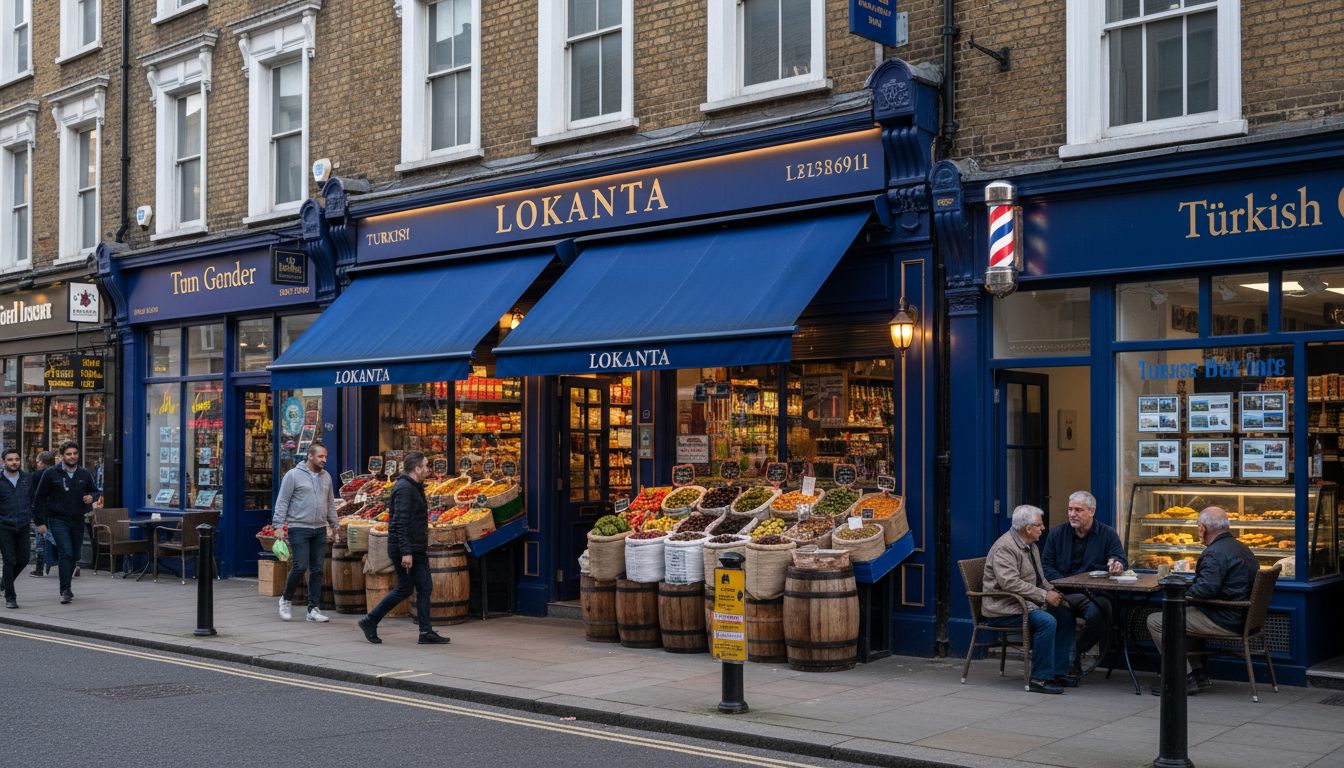
Across the UK, neighbourhood high streets are being re-energised not only by shops, but by food. Independent bakeries, grocers, cafés, market stalls, deli counters and street-food traders are helping local parades feel useful, social and alive again. For many communities, including Turkish business owners and families across Britain, food is more than a product to sell. It is a way to build trust, create routine footfall and give a street a recognisable local identity.
Recent evidence strongly supports that shift. Spring Fair and Faire’s Voices of Retail 2026 research found that food-and-drink independents are now the strongest-growth category on UK high streets, with 61% saying they were growing. The same study also showed that 96% of shoppers want more independent shops on their high street, 95% would spend more if there were more independent options, and 85% would rather spend with a local business than a corporate chain. In other words, the public mood is already aligned with the local food revival many neighbourhoods are trying to build.
Food independents are becoming the new anchors of the high street
One of the clearest changes on British high streets is that local food businesses are no longer side attractions. They are increasingly the main reason people visit. A good bakery in the morning, a reliable greengrocer, a family-run café, a specialist butcher or a fresh-produce stall can generate repeat visits several times a week. That kind of frequency matters far more to neighbourhood shopping streets than occasional chain-based browsing.
The 2026 growth figures show why this matters. When 61% of food-and-drink independents report growth, it suggests food is not just surviving difficult trading conditions but actively driving local commercial resilience. For smaller high streets, especially in residential areas, food-led businesses often perform a role that fashion or comparison retail cannot: they connect everyday needs with habit, familiarity and personal service.
This is especially relevant for culturally rooted enterprises. Turkish bakeries, restaurants, supermarkets, sweet shops and cafés often succeed because they serve both a core community and a wider local audience. They bring authenticity, specialist products and hospitality, but they also add colour and distinction to a high street. In practice, that makes them commercial assets and community anchors at the same time.
Neighbourhood footfall is returning where local centres feel useful
Footfall data also points toward a neighbourhood-based recovery. According to the Office for National Statistics, compared with February 2026, footfall in March 2026 rose by 9% in local centres, a of retail parks at 7% and city centres at 5%. That is an important signal for anyone thinking about where revival is really happening.
Local centres tend to perform best when people can combine errands with social time. A quick food shop turns into a coffee stop, a market browse or lunch with family. This is one reason food-led streets often recover faster than places relying on destination shopping alone. They are woven into everyday life, especially when they are close to homes, schools, places of worship and transport routes.
For business owners, this means that convenience, consistency and street presence matter. A visible produce display, a takeaway counter, outdoor seating or participation in a local market can all help turn passing movement into spending. As people return to nearby centres, high streets that offer fresh food and familiar faces are better placed to benefit.
Markets are proving they are economic engines as well as community spaces
Markets have moved back to the centre of the high-street conversation. A 2026 Greater Cambridge study found that local markets create jobs, support small businesses, enrich local character, strengthen community interaction and improve access to diverse produce. Those are not small cultural benefits. They are practical economic reasons to treat markets as core infrastructure.
The same study recommended stronger partnership working between markets and local businesses to boost footfall and economic linkages. That idea is simple but powerful. A market should not compete with the rest of the street; it should feed it. Someone who comes for olives, bread, fruit or hot food may also stop at a barber, tailor, pharmacy or café nearby. The most successful neighbourhood high streets understand this spillover effect.
Cambridge also offers a useful example of direct support. Its markets programme, running since 2023, was extended for 2025 and 2026 with £110,000 of investment for mentoring, training and financial support for traders. This kind of backing matters because many food pioneers are talented operators but still need help with compliance, branding, pricing, equipment and growth planning. Strong local networks can make that difference.
Community networks turn individual traders into local ecosystems
When a neighbourhood food business succeeds, it rarely does so alone. It relies on wholesalers, nearby suppliers, loyal residents, local social media, council support, market organisers and word-of-mouth recommendations. That is why community networks matter so much. They turn a single business into part of a wider local ecosystem.
Useful lessons can also be drawn from food-hub models. The 2025 National Food Hub Survey, summarised in 2026 by Michigan State University’s Center for Regional Food Systems, found that 81% of food hubs include community members in decisions, 55% reinvest part of profits in the surrounding community, and 51% recruit community residents as employees. Even though these examples are not all from the UK, the principle is highly relevant: food infrastructure works best when local people have a stake in it.
The same survey found nearly 60% of food hubs saw growth opportunities in direct-to-consumer sales, 55% in restaurant and bakery markets, and 49% in small retail markets. It also showed that average gross sales to schools more than tripled between the 2021 and 2025 surveys, while sales to food banks and pantries nearly doubled. This suggests that local food systems are expanding beyond niche shopping and becoming broader place-based supply networks that can sustain producers, traders and nearby high streets together.
Farmers’ markets and food events are acting like civic infrastructure
Recent public-policy thinking increasingly treats farmers’ markets as more than temporary retail. Philadelphia said in 2025 that its more than 30 farmers’ markets and farm stands bring fresh produce to neighbourhoods, connect urban communities to local and rural agriculture, and support the local and regional farming economy. That phrase, “they connect urban communities to local and rural agriculture”, captures the bigger role these spaces now play.
Academic research is moving in the same direction. A 2026 paper, Farmers Markets as Community, argues that farmers’ markets contribute to resilient local economies, healthier food systems and vibrant community life. This helps explain why food-led street revival often feels different from older regeneration models. It is not just about filling vacant units. It is about restoring a local system of exchange, belonging and everyday contact.
Food festivals and special market days also fit this model. Wakefield Council said Pontefract’s 2025 Continental Street Market would help “boost footfall and support our local economy”, while Ashfield District Council described its 2026 Food and Makers Market as part of efforts to “boost footfall, support small businesses and create more reasons for people to visit and enjoy” the town centre. These events work best when they are not isolated spectacles but stepping stones into surrounding independent businesses.
Walkability makes food-led streets stronger
Food clusters thrive where people can reach them easily on foot. Living Streets’ updated 2024 Pedestrian Pound research found that people who walk or wheel to shop spend more money, and that pedestrianised high streets see bigger sales. For neighbourhoods built around cafés, bakeries, delis, convenience stores and markets, this is highly significant.
Living Streets’ chief executive put it clearly: “This new report proves that making high streets and town centres more walkable increases time, and money, spent in those businesses.” Food businesses especially benefit because they depend on frequent, low-friction visits. A person may not drive for a loaf of bread, simit, a coffee or fresh herbs, but they will often walk for them if the route feels safe, easy and pleasant.
That is why public realm improvements matter to local traders. Better pavements, seating, crossings, lighting and signage do not just improve appearance. They increase dwell time and make street-based food trade more visible and inviting. For Turkish and other independent businesses, a walkable high street can turn hospitality into footfall and footfall into loyal custom.
Community ownership keeps more value in the neighbourhood
Another important part of the revival story is ownership. According to Health on the High Street in 2025, citing Power to Change research, 56p of every £1 spent by community businesses stays in the local economy, compared with 40p for large private businesses. That difference is huge for places trying to rebuild local spending power.
The same report notes that there are at least 6,300 community-owned buildings and green spaces in the UK, contributing £220 million in GVA. On or near high streets, this can include community cafés, food co-ops, shared kitchens, market halls and multi-use social spaces. These models often succeed because they are rooted in local need rather than imported from a national template.
The report offers a useful principle: “This is not about things being done to the community; it is about the community being the leaders and statutory organisations being the enablers.” That thinking fits food-led renewal particularly well. A street changes most sustainably when residents, traders, organisers and councils work together, with local people shaping what is needed and institutions helping it happen.
The most resilient high streets are diverse, collaborative and locally distinctive
The wider policy debate is now catching up with what many local traders have known for years. The London Assembly’s 2025 report on high streets argues that they are only “dying” if retail is treated as the sole measure of vitality, and it highlights the need to encourage a greater role for communities. The Mayor’s new £20 million High Streets Fund for boroughs points in the same direction: renewal is now about mixed use, local identity and neighbourhood participation.
Examples from around the country reinforce this. Manchester City Council said the new Levy Artisan Market would act as “a catalyst for driving footfall into Levenshulme’s established shops, cafes, restaurants and independents”, while Banbury linked its “Love Your Local Market” campaign to fresh food, community spirit and measurable increases in footfall. Stockport has also reported rising demand from independent traders and growing town-centre footfall, showing that the appetite for this model is far from niche.
Academic evidence supports the same pattern. A 2025 study in Cities found that long-lived British high streets tend to have greater land-use diversity and stronger neighbourhood and city-wide centrality. In plain terms, places last longer when they mix food retail, cafés, services, social uses and public life instead of depending too heavily on chain retail. For high streets serving the Turkish community and beyond, distinctiveness is not a weakness. It is often the reason people come.
The clearest lesson from recent research is that neighbourhood high streets are not being revived by retail alone. They are being revived by local food pioneers, market traders, community organisations, walkable streets and practical support networks working together. Food gives people a reason to come back regularly, while community partnerships help those visits spread value across the wider street.
For UK towns and city neighbourhoods, including areas with strong Turkish business presence, this creates a real opportunity. A high street with a bakery, grocer, café, market stall, makers’ event and community backing is not just more attractive. It is more resilient. When local character, fresh food and shared ownership come together, the high street becomes more than a shopping destination. It becomes part of everyday neighbourhood life again.