
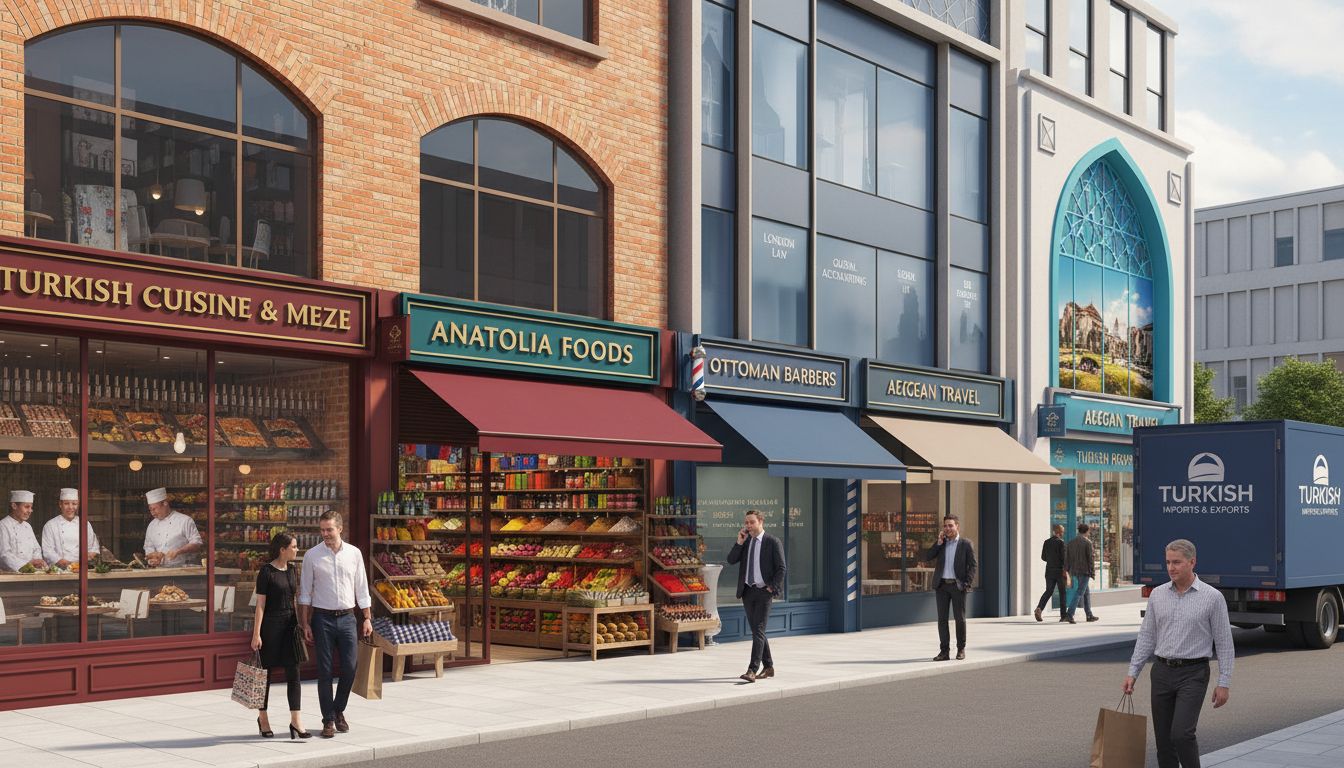
Across Britain, diaspora entrepreneurship is entering a fresh phase. For many Turkish and Türkiye-linked founders, the opportunity is no longer only about serving a local community with familiar products and services. It is increasingly about building businesses that sit confidently between two active markets: the UK and Türkiye. With bilateral trade in goods and services reaching £28.3 billion in the four quarters to the end of Q3 2025, this corridor is larger than ever, giving founders a stronger commercial bridge to work with.
At the same time, the mood in hospitality has shifted. London’s restaurant market recorded 146 openings and 64 closures in 2025, leaving 81 net new openings, the strongest net growth since the disruption of the Brexit years. For Turkish founders, this matters because trade reform and restaurant renewal are happening together. Better cross-border sourcing possibilities, a visible pipeline of Turkish-led openings, and growing mainstream interest in Turkish cuisine are creating a climate in which diaspora businesses can scale with more confidence.
The UK-Türkiye corridor is now too big to ignore
The first reason this story matters is simple: the commercial relationship is already substantial. According to the UK government’s trade and investment factsheet, total UK-Türkiye trade in goods and services reached £28.3 billion in the four quarters to the end of Q3 2025, up 5.8% year on year. UK exports to Türkiye came to £10.1 billion, while imports from Türkiye reached £18.2 billion. For diaspora entrepreneurs, that is not just a macroeconomic number. It signals volume, momentum and a market relationship with enough depth to support specialist sourcing, branding partnerships, logistics services and food concepts.
There is also a useful practical point behind the line. In 2024, Britain counted around 7,800 VAT-registered goods exporters selling to Türkiye and about 14,200 importing goods from Türkiye. That means entrepreneurs are not building in isolation. A sizeable procurement and distribution ecosystem already exists, and diaspora-led firms can plug into it. Whether the business is importing ingredients, sourcing furniture for a restaurant fit-out, developing a packaged food line, or creating a lifestyle brand, there is already a wider network of freight, compliance, warehousing and wholesale relationships in place.
For British Turks and Türkiye-connected founders, this creates a particular advantage. Many understand both consumer cultures, both business habits and often both languages. In a growing trade corridor, that kind of operational fluency matters. It can reduce misunderstandings, speed up supplier relationships and help businesses move more confidently from family-scale trading into structured growth.
Why new trade talks matter beyond tariffs
In 2025, the UK and Türkiye began negotiating an enhanced free trade agreement, with the first round held in Ankara from 23 June to 2 July. The UK government said the talks covered trade in services, including digital, financial and professional business services, as well as regulatory issues and themes such as labour and women’s economic empowerment. That matters because many diaspora businesses do not sit neatly inside a goods-only model. They combine products with services, hospitality, consultancy, franchising, design, technology and cross-border brand management.
The current UK-Türkiye deal is still largely goods-first. The government says it mostly replicates the effect of the EU-Turkey Customs Union, with industrial products already fully liberalised and agricultural goods partially liberalised. In other words, the existing framework has been helpful, but it still leaves room for improvement. Founders who operate across food, logistics, e-commerce, hospitality and professional services have good reason to watch the negotiations closely.
For diaspora entrepreneurs, trade rules are often not an abstract policy topic. They shape whether a business can add new services, onboard suppliers more easily, open a second location with imported inputs, or structure a cross-border brand more efficiently. If an enhanced agreement makes services and regulation easier to navigate, that could strengthen the position of the exact kinds of founders who already know how to operate between Britain and Türkiye.
Rules of origin, self-certification and the quiet advantage of know-how
One of the most important practical details in the current UK-Türkiye agreement is that exporters prove origin through self-certification. For many small and medium-sized businesses, this can create useful flexibility. GOV.UK also notes that, in certain cases, businesses can use EU materials or processing in exports between the UK and Türkiye, provided the origin conditions are met. For restaurant groups, delicatessen brands and food importers working with mixed UK-EU-Türkiye supply chains, that is highly relevant.
But flexibility does not mean simplicity. The government is clear about the need for ongoing checks: “As trade agreements can change, you’ll need to make sure your goods meet the relevant rules of origin every time you claim a tariff preference.” This is exactly where diaspora business knowledge can become a competitive edge. Founders who can speak to suppliers in Türkiye, understand UK documentation requirements and keep an eye on product classifications are often better placed to avoid costly mistakes.
This may sound technical, but in hospitality and retail it quickly becomes commercial. A founder opening a modern Turkish restaurant may need specialty ingredients from Türkiye, packaging from another country and some processing or distribution through the EU. A packaged-food startup may mix British manufacturing with Turkish raw materials. In these cases, customs knowledge is not back-office trivia. It shapes margins, menu pricing, delivery times and the confidence to scale.
Lower friction matters almost as much as lower duties
The UK government’s 2026 consultation response on possible accession to the Pan-Euro-Mediterranean, or PEM, Convention gives another useful clue about what businesses actually want. In that review, 79% of respondents supported accession, 92% said harmonised rules of origin across nearby trade deals were important, and 85% said diagonal cumulation of non-EU PEM inputs would be moderately or very helpful. For Türkiye-linked operators, this points to strong business demand for easier regional supply chains.
That is particularly relevant for diaspora SMEs, which often build pragmatically rather than in a straight line. A single business may source tableware from one market, ingredients from Türkiye, specialist packaging from Europe and final branding in the UK. Harmonised rules can make those chains easier to manage. They also make it easier for smaller firms to behave like sophisticated operators without needing the back-office resources of a major multinational.
The same consultation also underlined the cost of paperwork. The government noted that “Around half of respondents (32 of 66, equivalent to 48%) highlighted that requiring movement certificates to prove origin would increase costs and favoured minimising administrative burdens in UK-EU trade.” That sentence matters because diaspora entrepreneurship often succeeds on speed, adaptability and lean operations. Lower compliance friction can be just as valuable as tariff savings, especially for independent food businesses and growing import-led brands.
A dining renaissance is giving Turkish concepts a stronger launchpad
Trade opportunities alone do not create visible brands. The second half of the story is demand, and London’s restaurant market has shown renewed energy. Harden’s figures, reported by The Caterer, showed 146 openings and 64 closures in 2025, giving the capital 81 net new openings. The Standard described the moment as a fine-dining “boom amid the gloom,” with openings up from 132 and closures down from 84. This is not just background optimism. It is a stronger operating environment for founders willing to launch or reposition ambitious food concepts.
The quote that best captures the shift came from Harden’s chair Peter Harden: “People are still chucking big money at London restaurant openings.” For the Turkish category, that confidence matters because premium hospitality needs more than community demand. It needs investors, landlords, consumers and collaborators to believe that new concepts can win attention in prime locations. A more active market gives diaspora restaurateurs a better chance to secure sites, generate media interest and build momentum.
This matters outside London too, because the capital often sets the tone for broader British dining culture. When Turkish food is represented in contemporary, design-led, all-day or wine-led formats in London, that helps reshape how the category is understood nationally. It creates a halo effect for neighbourhood restaurants, regional openings, specialist suppliers and even service providers such as designers, accountants and recruiters working with Turkish-owned hospitality businesses.
Turkish dining in Britain is becoming broader, bolder and more premium
One of the clearest signs of change is that Turkish dining growth is no longer limited to the traditional kebab-house model. In late 2025, brothers Ozgur and Sidar Akyuz opened Nora in Canary Wharf, described as a modern Turkish restaurant. The concept reportedly included a 100-bottle wine list, much of it from Turkey, alongside cocktails using raki and references to Ottoman-era techniques. That combination tells us something important: Turkish hospitality in Britain is increasingly being framed as a full cultural and sensory experience, not simply a familiar takeaway cuisine.
There are other strong examples. Turkish restaurant group Tike made its UK debut in London at 5 Fenchurch Place, signalling confidence from established operators entering the British market. Former Oklava chef-owner Selin Kiazim also launched Leydi at Hyde London City, an all-day Turkish restaurant with hotel backing. Kiazim said the restaurant is about “creating a stage” for Istanbul’s culinary heritage and described the menu as “full of unapologetically delicious dishes that define the Istanbul dining tradition, designed to be enjoyed with friends and family long into the night.” That is exactly the kind of language that places Turkish cuisine within Britain’s premium dining conversation.
Even beyond explicitly Turkish restaurants, the influence is growing in serious food and wine culture. The National Restaurant Awards profile of Trivet highlights Turkish-born co-founder Isa Bal and a wine list that begins with ancient wine regions including Turkey. Mangal 2, meanwhile, has been recognised for a “far more gastronomically ambitious, ingredient-led approach to Turkish cuisine” than almost anything else in London. Together, these examples show a category moving upward, outward and into new audience segments.
Diaspora founders are well placed to connect supply chains with storytelling
What makes this moment especially powerful is the overlap between trade capability and cultural confidence. A diaspora founder is often not just importing products or serving meals. They are translating context. They can explain a Turkish wine to a British diner, frame a regional ingredient for a mainstream audience, or build a retail brand that feels authentic without being inaccessible. In a market where Turkish food is becoming more premium and more varied, that ability to connect sourcing with storytelling is a real business asset.
This is why the current moment is bigger than restaurants alone. The same conditions can support bakers, wine importers, specialty grocers, packaging brands, events businesses, consultants, tour operators, interior suppliers and digital services aimed at the UK-Türkiye corridor. Once bilateral trade becomes larger and easier to work with, every surrounding support industry gains room to grow. Hospitality is simply the most visible expression of a wider entrepreneurial shift.
It also helps explain why community-focused platforms and directories matter. As more businesses launch, people need trusted ways to find Turkish professionals, suppliers, venues and advisers in the UK. Visibility becomes part of growth. A founder may start with a kitchen, shopfront or sourcing relationship, but scaling often depends on being discoverable by the wider community and by non-Turkish customers looking for quality services and authentic experiences.
The next chapter is likely to be about scaling, not just starting
There is also an important immigration and business-retention angle. New applications for the Turkish Businessperson visa have closed, but existing holders can still extend, continue running their businesses and, after five years, may be able to apply for indefinite leave to remain. In practical terms, that means the legal landscape is now less about a fresh inflow through this legacy route and more about helping an established founder base retain, stabilise and grow.
The extension rules are explicitly linked to business performance. Applicants must show they are still running a viable business, can pay their share of the running costs and that profits remain enough to support themselves and their family without taking another job. That performance-based framework aligns closely with the broader story in 2026: businesses that can demonstrate resilience, compliance and commercial traction are the ones most likely to benefit from stronger trade links and a healthier restaurant market.
Population measurement also matters for anyone thinking about audience size and long-term demand. The Office for National Statistics has said the best recent base for sizing the Türkiye-born community remains the 2021 censuses across the UK nations, with Census 2021 country-of-birth data for England and Wales being the recommended source for Türkiye-born residents there. For entrepreneurs, that is a reminder to balance community intuition with official data. A durable business model should understand both the Turkish customer base and the wider British market now showing more interest in Turkish products, services and cuisine.
Put together, the picture is unusually encouraging. On one side, the UK-Türkiye corridor is worth £28.3 billion, supported by thousands of UK importers and exporters and deepening investment ties, including £9.5 billion in UK FDI stock in Türkiye at the end of 2024 and £1.1 billion in Turkish FDI stock in the UK. On the other side, London’s 146 restaurant openings and the growing visibility of concepts such as Leydi, Nora and Tike show that Turkish-led hospitality is finding new confidence in Britain.
For diaspora entrepreneurs, that combination is powerful. Trade reform creates room to source, move and structure businesses more intelligently, while the dining renaissance creates a stronger stage on which to present Turkish culture, products and services. The opportunity now is not only to open more businesses, but to build better connected, better branded and more ambitious ones. For the Turkish community in the UK, and for anyone seeking Turkish expertise, this is a moment worth watching closely.