
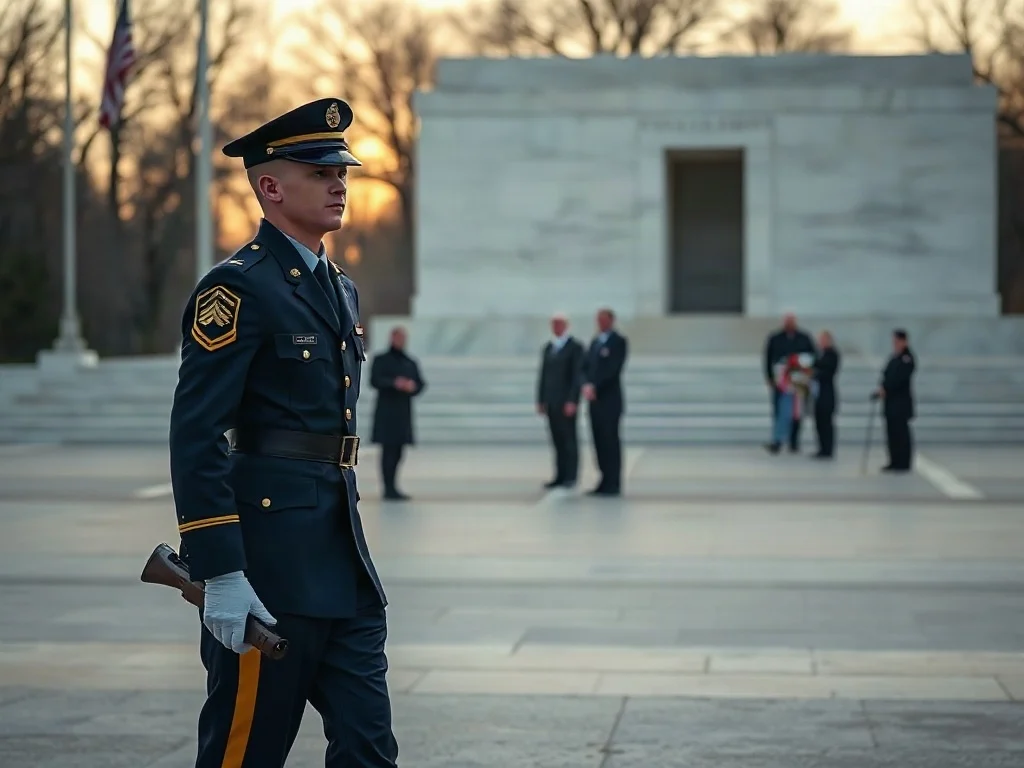
The reported reprimand of Defense Secretary Pete Hegseth and his advisers by a guard at the Tomb of the Unknown Soldier is a small incident with a large symbolic charge. According to the news report behind this analysis, a group that included Hegseth was shouted at to be quiet after a ceremony marking Veterans Day. Few details have been published beyond that headline. This article therefore does not speculate about who said what. It examines what the episode shows about Hegseth and the Tomb of the Unknown Soldier, the rules of the site, and the relationship between civilian leaders and the soldiers who serve them.
The central point is simple. At this memorial, the sentinel’s authority comes from the place, not from rank. That is by design.
What the Reported Incident Actually Tells Us
The facts available are thin. The report says a guard at the Tomb told a group including Pete Hegseth and his advisers to be quiet, and that this followed a Veterans Day ceremony. Nothing in the headline or summary establishes what was being said, how loud it was, whether the group was inside the controlled area, or whether the guard’s tone was formal or improvised. Any reading beyond that is interpretation.
Two readings are plausible, and they are not mutually exclusive:
- Routine enforcement: Guards at the Tomb routinely demand silence from anyone nearby. A noisy group would be told to stop whatever its status.
- Political amplification: The target was a senior official, so an ordinary act of site discipline became news.
The second reading explains why the story circulated. The first explains why the guard was almost certainly doing exactly what the post requires.
Why the Tomb of the Unknown Soldier Demands Silence
A Memorial Built Around Anonymity
The Tomb of the Unknown Soldier concept honors service members whose remains could not be identified. The American monument sits within Arlington National Cemetery. Its first interment, an unidentified American killed in World War I, took place on November 11, 1921. That date is the same one later observed as Veterans Day, which grew out of the armistice commemorations also marked as Remembrance Day elsewhere.
Because the honored dead have no names, the memorial relies almost entirely on conduct. Silence, posture and ritual do the work that inscriptions do at other monuments. Visitor noise breaks that effect directly, which is why the rule against it is enforced firmly rather than politely suggested.
The Sentinels and Their Standards
The Tomb has been guarded continuously since 1937, and the duty is performed by soldiers of the 3rd U.S. Infantry Regiment (The Old Guard). Those who qualify earn the Tomb Guard Identification Badge, one of the Army’s rarest. Their routine is exacting. Each changing of the guard follows a fixed script, and visitors are asked to stand and remain silent for it. The Arlington National Cemetery official website publishes the visitor conduct expectations and ceremony schedules.
A sentinel is a kind of sentry whose primary job is to protect the dignity of the post. Correcting disrespectful behavior is part of that job, not an excess of it.
Tomb of the Unknown Soldier Rules: Who Do They Apply To?
The rules of the site, as publicly described by the cemetery, ask all visitors for quiet and respectful behavior. Nothing in those published expectations carves out an exemption for officials. Protocol practice around memorials generally runs the same way. Even in the world of diplomatic protocol, senior figures are guided by those who manage the ceremony, not the other way around.
That means a reprimand is not, on its face, a breach of any hierarchy. It is the application of a standard the guard is trained to uphold. Where the incident may complicate matters is the hierarchy of the uniformed force itself, which the next section addresses.
Civil-Military Dynamics: Does Rank Matter Here?
The Formal Chain
The Secretary of Defense sits above every service member in the chain of command, beneath only the president as commander-in-chief. This principle is the basis of civilian control of the military. A junior soldier raising his voice at the department’s civilian head looks, at first glance, like an inversion of that order.
The Functional Exception
In practice, military organizations distinguish between command authority and post authority. A sentinel on duty is executing orders that specify how the post is conducted. Enforcing those orders against anyone, including a superior, is consistent with military discipline, not in tension with it. A guard who let a senior visitor disrupt a ceremony because of rank would be failing the order, not honoring the chain of command.
The more interesting question is tone. Shouting is unusual in formal settings, and without more detail it is unclear whether the report describes a sharp but standard admonition or something unscripted. That distinction matters for how the episode should be judged, and the public record does not yet settle it.
The Political Reading and Its Limits
Hegseth is a polarizing figure. Since taking charge of the Pentagon, his decisions on personnel, communications and culture have drawn intense praise and criticism, so any story that places him in an awkward moment is read through partisan lenses. Supporters may see an irrelevant anecdote magnified by hostile coverage. Critics may see evidence of disrespect at a sacred site.
A disciplined reading resists both. The evidence supports only this: a group including the secretary was told to be quiet at a place that requires quiet. It does not show intent, malice, or a pattern. A single report of a reprimand cannot carry conclusions about character, and treating it as if it could is the kind of inference this story invites and does not justify.
Practical Lessons for Officials and Visitors
Whatever the details, the episode is a useful case study in ceremonial conduct for anyone accompanying senior figures to a memorial.
- Brief the entourage. Advisers, aides and security staff are often the noisiest part of a delegation. A pre-event briefing on the site’s rules should cover them as well as the principal.
- Move conversations away. After a ceremony, the zone around the Tomb remains an active post. Debriefs and logistics belong elsewhere.
- Defer to ceremony staff. Escorts and the guards themselves control the pace and the space. Deferring visibly sets the right example.
- Treat correction as a non-event. The best response to a legitimate admonition is quiet compliance. Visible irritation turns routine discipline into a story.
For ordinary visitors the takeaway is the same, only less public. Stand when asked, stay silent, and keep phones and conversation muted.
Frequently Asked Questions
Why do guards at the Tomb of the Unknown Soldier tell visitors to be quiet?
The memorial honors unidentified service members, and its meaning depends on solemn conduct. Guards enforce silence so that ceremonies and the vigil are not disrupted.
Can the Tomb guards correct senior officials?
Publicly available visitor expectations do not exempt anyone from respectful conduct. A sentinel carrying out the orders of the post can reasonably enforce them against any visitor, though how that plays out in a given case depends on circumstances not fully described in the report.
What happened between Hegseth and the guard?
The available report says only that a group including Hegseth was shouted at to be quiet after a Veterans Day ceremony. Further details have not been confirmed here.
Who guards the Tomb of the Unknown Soldier?
Soldiers of the 3rd U.S. Infantry Regiment (The Old Guard) serve as sentinels, and those who complete the demanding qualification receive the Tomb Guard Identification Badge.
What This Moment Should Make Us Watch Next
The most durable insight from this episode is that the Tomb works as a rare space where ceremony outranks status. The reprimand, whatever its tone, was an expression of that principle rather than a challenge to civilian authority. If the exchange is later clarified by video, official statements or firsthand accounts, the question will shift from whether the guard had the right to speak to whether the group’s conduct and the guard’s reaction were proportionate.
The unanswered question is whether the Pentagon and Arlington will treat this as a teachable moment or let it harden into a partisan talking point. The institutional response will say more than the incident itself. Silence, in this case, may prove to be the more instructive reaction: if the story fades without any attempt to punish the guard, it will confirm that the Tomb’s standards bind everyone who stands before it. If it does not, the military will have a harder time defending the idea that some places answer to tradition before rank.
Frequently Asked Questions
Was the guard out of line for reprimanding a senior official like Hegseth?
Probably not. The article stresses that a sentinel's authority comes from the post, not from rank. Published visitor expectations ask everyone for quiet and exempt no one, so demanding silence is the guard applying a trained standard, even when the group includes a senior official.
What do we actually know about what happened at the Tomb?
Very little. The report says a guard told a group including Hegseth and his advisers to be quiet after a Veterans Day ceremony. Details are missing on what was said, how loud it was, or whether the group stood in a controlled area, so any further reading is only interpretation.
Why is silence enforced so strictly at the Tomb of the Unknown Soldier?
The honored dead have no names, so the memorial depends on conduct rather than inscriptions. Silence, posture and ritual carry its meaning, and visitor noise directly breaks that effect. For that reason the rule is firmly enforced instead of being a polite suggestion.
Who guards the Tomb and what makes the duty distinctive?
Soldiers of the 3rd U.S. Infantry Regiment (The Old Guard) have guarded the Tomb continuously since 1937. Those who qualify earn the Tomb Guard Identification Badge, one of the Army's rarest. Their duties follow an exacting script, including a fixed changing-of-the-guard ritual during which visitors must stand silently.
Why did this minor incident become news?
One plausible reason is political amplification: because the group included a senior official, an ordinary act of site discipline drew attention. The article notes this does not exclude routine enforcement. Both can be true, and the second explains why the story spread while the first explains the guard's behavior.
Does the Secretary of Defense's place in the chain of command change the rules at the Tomb?
Formally, the Secretary sits above every service member, beneath only the president. At the memorial, however, the article argues that the guard enforces the site's standard, not a personal hierarchy. Protocol practice generally has senior figures follow those managing the ceremony, so rank does not override the post's rules.