
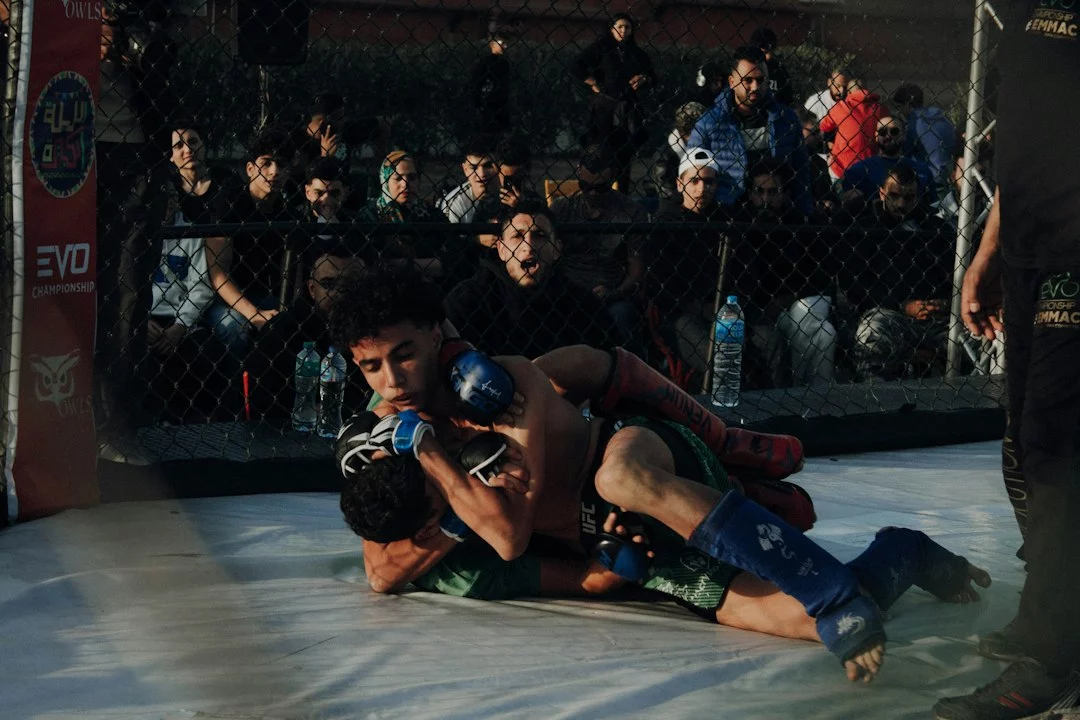
A knee strike ended Mick Parkin’s night and exposed the central truth of mixed martial arts: the sport is often decided less by volume than by one clean structural error. In the Ultimate Fighting Championship, especially in the heavyweight class, a single exchange can end a fight before the broader game plan has time to matter. A finish like this is not just a highlight. It is a technical event, a medical event, and a rules event at the same time.
The headline language is dramatic, but the useful question is more precise: what actually allowed the strike to land, why did the response look so severe, and what does that tell us about the risks of elite combat sport? The answer starts with posture, distance, and the brutal efficiency of a knee strike thrown inside the Octagon.
How a single knee ends a heavyweight fight
In clinch fighting, the athlete who wins head position and upper-body control usually owns the next beat of the exchange. Once the hands are tied up and the torso is upright, the knee becomes a direct line through the center of the target. That is what makes it so dangerous: it does not need a wide swing or a long runway. It only needs a fraction of a second and a small defensive mistake.
Parkin’s loss, as reported from Salt Lake City, was a reminder that the difference between defending and being punished is often posture, not toughness. A fighter who is tall, squared up, or late on a frame gives the attacker a cleaner path to the chin, jaw, or temple. The same pattern appears across the sport, from technical knockouts to full knockouts: the moment a fighter’s structure collapses, the strike lands with much greater effect.
That is why the result should not be flattened into the usual locker-room cliché that someone was merely caught. Being caught is the end of the story, not the mechanism. The mechanism is a lost battle over position.
| Observed detail | Technical reading | Practical meaning |
|---|---|---|
| Guard opens in the clinch | Frame and head control were beaten | A straight knee lane appears |
| Fighter goes limp on impact | Neurological shutdown from sudden trauma is possible | The referee must react immediately |
| Post-impact jerking or convulsive movement | Could be a convulsive response after head trauma | Medical staff should treat it as urgent, not theatrical |
Why the visual looked so severe
Fans often describe a knockout in emotional language, but the body’s response can look alarming for reasons that are not obvious on first viewing. A hard blow to the head can cause a concussion or broader head injury, and the immediate aftermath can include loss of tone, a blank stare, or convulsion-like movements. That does not mean every fighter is having an epileptic seizure. It does mean the brain has been shocked enough that the body’s control systems are temporarily unreliable.
This is where casual commentary becomes sloppy. A finish can be devastating without being mysterious. In neurology, the key issue is not whether the movement looks dramatic on video; it is whether the athlete has suffered enough trauma to impair awareness, balance, memory, or autonomic control. In convulsion, the visible motion is only a symptom, not a diagnosis. The safe response is always the same: remove the athlete, assess clinically, and do not rely on adrenaline or bravado to judge readiness.
That is why sports medicine teams place so much weight on the first few minutes after a knockout. A fighter who appears lucid a minute later may still have concussion symptoms, amnesia, or delayed deterioration. The broadcast ends when the crowd stops cheering; the medical problem does not.
What the rules say, and what they do not say
Under the Unified Rules of Mixed Martial Arts, knee strikes to the head can be legal in the UFC, but not every promotion applies the same definitions or restrictions. That matters because legality and safety are not the same thing. A legal shot can still be ruinous. A legal finish can still prompt a medical suspension.
The referee is therefore not just a timekeeper. He or she is the first safety filter once a fighter’s defensive responses disappear. A late stoppage is not a stylistic problem; it is a risk-management failure. Yet refereeing in real time is difficult because a single frame can determine whether the strike landed cleanly, whether the defender was still functional, and whether the bout was already over before the body fell.
This is one reason why the controversy around violent finishes never really goes away. Spectators want decisive endings. Regulators want consistency. Trainers want their athletes protected. The sport sits inside a permanent tension between action and harm.
What this means for Mick Parkin’s career trajectory
A knockout loss is not the same as a technical collapse, but it does create a practical reset. For a heavyweight prospect, the first concern is not image management. It is recovery. The next camp should be shaped by what the loss exposed: clinch exits, hand positioning, head placement, and reactions when the opponent closes distance.
That is where many fighters make the wrong adjustment. They chase the highlight by becoming more aggressive, when the better fix is usually more disciplined. The lesson from a knee strike is often to reduce the number of clean entry points, not to trade harder. In heavyweights, that can mean better framing, earlier footwork, more conservative clinch exchanges, and cleaner breaks before contact becomes unavoidable.
Parkin also has to absorb the career politics of a visible knockout. In the UFC, one bad night does not erase a profile, but it changes how matchmakers think about durability, pace, and risk. The division is full of large men who can end a fight with one sequence. Surviving that ecosystem requires more than power. It requires repeatable defensive habits under stress.
There is an important distinction here between a fighter being finished and a fighter being fundamentally limited. The first is a moment; the second is a pattern. One knee does not define a career. The response to it often does.
Why heavyweight knockouts keep drawing attention
Heavyweight bouts attract exaggerated reactions because the physics are obvious. Bigger bodies create bigger impacts, and there is less room to recover when the exchange is close-range. Yet the real lesson is not simply that big men hit hard. It is that in a division where every exchange can be decisive, tactical sloppiness is punished faster than in lower weight classes.
That is also why fight analysis often misunderstands the role of power. A great knockout is usually a chain of smaller failures: a missed frame, a late pivot, a square stance, an overcommitment, a chin left high. The final strike is the visible end of a process that started seconds earlier. In that sense, the finish says as much about defensive architecture as it does about force.
For fans, the temptation is to treat the clip as proof of destiny. For coaches, the clip is a checklist.
A brutal finish is rarely just a moment of violence. It is a diagnostic tool that shows where the defensive structure broke down.
What readers should watch next
The important question is not whether the knockout was spectacular. It was. The important question is whether the response to it becomes smarter. Watch for three things: medical clearance timelines, any public explanation of the technical error, and whether Parkin’s next outing shows tighter clinch defense rather than emotional overcorrection. Those details tell you more about the real significance of the loss than the replay itself.
The broader trend is also worth watching. As the UFC and other promoters keep prioritizing speed and finish potential, the sport will continue facing pressure to justify how it manages post-concussion syndrome, return-to-fight timing, and long-term damage. The balance between spectacle and safeguard is getting harder, not easier, because the public rewards violence and the medical system absorbs the cost.
That is the unresolved issue beneath every clip like this one. The sport can keep producing dramatic knockouts, and it probably will. The harder question is whether fighters, commissions, and trainers are getting better at limiting the damage that follows. If they are not, the highlight reel will keep outrunning the lesson.
FAQ: what people ask after a knockout like this
Is a fighter always unconscious after a knockout?
No. A knockout can involve a brief loss of consciousness, but some fighters remain semi-aware or quickly regain awareness. The key issue is whether brain function and defensive control were disrupted.
Why are knee strikes so dangerous in the clinch?
Because they travel on a short path with little warning. In clinch fighting, the target’s posture is already compromised, so the strike meets less resistance and more vulnerable angles.
Should viewers assume convulsions mean a seizure disorder?
No. A convulsion-like response after head trauma can happen without any pre-existing seizure disorder. It is still a serious medical signal and should be treated as such.
When can a fighter return after a head knockout?
That depends on the medical evaluation, the commission’s suspension, and the athlete’s symptoms. A return should be based on clearance, not on how quickly the fighter says he feels fine.
What this fight exposed about modern heavyweight MMA
The most important insight is blunt: in modern heavyweight MMA, a single clinch mistake can turn strategy into emergency. The fight does not simply reward aggression. It rewards control of posture, position, and timing. Parkin’s loss is therefore not just a bad night; it is a reminder that the smallest defensive lapse at elite level can become the defining image of the entire event.
What to watch next is whether this kind of finish pushes teams to spend more training time on clinch exits, post-impact medical assessment, and conservative recovery planning. The unanswered question is how much brutality the sport can keep normalizing before technique, regulation, and athlete welfare are forced to evolve together rather than separately.
Frequently Asked Questions
Why is a knee strike so effective in the clinch compared with other strikes?
A knee is effective because it travels on a short, direct line and does not need much space to generate force. In the clinch, once head position and upper-body control are lost, the defender’s posture opens a clean lane to the jaw or chin. That makes even a brief mistake far more dangerous than a longer exchange at range.
Does the jerking or convulsive movement after a knockout always mean a seizure?
No. Convulsive-looking movement after a knockout can happen without a true epileptic seizure. After sudden head trauma, the body may briefly lose normal motor control and produce alarming motions. The key issue is not the appearance alone, but whether the fighter has suffered a brain injury that affects awareness, balance, memory, or autonomic function.
If the knee was legal, why does the finish still raise safety concerns?
Legality and safety are not the same thing. Under the Unified Rules, a knee strike to the head can be legal, but that does not make it harmless. A perfectly legal shot can still cause a concussion, knockout, or worse. That is why medical evaluation matters even when the referee and rules were correctly applied.
What does a knockout like this reveal about heavyweight fighting specifically?
Heavyweight fights often end abruptly because bigger athletes produce enormous force, and defensive errors are punished immediately. There is less room for high-volume attrition to shape the result. In that division, a single structural mistake in posture or distance can decide everything before endurance, tactics, or momentum have much time to matter.
Why do doctors and commissions treat the first minutes after a knockout so seriously?
Because the athlete may look better before the real danger has passed. A fighter can regain consciousness quickly and still have concussion symptoms, amnesia, or delayed neurological issues. The first post-fight minutes are critical for checking orientation, balance, speech, and warning signs. Adrenaline can mask how serious the injury actually is.