
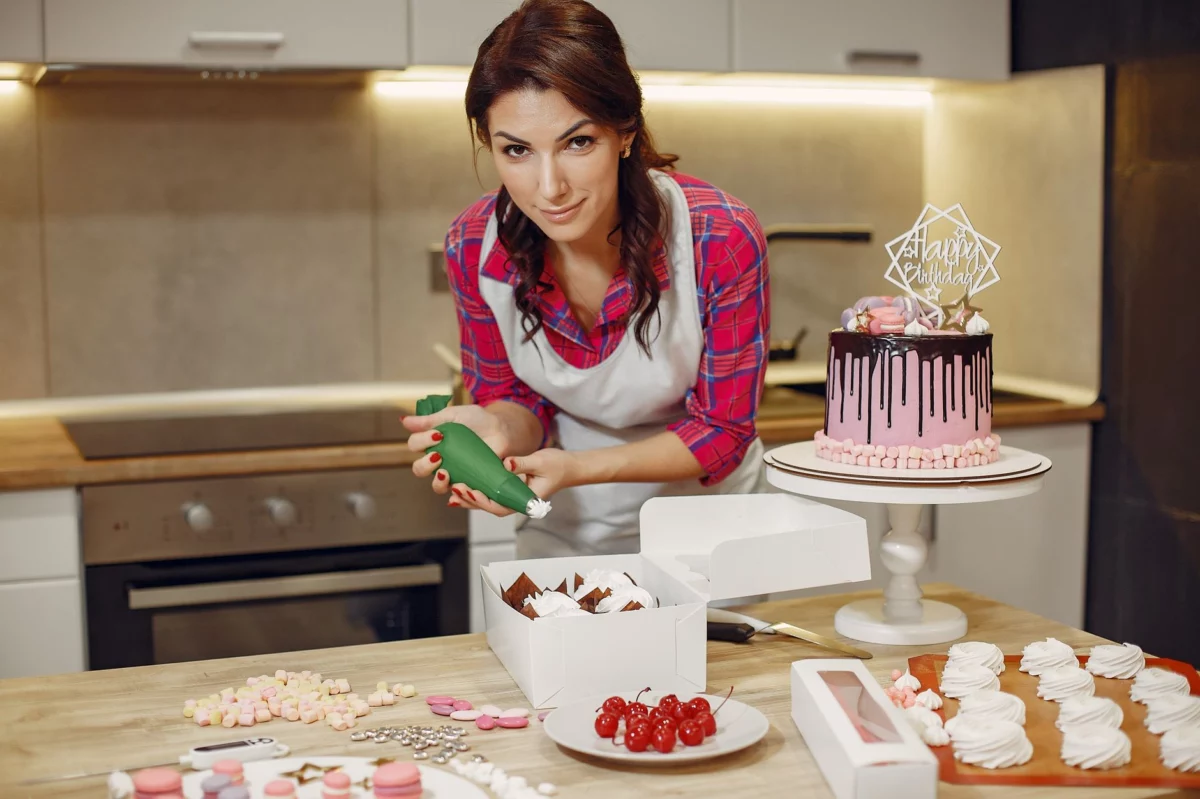
The Ruby Bhogal cookbook matters because it sits at the point where television fame, recipe design, and the modern appetite for visually ambitious desserts overlap. As a 2018 Great British Bake Off finalist, Bhogal carries the familiar authority of a contestant who has already proven she can work under pressure. But the more interesting question is not whether she can bake. It is whether her book turns the logic of competitive baking into something a home baker can actually use.
That is the real value of Ruby Bhogal‘s appeal. In baking culture, spectacle can be empty. Height, gloss, sugar flowers, mirror finishes, and architectural layers often look impressive while hiding dull flavor and poor structure. A serious cookbook has to do more than reproduce a television moment. It has to explain why the cake works, how the texture is built, and what can survive a real kitchen rather than a studio tent.
Why Ruby Bhogal’s bakes feel timely
The renewed attention around Bhogal arrives just as another series of Bake Off is about to begin, which is not a coincidence. The show has helped define a generation of British home baking, and its influence still reaches far beyond the tent. The format made technical skill visible, but it also normalized the language of layers, fillings, finishes, and deadlines. In that sense, a book like Around The World In 80 Cakes is not merely a celebrity side project. It is a response to a baking culture that now expects ambition as standard.
The best comparison is not with vague lifestyle branding but with the long tradition of recipe books that try to turn a personal point of view into repeatable method. A strong baking book borrows from culinary arts and gastronomy without becoming precious. That balance matters. If the recipes are too theatrical, they collapse under their own decoration. If they are too cautious, they disappear in a crowded market of generic dessert books.
The real test of a showstopper cake
In practice, a showstopper is not just a large cake. It is a stack of competing priorities: structure, flavor, timing, and presentation. A successful layered cake must hold weight without turning dry; a glazed finish must look deliberate without becoming cloying; a decorative element must contribute something other than visual noise. That is where the line between professional technique and home adaptation becomes visible.
What the Bake Off format trained viewers to notice
One reason the language of the show has lasting power is that it taught audiences to judge desserts more critically. Viewers learned that a sponge cake is not automatically simple, that a stable buttercream can rescue or ruin a design, and that a glossy finish on fondant can conceal either precision or panic. Those distinctions matter because they separate genuine craftsmanship from mere decoration.
The same logic applies to meringue-based bakes, where a crisp shell and a soft center have to be timed carefully, or to croquembouche-style constructions, where adhesive sugar becomes as important as flavor. The home baker who understands these mechanics can judge a recipe more honestly. The book is only useful if it teaches that judgment rather than hiding behind glossy photography.
Why global cake references can strengthen a cookbook
Bhogal’s premise, as the title suggests, is international rather than narrowly British. That gives the book a wider cultural job to do. When a baker assembles a collection around the world in cakes, the risk is obvious: reducing cuisines to surface decoration. But the opportunity is equally obvious: using cake as a language for travel, memory, and adaptation. The key is whether the recipes respect texture and method rather than treating “global” as a marketing adjective.
That is where references to specific traditions matter. A Victoria sponge is not simply a generic cake with jam; it is a format with a recognizable British identity. A Black Forest gateau has a different architecture again, built around chocolate, cream, and cherries. Even a dessert like tiramisu shows how technique and assembly can matter as much as baking itself. If Bhogal’s book treats these categories as systems rather than ornaments, it will have real staying power.
The same can be said of pastry-forward desserts. A disciplined baker knows the difference between pastry, choux pastry, and puff pastry, and knows that each one carries a different risk profile. Choux is about steam and structure; puff is about layers and lamination; cake is about air, fat, and balance. A cookbook that explains those distinctions is doing more than entertaining readers. It is teaching them how to think.
How to judge the recipes before you bake them
Readers do not need to bake from a cookbook to evaluate it well. They need to inspect the recipe architecture. A good sign is clarity: weights instead of vague volume measures, timing that matches the complexity of the method, and instructions that identify where failure is likely. Another good sign is restraint. If every recipe demands specialist molds, imported ingredients, and a full day of work, the book becomes aspirational in the worst sense.
Questions a careful baker should ask
- Does the recipe explain why a step matters, or only what to do?
- Can the cake be assembled in stages without losing quality?
- Are the decorative elements optional, or structurally essential?
- Does the recipe make use of familiar techniques such as folding, whipping, or layering?
- Does the finished bake rely on flavor as much as on appearance?
Those questions matter because home baking is full of false economy. A cake may look manageable until the filling splits, the sponge domes, or the icing slackens in heat. That is why recipes inspired by televised baking should never be judged solely by their photographs. The photograph is the promise; the method is the contract.
What differentiates a strong celebrity baking book from a weak one
The celebrity cookbook market is crowded, and not all books are equal. The weak ones are obvious: they outsource too much thinking to branding, they overstate accessibility, and they assume the reader wants proximity to fame more than reliable results. The stronger books use fame as a delivery mechanism for useful technique. That distinction is especially important in baking because precision is unforgiving. A slight error in a sauce can be adjusted; a failed sponge often cannot.
This is why the best baking books still feel tied to the fundamentals of baking rather than personality alone. They respect ratios, temperature, and timing. They understand that a dessert can be beautiful and still be poor if the crumb is tight or the sweetness unbalanced. They also recognize that home bakers often want one of two things: a reliable weekend cake, or a technically ambitious project that genuinely expands skill. Anything in between tends to disappoint.
Bhogal’s advantage, if her book is handled well, is that she comes from a format where failure is public and adaptation is necessary. That background tends to produce recipes with pragmatic instincts: if a decoration can be simplified without destroying the idea, it probably should be. If a filling can be swapped for a more accessible version, the book should say so. Good recipe writing is not about lowering standards. It is about removing unnecessary friction.
How this fits the current baking market
Consumer taste in baking has become more segmented. Some readers want nostalgia, others want technical challenge, and others want aesthetically optimized cakes for social media. The contemporary home baker often expects a recipe to be both camera-ready and practical. That is a difficult brief. The problem is not just taste; it is time. Decorative cakes demand planning, cooling, transport, and storage, which are precisely the things many recipe books understate.
That is also where the market for global dessert books has evolved. Readers now expect more than a generic travel metaphor. They want context. They want to know whether a recipe is inspired by tradition, adapted for a different pantry, or purely decorative in its references. A credible book can borrow widely only if it is honest about what it is borrowing and why. That is where cultural sensitivity becomes a practical issue, not an abstract one.
There is a useful parallel here with the way cookbook readers now respond to recipes that claim international scope. The best of them behave like carefully edited surveys, not souvenir albums. They draw on recognizable forms, from meringues to layered cakes, while avoiding the temptation to flatten every cuisine into the same buttercream template. The best-case scenario is a book that helps readers bake more adventurously while thinking more critically.
Practical lessons for home bakers
If Bhogal’s bakes appeal, the lesson is not that every home baker should chase maximalist decoration. It is that a successful cake is usually the result of disciplined decisions made early. Choose the structure before the garnish. Choose the flavor profile before the color palette. Decide whether the cake is meant for slicing, transporting, stacking, or merely displaying. Those choices determine everything that follows.
Best practices that matter
- Build for structure first. A stable crumb and proper cooling prevent most decorative failures.
- Keep fillings proportionate. Too much filling weakens layers and causes collapse.
- Match decoration to the event. A wedding-style finish is not always practical for a Tuesday bake.
- Use familiar techniques deliberately. Simple methods often outperform elaborate flourishes.
- Test for flavor balance. Sweetness needs acidity, salt, or bitterness to stay interesting.
For readers new to ambitious cake work, the most valuable recipe books are those that make these choices visible. They reduce fear without reducing ambition. That is a harder achievement than it sounds. It requires editorial discipline, technical competence, and a refusal to treat every page as a stage set.
FAQs about Ruby Bhogal’s baking appeal
Is Ruby Bhogal’s cookbook only for experienced bakers?
Not necessarily. A well-edited baking book can contain both approachable recipes and harder showpieces. The key is whether the instructions are clear and whether the decoration can be scaled to the baker’s confidence.
What makes a showstopper cake different from a regular cake?
A showstopper usually adds height, layering, decoration, or a more complex finish. But good showstoppers still have to taste balanced and slice cleanly. Visual impact without structural control is just unfinished decoration.
Why do Bake Off contestants often become cookbook authors?
The show rewards visible competence, and that makes contestants credible to a broad audience. A cookbook lets them convert that credibility into recipes that outlast a single season of television.
What should readers look for before buying a celebrity baking book?
Look for method clarity, realistic timing, ingredient accessibility, and a clear sense of purpose. If the book explains technique rather than just displaying results, it is more likely to be useful.
The next test for celebrity baking books
The most important insight here is blunt: modern baking books are no longer judged only by their glamour. They are judged by whether they help readers make better decisions. Ruby Bhogal’s value depends on whether she uses the language of the tent to produce recipes that survive ordinary kitchens, ordinary ovens, and ordinary patience. That is where the real distinction lies between a beautiful dessert and a genuinely instructive one.
What should readers watch next? The direction of baking culture itself. If future books lean further into cross-cultural inspiration, they will face a sharper test of authenticity and technique. If they lean toward simpler, flavor-first cakes, they may reject spectacle only to rediscover it in subtler form. The unresolved question is whether the next generation of celebrity bakers can keep the drama of a meringue tower, a carefully finished cake, or a layered dessert while making those recipes more usable, not less. That is the standard worth applying now.
Frequently Asked Questions
Is Ruby Bhogal’s cookbook mainly for fans of The Great British Bake Off, or is it useful for everyday home bakers too?
It should be useful beyond fandom if it does what the article values: turn showstopper logic into repeatable method. The real test is whether the recipes explain structure, timing, and texture in a way a home kitchen can manage. If so, it works as a practical baking book first and a TV tie-in second.
Why is “showstopper baking” seen as more than just decoration?
Because a true showstopper has to succeed on multiple levels at once. It needs enough structure to hold layers, enough balance to avoid becoming too sweet or dry, and enough technique to look polished. Decoration matters, but the article argues it should support the cake’s flavor and stability, not hide weaknesses.
What makes a cookbook like this different from a generic dessert book?
A generic dessert book often focuses on familiar, safe recipes. A stronger book tied to competitive baking has to teach judgment as well as instructions: when a sponge is done, how a glaze behaves, why buttercream matters, and how to adapt ambitious designs for real kitchens. That makes it more technical and more purposeful.
Does a global cake concept risk turning different cuisines into a gimmick?
Yes, that is a real risk. The article suggests the book succeeds only if it treats international cake traditions with respect for method, texture, and identity. When done badly, “global” becomes surface styling. When done well, it uses cake to connect memory, travel, and adaptation without flattening the original traditions.
Why does the article put so much emphasis on structure and texture instead of presentation?
Because appearance alone can be misleading. A glossy finish or tall layer can look impressive while hiding dryness, instability, or poor balance. The article argues that serious baking should explain how a cake holds together, how fillings behave, and how finishes affect the final result. That is what separates real technique from visual noise.