
Generative Engine Optimization (GEO) is the practice of optimizing content so it can be retrieved, understood, and cited within AI-generated answers across platforms like ChatGPT, Perplexity, and Google AI Overviews.
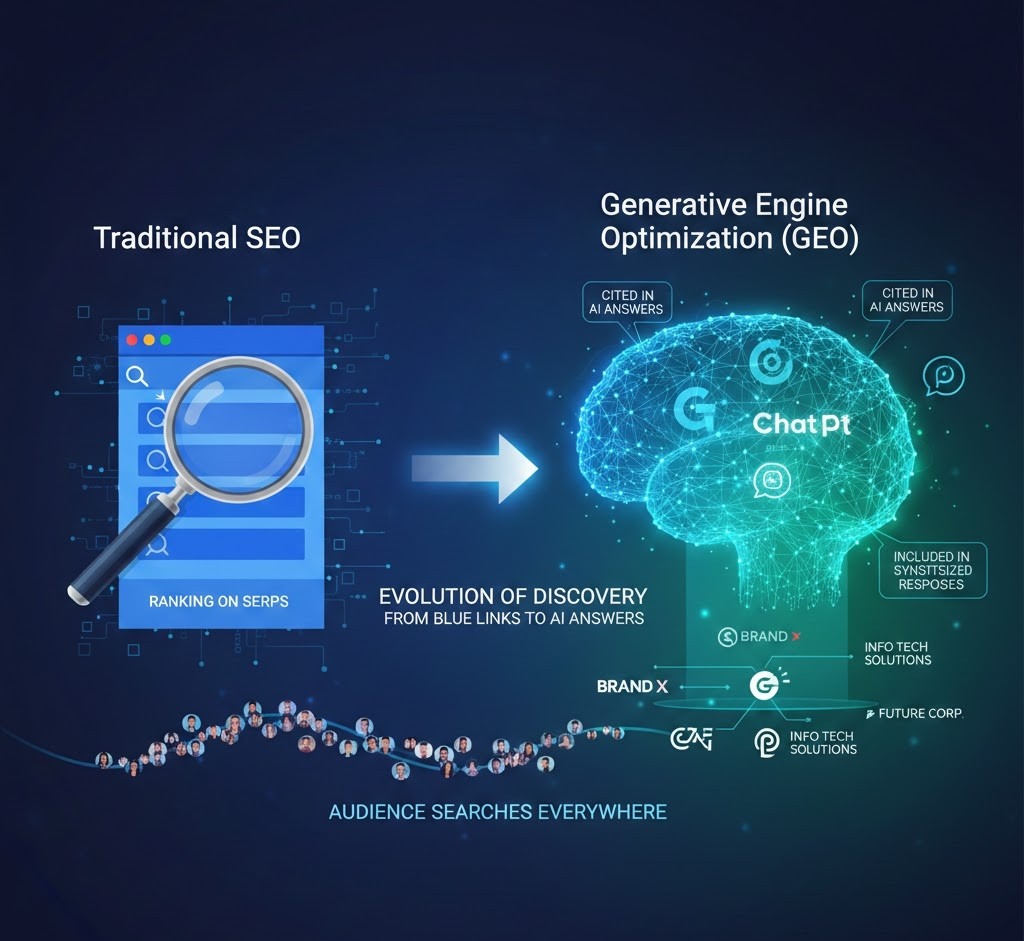
Traditional SEO is designed to win rankings on search engine results pages (SERPs). GEO focuses on something different: earning visibility inside the answers produced by large language models (LLMs) and generative search engines. Instead of competing for blue links, brands now compete for inclusion within synthesized responses.
Your audience searches everywhere. GEO ensures your brand is part of what AI systems surface when they do.
Why GEO Matters: A Shift in How Visibility Works
In classic SEO, success meant ranking as high as possible on a results page. Visibility was about position and clicks.
Generative search changes that model entirely.
AI Overviews, ChatGPT, and similar tools begin with a fully formed answer, often without showing a list of links at all. The competition now happens inside those generated paragraphs. The key question is no longer “How do I rank #1?” but “How do I get mentioned, cited, or relied upon when an AI constructs an answer?”
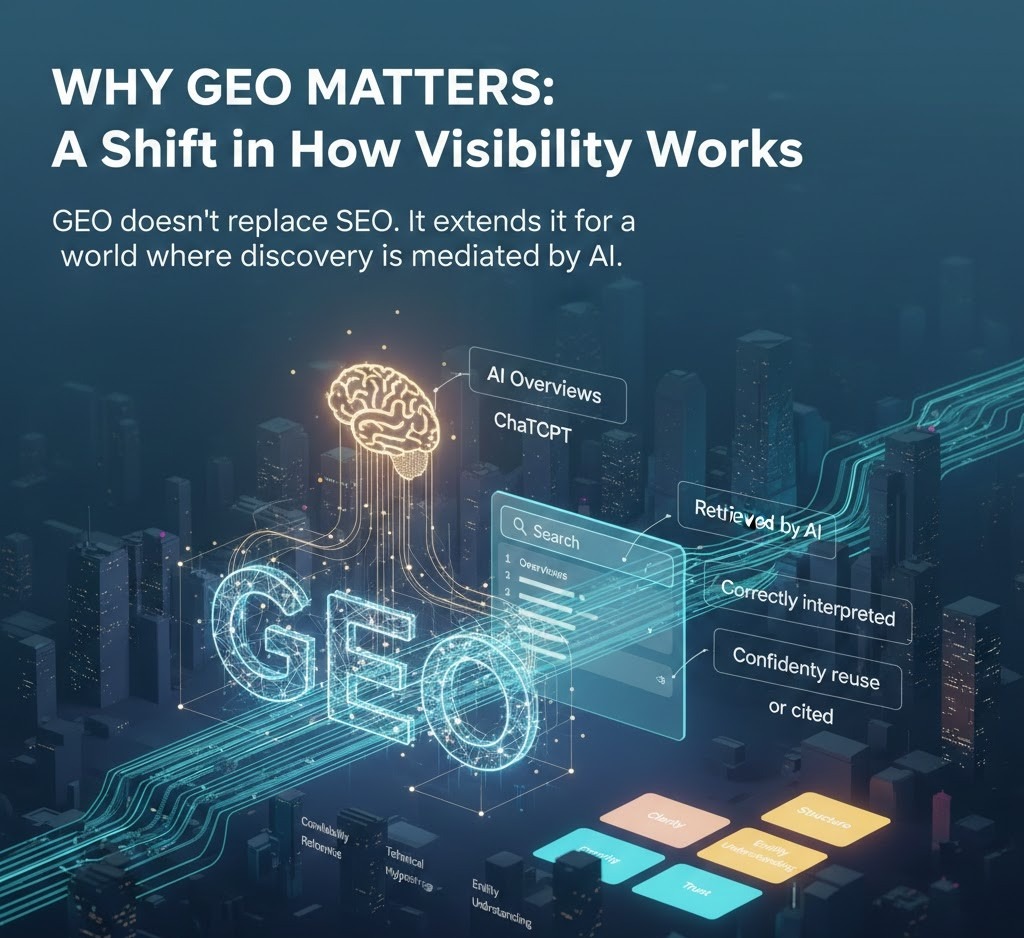
LLMs increasingly sit between users and the open web. They interpret queries, retrieve information, synthesize perspectives, and decide which sources to trust. As a result, visibility now depends on whether your content can be:
- Retrieved by AI systems
- Correctly interpreted
- Confidently reused or cited
Traditional SEO fundamentals—crawlability, relevance, authority, and technical hygiene—still matter. But they now operate alongside generative systems that prioritize clarity, structure, entity understanding, and trust.
GEO doesn’t replace SEO. It extends it for a world where discovery is mediated by AI.
How GEO Fits Into the AI Search Landscape
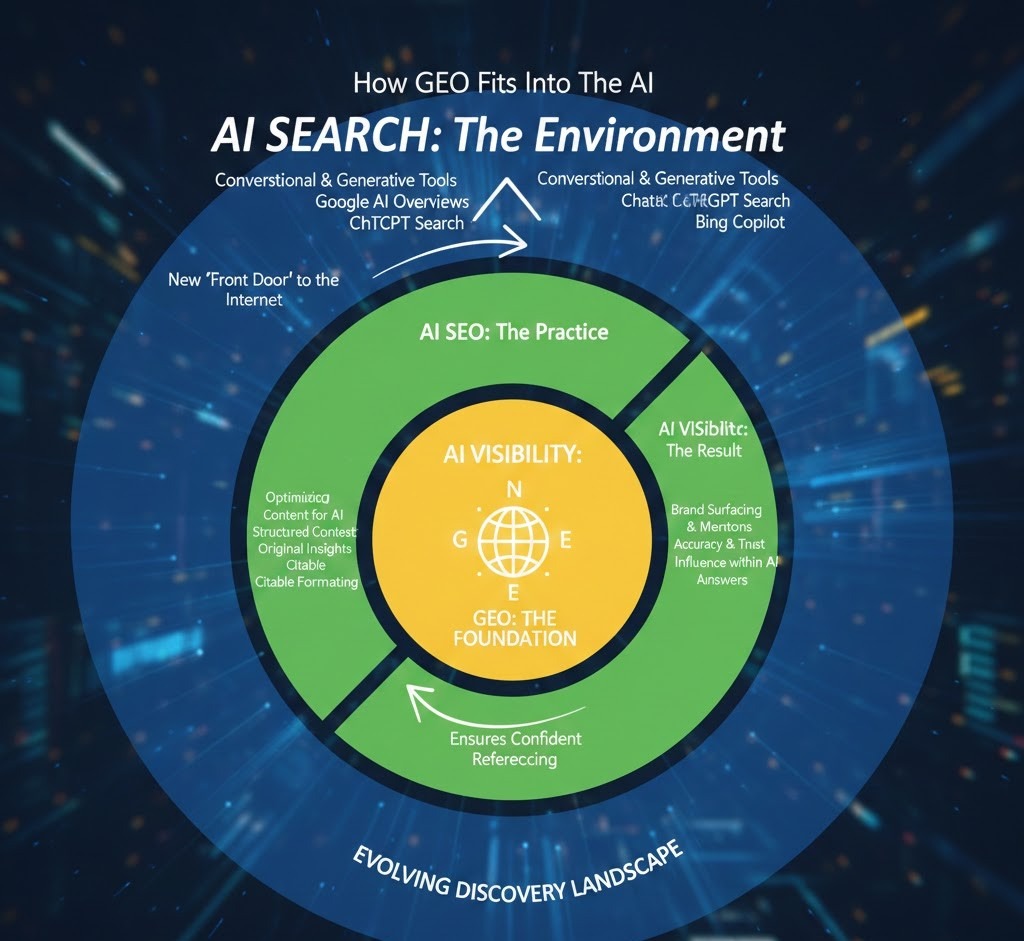
As search evolves, so does the language we use to describe it. Several related terms are often used interchangeably, but they describe different layers of the ecosystem.
AI Search: The Environment
AI search refers to the broader discovery landscape where users rely on conversational and generative tools—such as Google AI Overviews, ChatGPT Search, Perplexity, and Bing Copilot—to research, compare, and make decisions.
Instead of navigating lists of links, users increasingly engage with synthesized answers that shape understanding instantly. This makes AI search the new “front door” to the internet, influencing perception and trust before a user ever visits a website—if they visit one at all.
AI SEO: The Practice
AI SEO is the hands-on work of optimizing content so it appears in AI-powered search experiences. It builds on traditional SEO while emphasizing entity clarity, structured context, original insights, and formatting that makes content easy to retrieve and cite.
The goal is not just to rank pages, but to ensure AI systems can confidently reference your content when generating answers.
AI Visibility: The Result
AI visibility measures how often—and how accurately—a brand is surfaced, mentioned, or cited within AI-generated responses. It shifts focus away from rankings and traffic alone toward presence, accuracy, and trust within the answer itself.
As AI increasingly mediates discovery, visibility becomes less about clicks and more about influence.
GEO vs. Traditional Ranking Signals and E-E-A-T
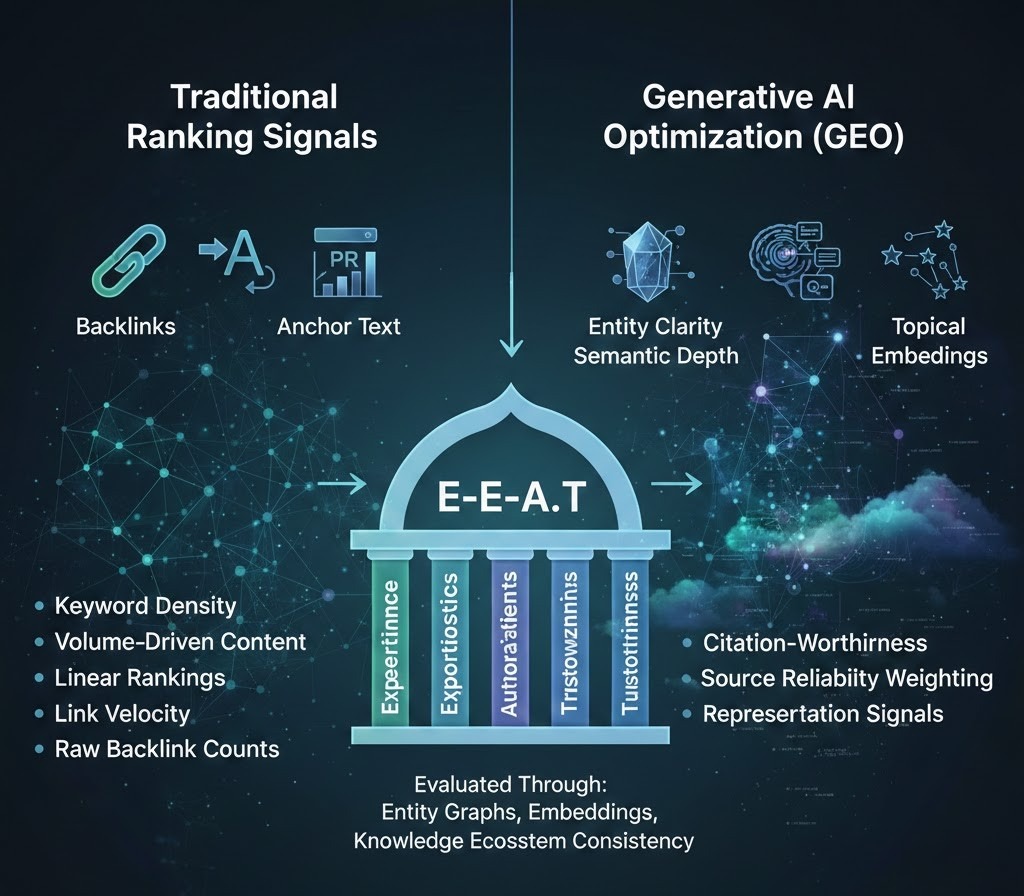
Traditional SEO focuses on ranking signals like backlinks, anchor text, and PageRank. GEO introduces a different set of priorities.
When AI systems generate answers, they aren’t ranking pages—they’re synthesizing information. Their decisions are guided by:
- Entity clarity rather than keyword density
- Semantic depth instead of volume-driven content production
- Topical embeddings rather than linear rankings
- Citation-worthiness rather than link velocity
- Source reliability weighting rather than raw backlink counts
GEO shifts optimization from ranking signals to representation signals. Instead of targeting keywords, brands must ensure AI systems clearly understand who they are, what they do, and what they’re authoritative about.
E-E-A-T (Experience, Expertise, Authoritativeness, Trustworthiness) remains critical, but it’s evaluated differently. In generative systems, these qualities are inferred through entity graphs, embeddings, and consistency across the wider knowledge ecosystem—not just on-page elements like author bios.
The takeaway is simple: GEO doesn’t replace SEO. It reflects how SEO is expanding as discovery moves inside AI-generated answers.
The New Reality: Visibility Without Clicks
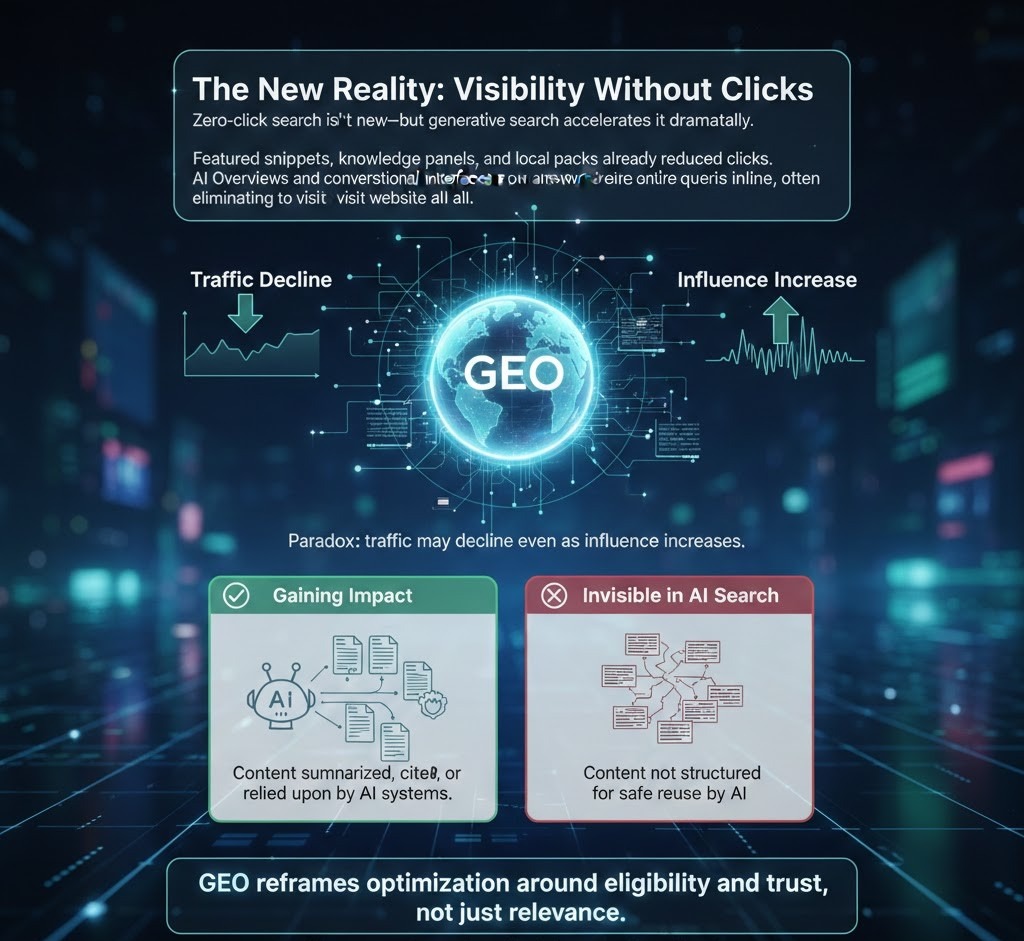
Zero-click search isn’t new—but generative search accelerates it dramatically.
Featured snippets, knowledge panels, and local packs already reduced clicks. AI Overviews and conversational interfaces now answer entire queries inline, often eliminating the need to visit a website at all.
This creates a paradox: traffic may decline even as influence increases.
A brand can lose sessions while gaining impact if its content is being summarized, cited, or relied upon by AI systems. Conversely, a page can rank well organically and still be invisible in AI search if its content isn’t structured in a way AI systems can safely reuse.
GEO reframes optimization around eligibility and trust, not just relevance. If your content isn’t clear, corroborated, and “safe” to reuse, it won’t be surfaced—no matter how well it ranks.
Why Traditional Rankings Don’t Dictate AI Answers
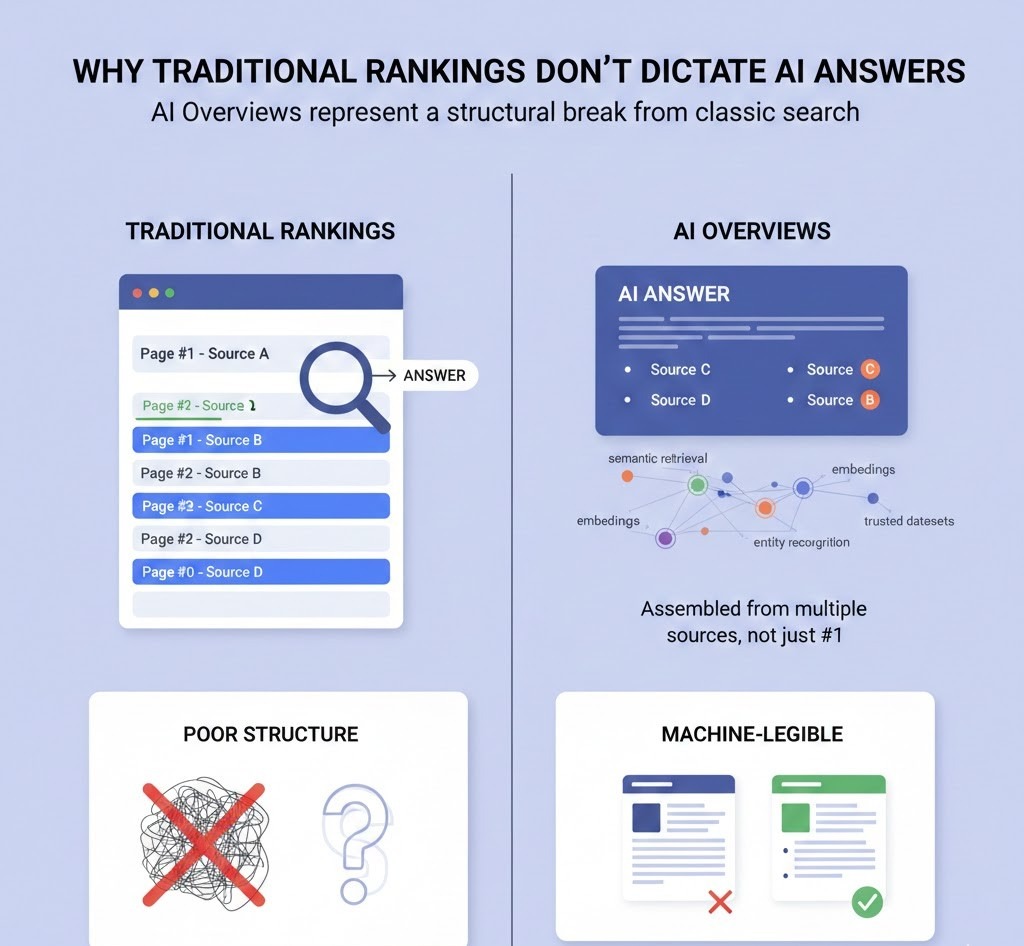
AI Overviews represent a structural break from classic search. Instead of selecting a single best page, they assemble answers from multiple sources.
That’s why citations often come from pages that don’t rank #1—or even page one—in traditional SERPs.
AI systems rely heavily on semantic retrieval, embeddings, entity recognition, and trusted datasets to reduce risk and avoid hallucination. Links and authority still matter, but primarily as eligibility signals rather than ordering mechanisms.
Content that’s poorly structured, overly narrative, or unclear about facts versus opinion is difficult for AI systems to extract and reuse. Even authoritative sites can be ignored if their information isn’t machine-legible.
The risk isn’t just invisibility—it’s misrepresentation. Weak structure increases the chance your ideas are flattened, distorted, or attributed incorrectly.
Planning Your GEO Strategy: 8 Core Principles

1. Structured, Clear Content
AI systems favor content that presents information cleanly and unambiguously. Clear headings, tables, bullet points, and factual statements make content easier to interpret and reuse.
2. Strong Entity Definition
Be consistent in how you reference your brand, products, people, and topics. Reinforce entity clarity with schema markup and contextual explanations. External validation—from trusted mentions across the web—strengthens these signals.
3. Easy-to-Extract Information
Concise sections, FAQs, fact callouts, and supported claims help AI systems isolate trustworthy information. Clear sourcing, author attribution, and dates matter.
4. Accurate and Consistent Freshness Signals
Dates must align across the page, metadata, and schema. In fast-changing topics, recency can outweigh depth—but only if freshness signals are credible.
5. Trusted Links, Citations, and Mentions
Quality matters more than quantity. Mentions from authoritative publications, documentation, and respected media help AI systems validate your credibility—even when links aren’t present.
6. Multi-Channel Presence
AI systems learn from across the web, not just your site. Consistent visibility on social platforms, videos, podcasts, and communities reinforces who you are and what you’re known for.
7. Intent-Driven Content
Optimize for real questions people ask in AI tools—not just high-volume keywords. Clear explanations, trade-offs, edge cases, and decision guidance increase reuse.
8. Integrating SEO and GEO Signals
Crawlability, internal linking, depth, and authority still matter. In AI-driven search, these signals determine whether your content is retrievable, understandable, and trusted enough to be reused.
The Future of Visibility in an AI-Driven World

As search becomes more generative, visibility no longer means ranking—it means being selected.
Brands now compete to be included, cited, and trusted inside AI-generated answers. Over time, performance shifts from page-level wins to entity-level strength: consistent topical coverage, clear identity, and recognition across the web.
GEO doesn’t change SEO fundamentals. It changes what those fundamentals unlock.
Visibility today includes being summarized, explained, and recommended by AI systems—whether or not a click ever happens.
The real question is no longer “Where do I rank?”
It’s “Am I part of the answer?”